
Non-Life Insurers Face Critical H2 Turning Points with Manual Therapy Limits and Auto Insurance Reforms
South Korean non-life insurance companies face a shifting financial landscape in the second half of the year as new regulatory measures for private medical insurance and automobile policies take effect. Industry analysts identify the implementation of managed medical benefits for manual therapy and the proposed “8-week rule” for automobile insurance as the primary variables that will dictate future loss ratios and overall profitability.
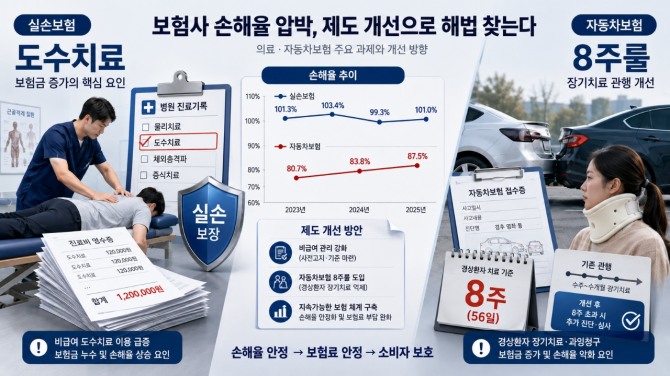
According to the insurance industry, the implementation of managed medical benefits for manual therapy, scheduled for July, serves as the first major turning point for private medical insurance loss ratios. The new policy sets the price of manual therapy at 43,850 won for a 30-minute session and restricts coverage to a maximum of two sessions per week, with an annual limit of 15 sessions. In cases where medical necessity is established, this can be extended to 24 sessions annually. Additionally, patients must now complete at least four sessions of basic physical therapy or rehabilitation over a period of at least two weeks before qualifying for manual therapy coverage.
In 2023, insurance payouts for musculoskeletal conditions, including manual therapy, reached 2.7 trillion won, surpassing the 2.6 trillion won paid out for severe illnesses such as cancer and cardiovascular diseases for the first time.
Why the 8-Week Rule for Automobile Insurance Remains Stalled
While changes to private medical insurance are moving forward, the “8-week rule” for automobile insurance remains in limbo. This regulation would require patients involved in minor traffic accidents to submit additional medical certificates and undergo a separate review process if they require treatment beyond eight weeks. Data from major insurers shows that while 88.6% of the 1.22 million minor injury patients finished their treatment within eight weeks in 2023, the remaining 11.4% sought longer-term care.
The regulatory amendment has passed review by the Ministry of Government Legislation but still requires approval from vice-ministerial and cabinet meetings. The implementation timeline is currently uncertain due to strong opposition from the Korean medicine community and certain consumer groups, who argue that the policy restricts a patient’s right to receive necessary medical care.
The struggle to control loss ratios highlights a fundamental conflict between rising healthcare costs and the financial sustainability of the insurance sector. For insurers, the “balloon effect”—where claims simply shift from one category, such as manual therapy, to another, like non-covered injections—remains a significant risk that could offset any gains from new regulations.
Financial Implications for the Insurance Sector
The insurance industry is under significant pressure following a difficult fiscal year. In 2023, private medical insurance recorded a loss of 1.87 trillion won, an increase of 250 billion won from the previous year. Although premium income grew by 10% to 18 trillion won, insurance payouts rose by 11.4% to 17 trillion won, pushing the loss ratio to 101%. Non-covered medical expenses, which accounted for 57.1% of total payouts, remain a primary driver of these deficits.

Automobile insurance also continues to struggle with profitability despite premium hikes earlier this year. Five major insurers—Samsung Fire & Marine, Meritz Fire & Marine, DB Insurance, Hyundai Marine & Fire, and KB Insurance—reported a combined loss of 46.1 billion won in the first quarter of this year. This follows a total industry deficit of 708 billion won in the automobile insurance sector throughout 2023, largely attributed to excessive treatment of minor injuries and rising costs for vehicle parts and repairs.
What May Happen Next
The financial outlook for the second half of the year depends heavily on the successful integration of the July manual therapy guidelines and the legislative passage of the 8-week rule. If the new manual therapy restrictions effectively curb high-frequency claims, insurers could see a reduction in their loss ratios. However, if claims migrate to other non-covered items, such as robotic surgeries or high-intensity focused ultrasound (HIFU) procedures, the anticipated relief may be limited. For automobile insurance, the sector’s ability to return to profitability is likely contingent on whether the 8-week rule is eventually enacted to manage long-term treatment costs for minor injuries.
Frequently Asked Questions
What is the 8-week rule for automobile insurance?
It is a proposed regulation requiring patients with minor injuries from car accidents to provide additional medical documentation and undergo a special review if they seek treatment beyond eight weeks.

Why is the implementation of the 8-week rule delayed?
The implementation is pending further government cabinet review, and it faces opposition from the Korean medicine community and some consumer groups who cite concerns over patients’ rights to medical access.
What changes are coming to manual therapy coverage in July?
New rules will limit manual therapy to two sessions per week and a maximum of 15 to 24 sessions per year, while also requiring patients to undergo at least four sessions of preliminary physical therapy before qualifying for coverage.
How do you think these regulatory changes will affect the cost and quality of care for patients?