

NYT Pips Answers and Walkthrough for Today’s Puzzles
NYT Pips is a logic-based puzzle product featuring three difficulty tiers—Easy, Medium, and Hard—where users fill multicolored grids with dominoes to meet specific numerical conditions. According to gameplay documentation by Erik Kain, players must satisfy requirements such as equality, inequality, and specific value thresholds to complete each puzzle.
How does the NYT Pips puzzle system operate?
The system uses a grid of multicolored boxes where each color represents a specific condition. Players use a set number of dominoes to fill the grid, and every domino must be used to win. According to the rules, dominoes can be rotated to fit the available spaces.
The product is structured into three tiers of difficulty: Easy, Medium, and Hard. Some puzzles may have only one viable solution, while others allow for two or more different outcomes.
What are the specific conditions for solving Pips?
Conditions are indicated by symbols and numbers within the colored tiles. According to Erik Kain, an equal sign indicates all pips in that group must be the same, while a crossed-out equal sign means pips must not equal one another. A “greater than” symbol (>) requires the pip to be higher than the listed number.
Some tiles specify an exact number, such as 6, which the pip must equal. Tiles without conditions can be filled with any available value. Players must manage these constraints to successfully clear the grid.
Why is the “Hard” tier considered a significant challenge?
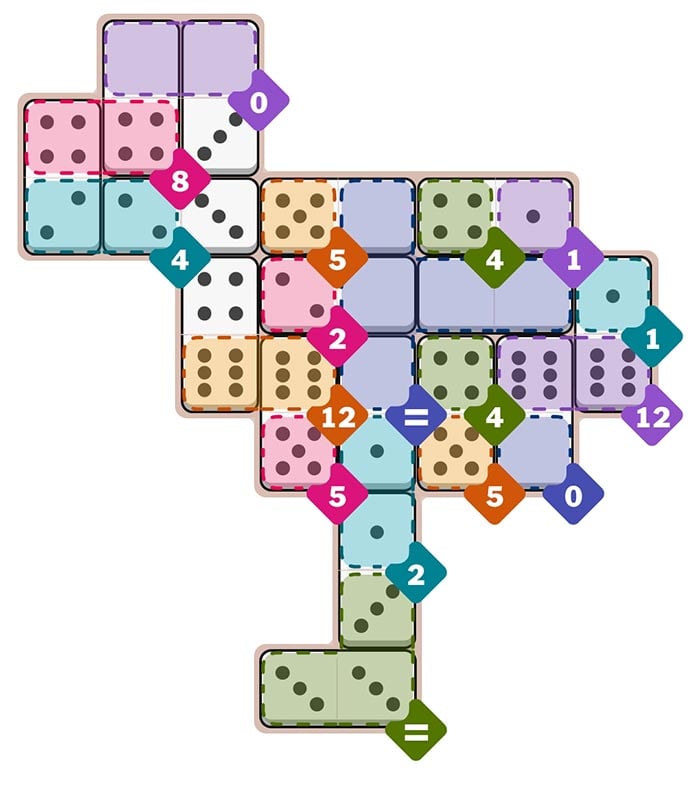
Hard tier puzzles often feature complex shapes and highly restricted placement options. One such puzzle is shaped like a dog, which Erik Kain suggests resembles a Highland Collie. The difficulty stems from the limited available options in specific areas, such as the “tail” of the dog shape.
Solving the Hard puzzle requires a precise sequence of moves. According to the walkthrough, this includes placing a 6/0 domino from Orange 11 into Green 0, followed by a 0/0 domino and a 0/3 domino. Subsequent steps involve placing a 2/1 domino and a 6/6 domino in Green 13 tiles.
Further steps for the dog-shaped puzzle involve placing a 2/2 domino in Purple =, a 6/5 domino from Dark Blue > 4 into Pink =, and a 5/5 domino in the remaining Pink = tiles. The process concludes with a 6/4 domino in the dog’s head and a 0/2 domino moving from Blue 0 into Dark Blue.
What may happen next for Pips players?
Users may encounter more complex shapes or additional conditions beyond “less than” or “greater than” in future iterations. Because some puzzles allow for multiple solutions, the developer could potentially introduce stricter constraints to limit the number of winning paths.
Frequently Asked Questions
What are the different difficulty levels available in Pips?
Pips offers Easy, Medium, and Difficult tiers.
What does the “≠” symbol mean in a Pips grid?
According to the rules, this symbol means all pips in that specific group must not equal one another.
How do players handle dominoes that do not fit the grid?
Players must click on the dominoes to rotate them so they fit where they belong.
Do you prefer puzzles with a single definitive solution or those that allow for multiple ways to win?