
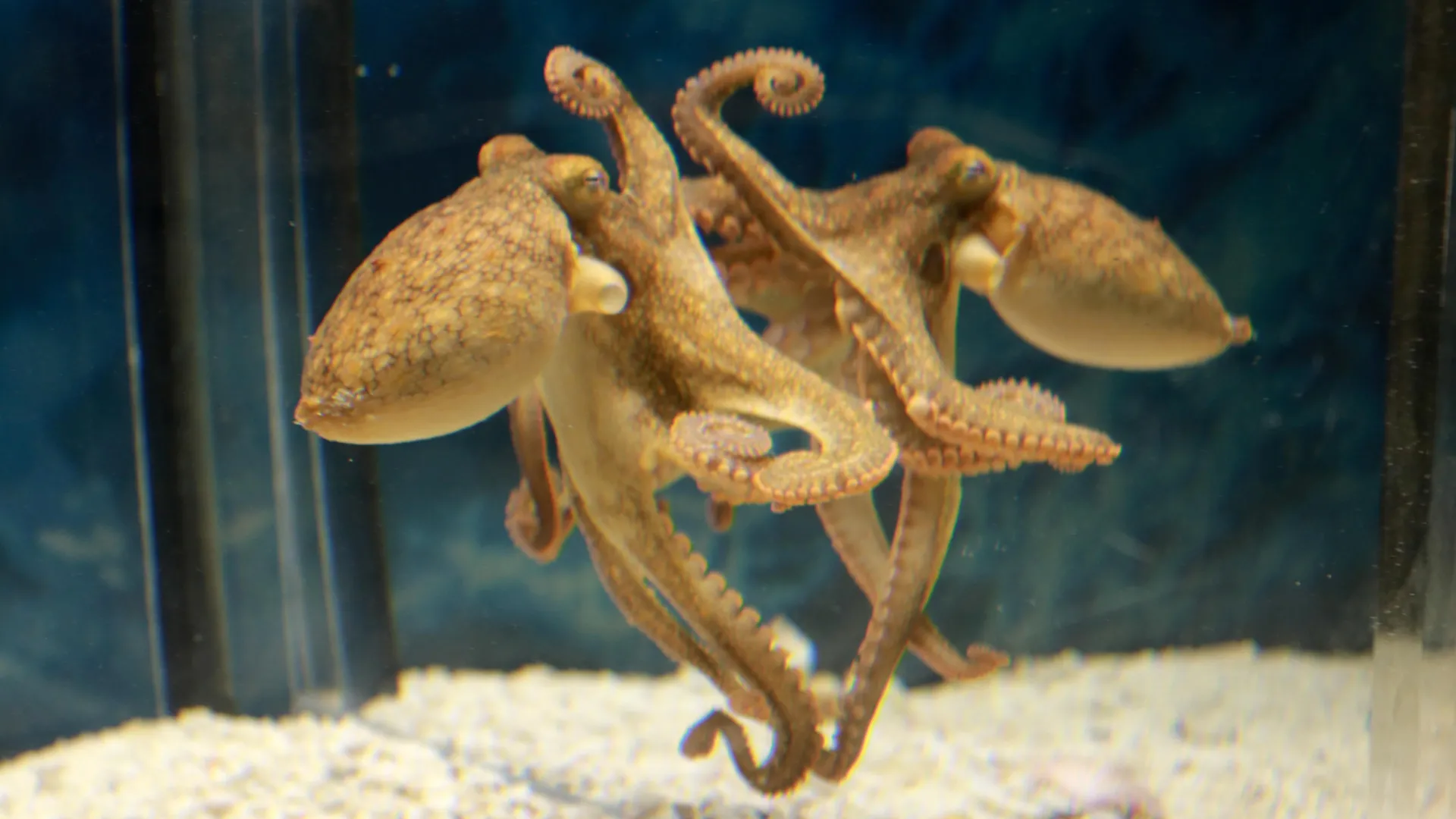
Octopuses use mirrors to find food they cannot see
Beyond the Reef: What Octopus Intelligence Means for the Future of AI
We’ve long known that octopuses are the geniuses of the ocean. From the legendary escape of Inky the octopus, who famously navigated a drainpipe to freedom, to their ability to solve complex puzzles, these cephalopods continue to defy our expectations. Now, a groundbreaking study from Dartmouth researchers has added a new, mind-bending skill to their resume: mirror-guided spatial cognition.
For the first time, researchers have proven that an invertebrate can use a mirror to locate hidden prey. This isn’t just a fun fact for marine biologists; it’s a revelation that changes how we view the evolution of intelligence—and how we might build the machines of tomorrow.
The Evolution of “Convergent Intelligence”
Why does it matter that an octopus can use a mirror? According to lead author Mary Kieseler, this ability was previously thought to be exclusive to vertebrates like mammals and birds. The fact that octopuses—whose last common ancestor with humans was a worm-like creature living over 350 million years ago—developed this skill independently is a classic example of convergent evolution.

This suggests that nature has a “blueprinted” solution for spatial awareness. When an animal faces the challenge of navigating a complex environment—like a coral reef or a cluttered seafloor—the brain naturally evolves tools like mirror-processing to map out the world. This discovery is catching the eye of AI researchers who are looking for new ways to teach robots how to navigate physical spaces without being explicitly programmed for every scenario.
Mirroring Human Cognition: The Future of Robotics
If we can decode how an octopus uses a mirror to create an “internal map” of its surroundings, we might be looking at the next leap in autonomous robotics. Current AI often struggles with “spatial reasoning”—understanding that an object exists even when it’s tucked behind a corner or reflected in a surface.
How Cephalopod Research Impacts Tech Trends:
- Soft Robotics: Mimicking the flexible, arm-based movement of an octopus to navigate tight, human-made spaces.
- Spatial Mapping: Developing AI that can infer the location of objects through indirect visual cues, similar to how the study’s subjects found the virtual crab.
- Decentralized Processing: Moving away from heavy, centralized computing toward “edge computing,” where individual sensors make local decisions.
FAQ: Understanding Octopus Intelligence
Q: Are octopuses the only invertebrates that can use tools?
A: While octopuses are the most famous, other invertebrates like bees and certain crabs have shown impressive cognitive feats. However, the ability to use a mirror to deduce spatial location is a unique milestone for invertebrates.
Q: Why did the researchers use a virtual crab?
A: Octopuses have powerful chemoreceptors in their suckers. If they had used a real crab, the octopuses might have “smelled” their way to the target. Using a virtual image ensured they were truly using visual and spatial reasoning.
Q: Does this mean octopuses have self-awareness?
A: Not necessarily. The study proves they can use a mirror to understand their environment, but it doesn’t confirm they recognize themselves in the mirror, which is a different cognitive threshold.
Join the Conversation
The more we learn about the octopus, the more we realize that intelligence isn’t a human monopoly—it’s a survival mechanism that takes many forms. As we continue to bridge the gap between biological research and artificial intelligence, the humble octopus may just be our best teacher.
What do you think? Does the intelligence of octopuses change how you view marine conservation? Let us know in the comments below, or subscribe to our newsletter for more deep dives into the weird and wonderful world of science!