

Pine Street Inn Celebrates 90 Graduates of Intensive Job Training Program
Ninety trainees graduated from the Pine Street Inn job training program last Thursday, transitioning from homelessness into new employment opportunities. According to Pine Street Inn, the New England region’s largest homeless services provider, the program combines vocational training in catering and housekeeping with life skills to facilitate permanent housing and job placement.
How does the Pine Street Inn job training program work?
The program consists of a 24-week curriculum divided into three eight-week segments. According to employment and stabilization specialist Tai Irwin, trainees complete eight weeks of classes, eight weeks of an internship, and a final eight weeks of nearly full-time work.
Executive Director Lyndia Downie stated the course provides food service and catering skills through the ICater program and a housekeeping training program. Students also attend classes on teamwork, mindfulness, and life skills, including financial and computer literacy.
The ICater program serves approximately 3,700 meals daily across four shelters and 27 nonprofit customers. Meanwhile, the housekeeping training requires students to maintain 93,000 square feet of space every day.
What are the employment outcomes for graduates?
Pine Street Inn assists graduates in securing placements with a variety of Boston-based employers. Tai Irwin noted that partners include all of the city’s hospitals and major universities, as well as private businesses such as Legal Sea Foods and Flour Bakery.
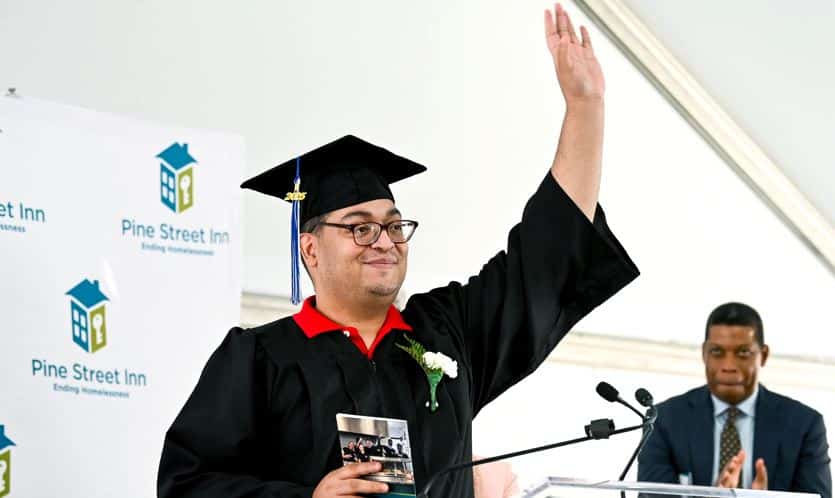
Graduate Durell Young-Blanchard told his fellow classmates that securing a job and a home provided the peace of mind necessary to focus on his future. Young-Blanchard, who spent 15 months with the organization, recounted a journey from incarceration to landing a full-time job and housing.
Irwin described the graduates as resilient and diverse, stating that the results in terms of obtaining work are among the best she has seen in her eight years with the organization.
How does Boston’s approach to homelessness compare to national averages?
Speakers at the graduation highlighted a significant disparity between local and national data. According to the presentation, while the national average of people sleeping outside is approximately 36%, that figure is only 2% in Boston.

Tai Irwin attributed this difference to the city’s willingness to implement specific structures to resolve the cycle of poverty and real estate challenges. She characterized the initiative as a “solution factory” that demonstrates how homelessness can be resolved when the city has the will to act.
Keynote speaker Michael Curry, President and CEO of the Massachusetts League of Community Health Centers, emphasized the value of the graduates’ personal stories. Quoting Frederick Douglass, Curry told the graduates that the depth of their struggles adds significance to the heights they reach.
What may happen next for the program and its graduates?
As graduates like Young-Blanchard exit the shelter system, it could create immediate capacity for new individuals seeking goals and stability. This rotation may allow the organization to serve a higher volume of people annually.
The continued partnership with major Boston universities and hospitals is likely to remain a primary driver for job placement. If the current success rates persist, the city may see a further decrease in the percentage of people sleeping outdoors.
Frequently Asked Questions
How long does the Pine Street Inn training program take to complete?
The program lasts 24 weeks, consisting of eight weeks of training, eight weeks of internship, and eight weeks of near full-time work.
What specific vocational skills are taught in the program?
Trainees learn food service and catering through the ICater program, housekeeping, and life skills such as financial literacy, computer literacy, teamwork, and mindfulness.
Who are some of the employers that hire graduates?
Graduates are placed with Boston businesses like Flour Bakery and Legal Sea Foods, as well as the city’s major universities and hospitals.
How could other cities adapt this vocational model to reduce outdoor homelessness?