
Pinterest Uses Content Fingerprints for URL Deduplication Across Millions of Domains
Pinterest has introduced a URL normalization system called Minimal Important Query Param Set (MIQPS) to solve the massive problem of content deduplication. By using data-driven analysis to distinguish essential URL parameters from tracking noise, the platform reduces infrastructure overhead and improves indexing accuracy across millions of merchant domains, moving away from unreliable manual allowlists.
Why Manual URL Normalization Is Failing at Scale
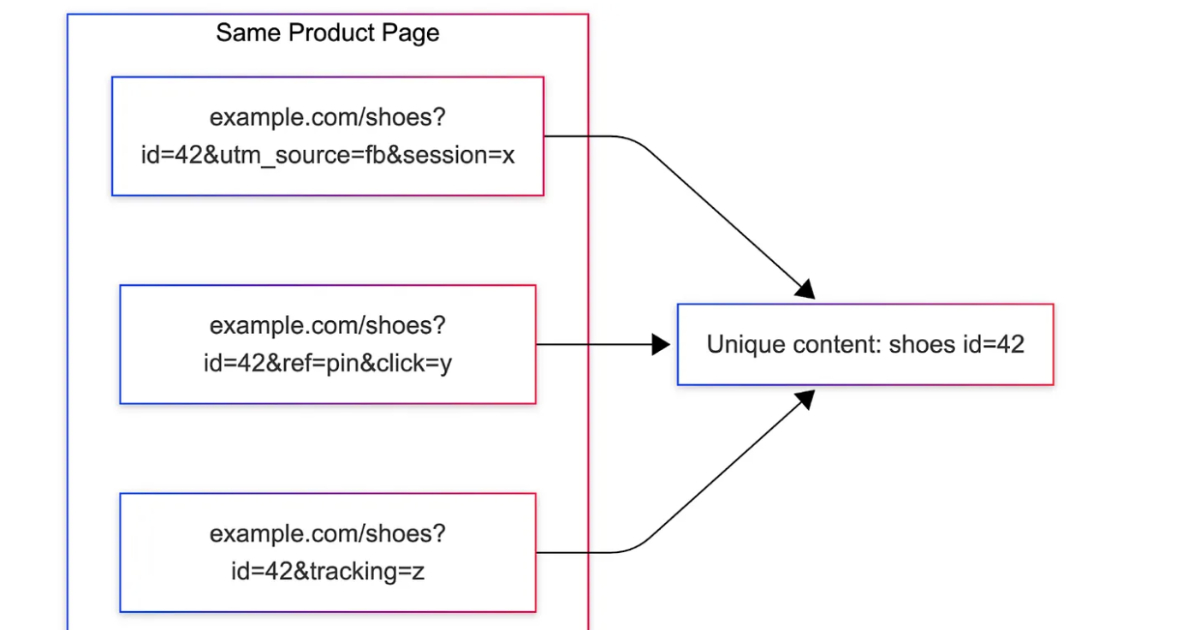
Traditional methods for cleaning URLs—like manual allowlists and denylists—are becoming obsolete for platforms dealing with the “long tail” of the web. As Pinterest engineer Shanhai Liao noted, these static rules work for top-tier platforms, but they fall apart when applied to millions of sites with inconsistent URL structures. When a system cannot distinguish between a vital product variant and a simple tracking pixel, it treats the same page as multiple unique entities.
This creates a massive “fetch and render” tax. Every time a crawler hits a duplicate URL variant, the infrastructure spends compute power to process content that has already been indexed. By shifting to MIQPS, Pinterest avoids the burden of maintaining thousands of custom rules, instead letting the data determine which query parameters actually change the page content.
How MIQPS Uses Content Fingerprinting
The core innovation of MIQPS is its shift from metadata-based logic to behavioral analysis. Instead of trusting what a website says about its own URL structure, the system renders the page and generates a content fingerprint. If removing a parameter—such as a session token or campaign ID—results in a page that looks identical to the original, the system marks that parameter as noise.
This process happens offline, which is a critical design choice for performance. By separating the heavy lifting of rendering and analysis from the runtime environment, Pinterest ensures that its ingestion pipeline remains fast. The output is a parameter importance map that the runtime system references instantly, ensuring that URL normalization doesn’t become a bottleneck for site performance.
Future Trends in Intelligent Crawling
The move toward automated, data-driven normalization signals a broader shift in how search engines and discovery platforms will handle the web. As tracking parameters become more complex, rule-based systems will continue to lose effectiveness. We are likely to see more platforms adopt machine-learning-based “importance maps” that evolve alongside the websites they index.

Another trend is the adoption of “early exit” logic, similar to the approach used in MIQPS. By setting mismatch thresholds, systems can stop testing a URL as soon as it is clear that a parameter isn’t changing the page content. This saves significant compute resources, a necessity as the volume of web content continues to grow exponentially.
Frequently Asked Questions
What is MIQPS in the context of Pinterest?
MIQPS stands for Minimal Important Query Param Set. It is an automated system that identifies which URL query parameters affect content and which are just tracking noise, allowing Pinterest to deduplicate pages accurately.

Why don’t canonical tags solve this problem?
According to Pinterest engineering, canonical tags are often inconsistent, missing, or improperly populated with tracking parameters, making them unreliable for large-scale infrastructure.
How does MIQPS handle new domains?
The system uses a conservative default, treating parameters as “non-neutral” (important) if there is insufficient data. It also uses anomaly detection to ensure that important parameters aren’t accidentally downgraded during updates.
Is this approach better than manual rules?
Yes. Manual allowlists are hard to maintain across the “long tail” of millions of domains. A data-driven approach scales automatically as new websites and URL patterns emerge.
Have you encountered issues with duplicate content impacting your site’s indexing? Share your experiences in the comments below, or subscribe to our newsletter for more deep dives into backend engineering and search infrastructure.