

Potentially Hazardous Asteroid (152637) 1997 NC1 close encounter: a new image – 13 June 2026.
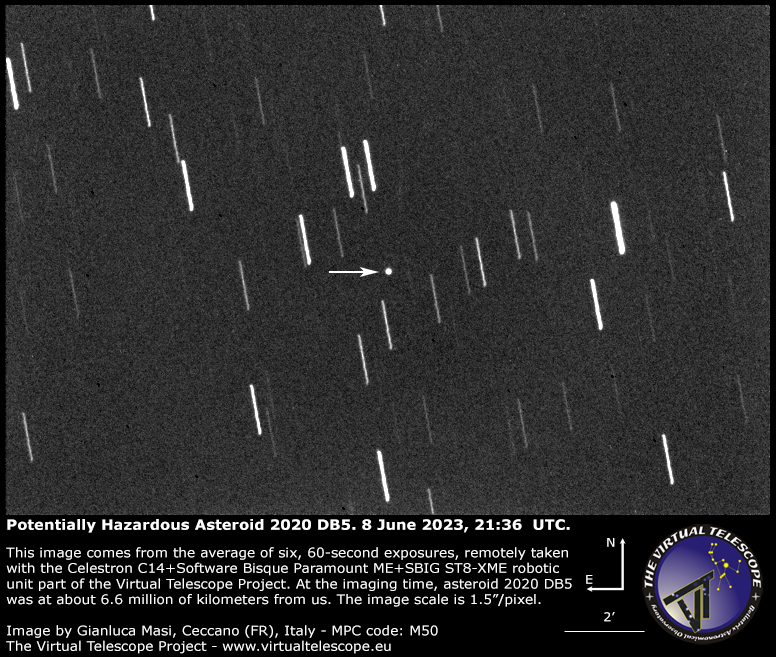
The potentially hazardous asteroid (152637) 1997 NC1 will pass Earth at a distance of 2.6 million kilometers on June 27, 2026, according to NASA/JPL. Measuring between 710 and 1,600 meters in diameter, the object poses no risk to the planet. The Virtual Telescope Project captured the asteroid’s approach on June 13, 2026, using a remotely operated telescope in Manciano, Italy.
Why is (152637) 1997 NC1 classified as potentially hazardous?
NASA classifies an asteroid as “potentially hazardous” based on its physical size and its proximity to Earth’s orbit. According to the Center for Near-Earth Object Studies (CNEOS), any asteroid larger than 140 meters that comes within 7.5 million kilometers of Earth meets these criteria. At 2.6 million kilometers—roughly 6.6 times the average distance to the moon—1997 NC1 qualifies under these safety monitoring guidelines despite having a well-understood and safe trajectory.
An asteroid of this magnitude (710–1,600 meters) typically makes a close approach of this distance approximately every ten years.
How do astronomers track these objects?
Astronomers use robotic observatories to maintain continuous monitoring of near-Earth objects. The Virtual Telescope Project, led by Gianluca Masi, utilizes a PlaneWave 17-inch robotic unit to track the apparent motion of asteroids against the background stars. In the June 13 image, the asteroid appears as a point of light in the center, while stars are rendered as short streaks due to the telescope’s tracking mechanism. This method allows researchers to verify the orbital path and refine impact probability models.
What does the future of asteroid monitoring look like?
Advancements in automated survey telescopes are increasing the frequency at which we detect, characterize, and catalog near-Earth objects. While 1997 NC1 is a well-studied object, the trend in planetary defense focuses on “early detection” to allow for potential deflection missions, such as the precedent set by NASA’s Double Asteroid Redirection Test (DART). Future surveys aim to identify smaller, more elusive objects that currently fall below the detection threshold of existing ground-based systems.
Comparison of Close Approaches
| Metric | 1997 NC1 Data |
|---|---|
| Closest Approach Distance | 2.6 million km |
| Estimated Size | 710–1,600 meters |
| Lunar Distance Equivalent | 6.6x |
Frequently Asked Questions
- Is 1997 NC1 going to hit Earth? No. According to NASA/JPL, the asteroid will pass safely at 2.6 million kilometers.
- How large is 1997 NC1? The object is estimated to be between 710 and 1,600 meters wide.
- Can I see the flyby? The Virtual Telescope Project provides live online observation opportunities for public viewing of such encounters.
Have questions about planetary defense or want to see the latest tracking data? Explore our Solar System archive or consider supporting the project to help maintain our robotic monitoring units.