
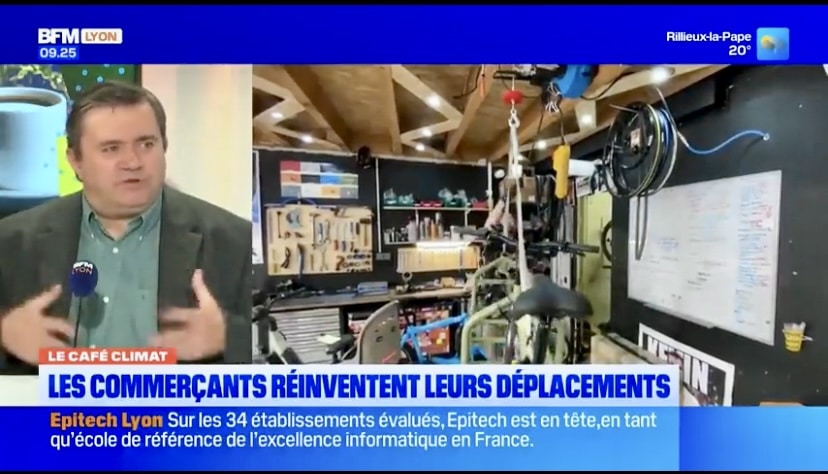
Programme Marguerite: Empowering Lyon Artisans With Electric Cargo Bikes
Faced with tightening urban traffic restrictions and the urgent need for environmental transition, professionals in Lyon are fundamentally rethinking their daily logistics. The Programme Marguerite, highlighted during the June 4, 2026, broadcast of Café Climat on BFM Lyon, has emerged as a central pillar in helping local artisans and merchants adopt low-carbon transport solutions.
Supported by the ADEME, the State, the Lyon Metropolitan Area, and the Chambre de Métiers et de l’Artisanat Lyon-Rhône, the initiative provides a comprehensive support system. It offers a free diagnostic to identify specific business needs, the opportunity to test specialized vehicles like electric cargo bikes for several weeks, and a €1,000 financial subsidy to facilitate these transitions.
The Shift Toward Cargo Bikes
For many tradespeople, the transition from traditional combustion-engine utility vehicles to electric cargo bikes is proving to be a practical evolution. Beyond the environmental benefits, these vehicles offer a way to bypass traffic congestion and the persistent challenges of inner-city parking.
Damien Dumas, an artisan woodworker based in Brindas, has integrated a Muli cargo bike into his routine. Covering roughly 25 kilometers daily, he notes that the bike’s compact design and foldable front basket allow him to carry essential tools for on-site repairs, such as door adjustments, without the logistical burden of driving a van into the city centre.
A Professional Tool for Diverse Trades
Maxence Sarazin, co-founder of the Lyon-based firm Fends la Bise, emphasizes that these cargo bikes are robust, technical tools designed for heavy loads rather than casual use. His firm, located near the Prefecture, assists a wide range of professionals, including plumbers, electricians, carpenters, and parquet floor installers.
While the initial investment for a professional-grade cargo bike starts around €3,500, the long-term savings on fuel, insurance, and maintenance make it a viable alternative to utility vans. As the city continues to evolve its transit policies, the adoption of these vehicles may expand among the estimated 75% to 80% of urban tradespeople who could benefit from such logistical shifts.
Beyond the Two-Wheeler
The Programme Marguerite is part of a broader effort to modernize local logistics, with over 900 tests conducted nationwide and 420 professionals already having converted their practices. The programme utilizes Certificats d’Économie d’Énergie (CEE) to support various alternatives, including mutualized delivery tours for groceries, shared waste collection services, and shared vehicle fleets.
Looking ahead, as more businesses complete their transition trials, it is likely that the infrastructure for shared logistics in Lyon will become more dense. Further integration of these systems could lead to a significant reduction in the presence of heavy delivery vehicles in the city centre, potentially reshaping how local services are delivered on a day-to-day basis.
Frequently Asked Questions
What financial support does the Programme Marguerite offer?
The programme provides a free diagnostic for businesses and a €1,000 financial aid package to assist professionals in testing low-carbon mobility solutions at a reduced cost.
Which trades can use cargo bikes effectively?
According to industry experts, cargo bikes are suitable for a wide range of professions, including electricians, plumbers, woodworkers, carpenters, and ascensorists.
Is the programme limited to electric bicycles?
No, the initiative also promotes other logistics solutions, such as shared delivery tours, shared waste collection services, and shared vehicle fleets, supported by Certificats d’Économie d’Énergie (CEE).
How might your own daily commute or business logistics change if you transitioned to a low-carbon transport model?