

Puerto Rico Health Department Announces $24.8 Million for Opioid Treatment and Prevention
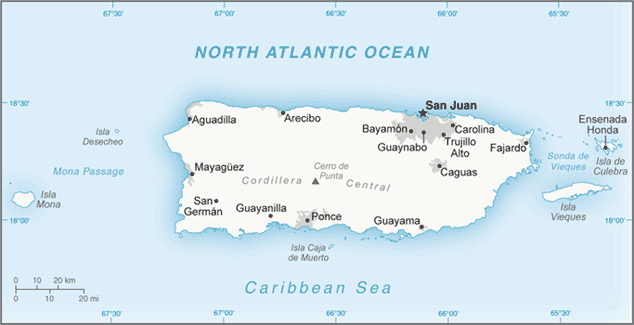
Puerto Rico’s Department of Health has announced a $24.8 million funding initiative to expand prevention and harm reduction services for the problematic use of potent analgesics, including fentanyl. This three-year effort specifically aims to address a historical lack of treatment access in the regions of Aguadilla and Mayagüez.
The announcement follows the identification of a service gap in the western part of the island. According to Dr. Eduardo Zavala, principal investigator of the Health Overdose Prevention Division, the goal is to establish a concrete route to treatment in areas where the need is most acute.
Strategic Allocation of Settlement Funds
The total allocation of $24,815,000 is funded through the “Opioid Settlement,” resulting from lawsuits against manufacturing, distribution, and dispensing companies in the United States. This follows a first phase of financing that distributed $27,226,982 across 52 grants in eight regions.
The current funding will be divided into specific categories. There will be 29 grants of $435,000 each for educational programs and five grants of $1.5 million each for treatment programs.
$4.7 million is designated for interagency agreements. This includes collaborations with the Institute of Forensic Sciences and the Department of Correction, and Rehabilitation.
Addressing the Opioid Crisis in the West
The significance of this expansion is underscored by mortality data. Between 2018 and 2025, Puerto Rico recorded 4,795 intoxication deaths, of which 3,625 were related to the presence of opioids.
Secretary of Health Víctor Ramos Otero noted that the lack of services in the west was linked to a “lack of visibility” regarding these programs. He emphasized that the new grants should specifically address the prevalence of xylazine in the western region.
Priority areas for the new grants include the expansion of medication-assisted treatment, detoxification, and integrated behavioral health. The department is also prioritizing telemedicine, transitional housing, and supported employment.
Application Process and Future Outlook
The call for proposals opens on Friday, May 29, and closes on June 29. Eligible applicants include municipalities, hospitals, non-profit organizations, health providers, community coalitions, and 330 primary health centers.
The agency has already reported progress in other areas, including increased admissions for medication-assisted treatment and the expanded distribution of naloxone. There has also been a reported reduction in overdose cases attended to in emergency rooms.
Looking forward, the successful implementation of these grants could potentially reduce the service disparity between the western coast and the rest of the island. If community-led proposals are adopted, it may lead to a more robust network of peer support and harm reduction, such as the distribution of fentanyl test strips and needle exchange programs.
Frequently Asked Questions
Who can apply for the $24.8 million in grants?
Interested parties include non-profit organizations, community coalitions, health providers, 330 primary health centers, hospitals, and municipalities.
Where does the funding for these programs originate?
The funds come from the “Opioid Settlement,” which the agency receives annually following lawsuits against opioid manufacturing, distribution, and dispensing companies in the U.S.
What specific services are being prioritized in the grant proposals?
Priorities include medication-assisted treatment, detoxification, telemedecine, transitional housing, supported employment, naloxone and fentanyl strip distribution, and needle exchange programs.
How do you think targeted regional funding changes the effectiveness of public health responses to addiction?