
Relativistic electron acceleration at the bow shock of Jupiter and beyond
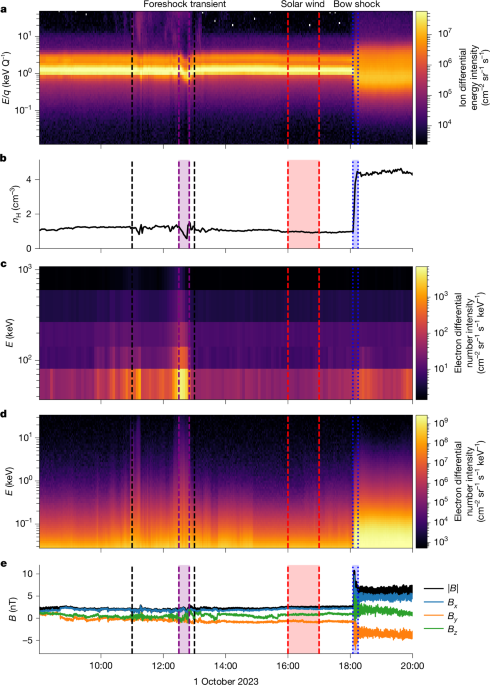
NASA’s Juno spacecraft has provided unprecedented insights into the particle acceleration processes occurring in Jupiter’s magnetosphere, revealing how energetic particles are generated and behave in the planet’s foreshock region—a turbulent zone upstream of its bow shock. Using data from the Jupiter Energetic Particle Detector Instrument (JEDI) and the Jupiter Auroral Distributions Experiment (JADE), researchers observed a transient event between 12:30 and 12:50 UTC, characterized by a sudden intensification of energetic ions and electrons, alongside a localized compression of plasma. The findings confirm that these particles are accelerated in situ, meaning they gain energy within the transient structure itself rather than being transported from external sources.
How Juno Uncovered Jupiter’s Particle Acceleration Secrets
The study leveraged Juno’s suite of instruments to capture high-resolution measurements of ions and electrons ranging from 10 electron volts (eV) to 1 mega-electron volt (MeV), as well as magnetic field data with a temporal resolution of 1 second. By analyzing the pitch angle distributions (PADs) of ions and electrons, scientists identified a clear isotropic population of accelerated particles—meaning particles were distributed uniformly across all angles, a hallmark of well-scattered populations within the foreshock. This behavior aligns with observations of similar transients near Earth’s bow shock, suggesting a universal mechanism at play in collisionless shocks across different environments.

Key to the discovery was the use of minimum variance analysis (MVA) on magnetic field data to determine the orientation and scale of the transient structure. Researchers estimated the transient’s size using the spacecraft’s velocity and the duration of the event, confirming Juno’s position approximately 1 Jupiter radius (RJ) upstream of the bow shock—a distance consistent with observations at Earth. The transient’s geometry, transitioning from quasi-parallel to quasi-perpendicular, further supported the presence of suprathermal particles, which are typically associated with such shock configurations.
A power-law fit to the energetic particle data yielded a spectral index of approximately −1.85, closely matching the canonical limit for diffusive shock acceleration (DSA), a process known to efficiently accelerate particles to high energies. This index also aligns with theoretical expectations for relativistic electrons, reinforcing the idea that Jupiter’s foreshock acts as a natural particle accelerator.
Why This Discovery Matters
The findings bridge a critical gap in understanding how cosmic rays and high-energy particles are generated not only in planetary magnetospheres but also in astrophysical environments like supernova remnants and protostellar jets. By demonstrating that Jupiter’s foreshock transients operate under principles similar to those observed at Earth and extrapolated to larger scales, the study provides a framework for predicting particle acceleration in distant, unobservable cosmic phenomena.
For industries reliant on space weather forecasting—such as satellite operations, telecommunications, and power grid management—the insights could refine models of radiation hazards in Earth’s magnetosphere. The study’s application of the Hillas criterion—a theoretical limit on particle energy based on magnetic field strength, shock velocity, and system size—offers a quantitative tool to estimate maximum achievable energies in diverse shock environments, from planetary bow shocks to supernova remnants.
The research also highlights the scalability of acceleration mechanisms across cosmic scales. By extrapolating Jupiter’s observations to astrophysical objects like the protostellar jet HH 211, supernova remnants SN 1987A, and SN 1006, scientists can now model how these systems might accelerate particles to energies exceeding 100 tera-electron volts (TeV), as observed in SN 1006. This could revolutionize our understanding of cosmic ray production and the role of collisionless shocks in shaping the universe.
What Could Happen Next?
Analysts expect this research to spur further investigations into how Jupiter’s foreshock transients evolve over time and under varying solar wind conditions. Future Juno passes could refine estimates of particle energy limits by capturing additional transients or by correlating observations with solar activity cycles. If similar transients are identified at other gas giants, such as Saturn, the framework could be expanded to compare acceleration efficiencies across planetary magnetospheres.
In the astrophysical realm, the study’s extrapolation to supernova remnants may inspire new observational campaigns using telescopes like the James Webb Space Telescope or the upcoming Nancy Grace Roman Space Telescope. These missions could search for signatures of foreshock-driven acceleration in distant cosmic shocks, testing whether the planetary-derived model holds at scales orders of magnitude larger. If confirmed, the findings could redefine our understanding of cosmic ray production and the lifecycle of stellar explosions.
For industries, the next steps may involve integrating these acceleration models into space weather prediction systems. By refining how energetic particles are generated and transported, operators could improve warnings for satellite anomalies or power grid disruptions caused by solar storms. The study’s emphasis on local acceleration mechanisms could inform the design of radiation shielding for crewed missions to the Moon or Mars, where exposure to high-energy particles remains a critical challenge.
Frequently Asked Questions
[Question 1]
What instruments on Juno were used to detect the particle acceleration event?
![[Question 1]](https://cdn.mos.cms.futurecdn.net/JETf6tj277ruUGcnQquTAm.jpg "NASA Juno Jupiter particle acceleration infographic")
The study relied on data from the Jupiter Energetic Particle Detector Instrument (JEDI), which measures ions and electrons from 30 keV to 1 MeV, and the Jupiter Auroral Distributions Experiment (JADE), which captures lower-energy ions and electrons. Magnetic field data were provided by the Magnetic Field Investigation (MAG) instrument.
[Question 2]
How does Jupiter’s foreshock compare to Earth’s in terms of particle acceleration?
The observations match key characteristics of foreshock transients at Earth, including isotropic pitch angle distributions of accelerated particles and a spectral index consistent with diffusive shock acceleration. Juno’s data confirm that the same physical processes govern particle acceleration in both environments, suggesting a universal mechanism across planetary bow shocks.
[Question 3]
Can this research help explain cosmic ray production in supernova remnants?
Yes. By demonstrating that Jupiter’s foreshock transients follow predictable scaling laws tied to shock geometry and magnetic field strength, the study provides a framework to estimate maximum particle energies in astrophysical shocks. This approach has already been applied to supernova remnants like SN 1006, where observed TeV emissions align with the model’s predictions.
How might industries like telecommunications or energy infrastructure adapt to these findings in the coming years?