

Researcher Finds Surprising Phenomenon in NASA Data From Mars
The Invisible Shield: Redefining How Planets Survive Solar Storms
For decades, the scientific consensus was straightforward: if a planet doesn’t have a strong global magnetic field, it’s essentially a sitting duck for the sun’s relentless solar wind. Earth is protected by its massive magnetosphere, acting like a cosmic umbrella. Mars, however, lacks this luxury, which is why scientists long believed its atmosphere was simply being stripped away over eons.
But recent data from NASA’s MAVEN spacecraft has flipped the script. The discovery of the Zwan-Wolf effect occurring directly within the Martian atmosphere suggests that nature has a “backup plan” for protecting worlds that lack a traditional magnetic shield.
The Zwan-Wolf Effect: A Game-Changer for Unmagnetized Worlds
To understand why this discovery is a breakthrough, we have to look at how plasma behaves. Normally, the Zwan-Wolf effect—which involves squeezing plasma through “magnetic flux tubes” to deflect solar wind—was thought to happen only in the magnetosphere, the region above a planet’s atmosphere.
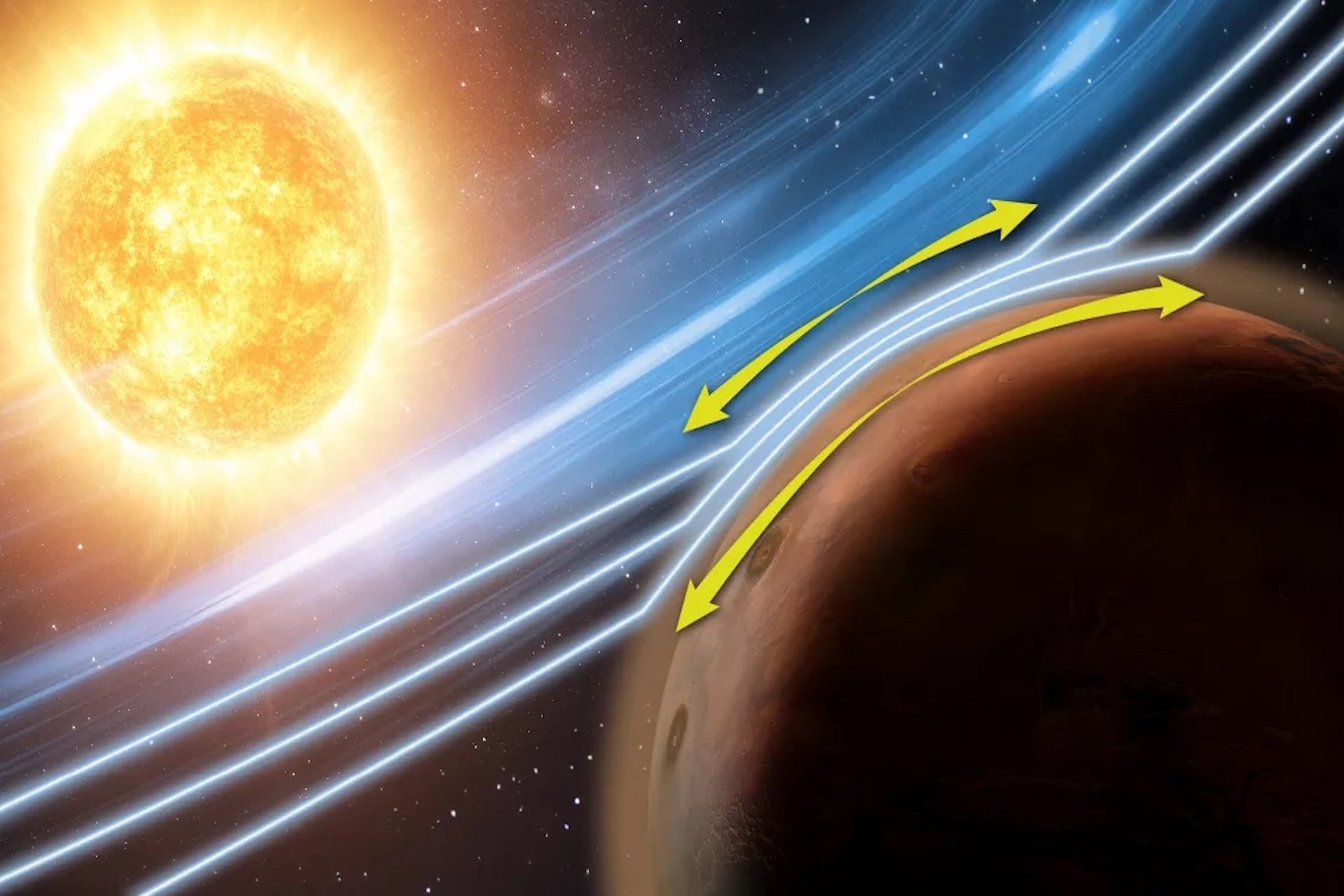
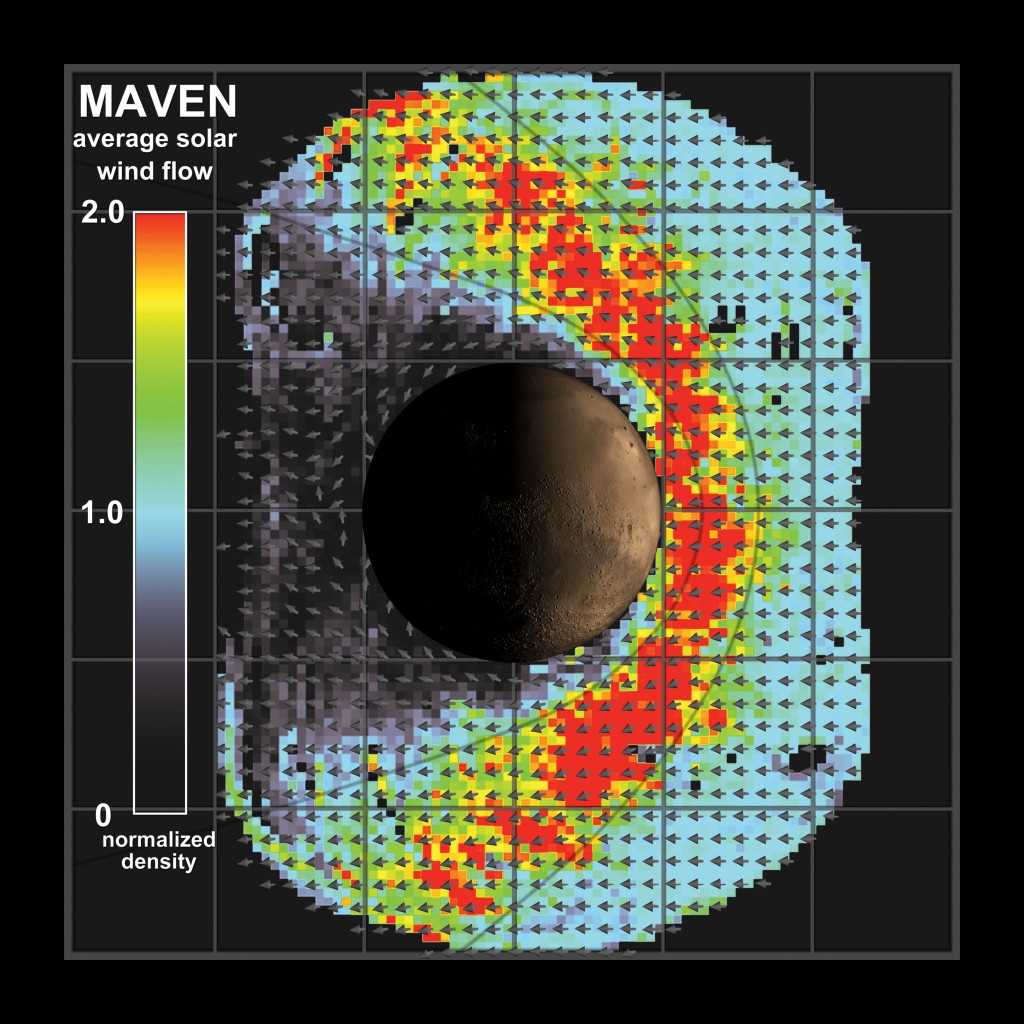
The MAVEN data reveals that during intense solar events, such as coronal mass ejections (CMEs), this effect can penetrate deep into the atmosphere itself. By reducing the density of plasma in front of the planet, the Zwan-Wolf effect creates a temporary, dynamic shield.
This implies that “unmagnetized” bodies—including Venus, comets, and Saturn’s moon Titan—might possess inherent mechanisms to mitigate solar erosion that we previously ignored. This shifts our understanding of planetary evolution from a binary (magnetized vs. Unmagnetized) to a more complex spectrum of protection.
Why This Matters for Future Mars Colonies
If we are serious about sending humans to Mars, we aren’t just fighting the cold and the dust; we are fighting radiation. The discovery that the Martian atmosphere can interact with solar storms via the Zwan-Wolf effect provides a new variable for calculating radiation dosages for future astronauts.
Future habitat designs may no longer rely solely on thick lead shielding or underground bunkers. Instead, engineers might look at how to augment these natural electromagnetic “wiggles” to create localized artificial shields, mimicking the Zwan-Wolf effect to protect human settlements during peak solar activity.
Beyond Mars: The Ripple Effect on Space Exploration
The implications of this research extend far beyond the Red Planet. As we expand our footprint in the solar system, our reliance on “space assets”—satellites, GPS constellations, and deep-space probes—increases exponentially.
Protecting Our Orbital Infrastructure
We’ve already seen how solar storms can cripple satellite networks. By understanding the Zwan-Wolf effect, NASA and private entities like SpaceX can develop more resilient satellite shielding. If You can model how plasma is “squeezed” and deflected, we can build hardware that survives the volatility of the interplanetary medium.
This is particularly critical for the burgeoning “New Space” economy, where thousands of small satellites are being deployed in Low Earth Orbit (LEO). A single massive CME could trigger a cascade of failures if we don’t understand the electromagnetic forces at play.
The Hunt for Habitable Exoplanets
Perhaps the most exciting trend is how this changes the search for alien life. Previously, when astronomers looked for “habitable” exoplanets, a strong magnetic field was often listed as a prerequisite for retaining an atmosphere and supporting life.
If the Zwan-Wolf effect can protect an atmosphere without a global magnetic field, the number of potentially habitable planets in the galaxy just skyrocketed. We may now look at “unmagnetized” worlds in distant star systems as viable candidates for life, rather than dismissing them as barren rocks.
Frequently Asked Questions
What exactly is the Zwan-Wolf effect?
This proves a phenomenon where electromagnetic forces squeeze solar wind plasma through magnetic flux tubes, deflecting the plasma around a planet and reducing its density in front of the atmospheric boundary.
Does Mars have a magnetic field?
Mars does not have a global, dipolar magnetic field like Earth’s. Instead, it has localized “crustal” magnetism—small patches of magnetized rock—which makes the discovery of the Zwan-Wolf effect in its atmosphere even more surprising.
How does this discovery affect life on Earth?
While the effect was observed on Mars, understanding these plasma dynamics helps scientists better predict how solar storms interact with any planetary body, improving our ability to protect Earth’s power grids and satellite communications.
Join the Cosmic Conversation
Do you think humans will successfully colonize Mars in the next 50 years, or are the radiation risks too high? Let us know your thoughts in the comments below!
Subscribe to our Space Intelligence newsletter for weekly updates on the frontiers of science.