
Rethinking Poetic Cinema: Beyond the Beautiful Image
Filmmaker and scholar Jerónimo Atehortúa is challenging the entertainment industry’s definition of “poetic cinema” in a new series of reflections. Prologued by Roger Koza, Atehortúa argues that poetry in film is frequently misunderstood as a mere synonym for visual beauty or “beautiful images.”
Instead of focusing on aesthetic splendor, Atehortúa proposes that true cinematic poetry lies in the tension between what is shown and what remains hidden. He suggests that the most powerful images are those that resist immediate explanation and require the viewer to “read” rather than simply “see.”
Beyond the “Beautiful Image”
Atehortúa critiques the tendency of critics to label films “poetic” when they feature iconic, postcard-like landscapes or dramatic sunsets. He argues that these images often deliver their meaning immediately, functioning as signs that close off thought rather than opening it.
Drawing on the work of Peruvian linguist Mario Montalbetti, Atehortúa distinguishes between the “visual,” which provides immediate meaning, and the “poetic,” which maintains a distance between the signifier and the signified. In this view, art exists in the space of the deferred, where meaning is not handed to the viewer instantly.
Cinema of the Global South
The filmmaker emphasizes that a real reflection on cinema must include an analysis of its conditions of existence. He notes a fundamental difference between being a filmmaker in the “Global South” versus a “central country.”

Atehortúa suggests that a “Hollywood diet” of cinema can lead to an atrophied, second-hand creative process. He argues that cinema is not merely a matter of images, but of “plans” that integrate time, sound, light, and the human body.
Analyzing Poetic Potency
To illustrate his point, Atehortúa contrasts the “automated” emotional legibility of Chloé Zhao’s Hamnet with the open signifiers in Andrei Tarkovsky’s The Mirror. He asserts that Tarkovsky’s work is poetic not because of its iconic imagery, but because it treats images as open questions.
Other examples of this boundary-pushing cinema include the works of Raúl Ruiz, who utilized narrative digression and detour, and Paula Gaitán. Gaitán’s film Luz nos trópicos is described as a “river-film” that flows without a fixed map, refusing to close its meanings.
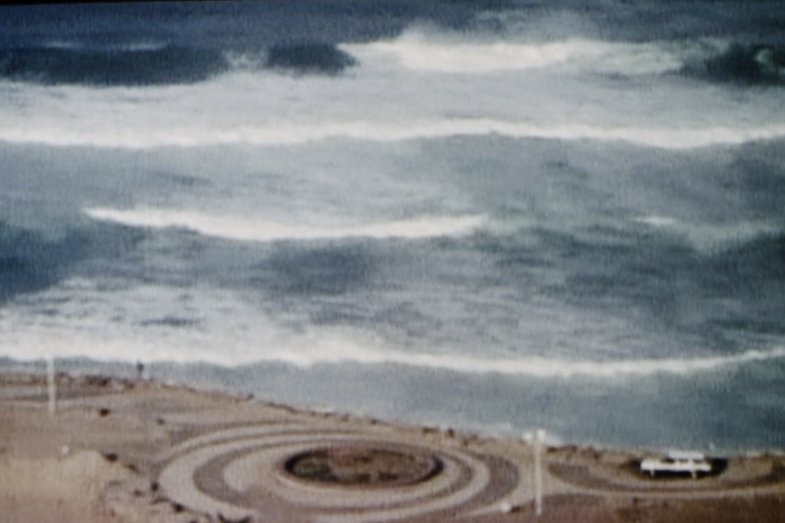
Atehortúa also highlights Kamal Aljafari’s Recollection, which operates in an “infracinematographic” zone. By digitally removing protagonists from footage of Jaffa, Aljafari uses the “ruin” of the image to represent the erasure of Palestinian memory.
The Role of the Archive
Working extensively with archives and fragments, Atehortúa believes that some images retain a “potency” that allows them to be re-articulated. He suggests that the poetic in cinema appears when an image refuses to be a closed sign.
This approach suggests that cinema can make present that which cannot be seen or fully said. By treating the image as a poem, filmmakers can displace a problem and make it habitable rather than simply attempting to resolve it.
Frequently Asked Questions
What is the difference between “seeing” and “reading” a cinematic image?
Seeing occurs when an image delivers its meaning immediately, closing the gap between the signifier and the signified. Reading occurs when an image suspends that closure, requiring the viewer to engage with the distance between what is shown and what is produced.
Why does the “Global South” perspective matter in filmmaking?
It forces a review of the material conditions of production and a departure from the imaginaries taught by industrial Hollywood cinema, which Atehortúa argues can otherwise result in an atrophied form of art.
How does Kamal Aljafari achieve a “poetic” effect in Recollection?
Aljafari uses the “borramiento” (erasure) of images, removing people from scenes to leave behind walls and empty streets. This creates an experience of absence that cannot be fully translated into verbal language.
Do you believe cinema should provide clear answers, or is its true power found in the images that leave us questioning?