
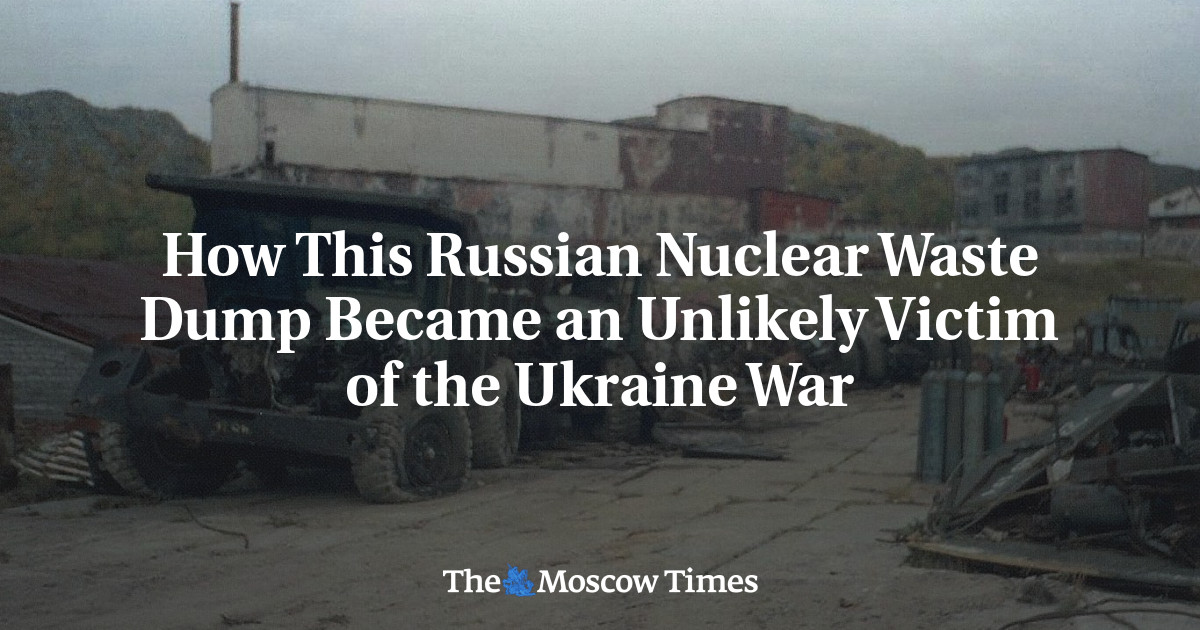
Russia’s Arctic Nuclear Waste Cleanup Stalls Amid Ukraine War
The Arctic’s Radioactive Time Bomb: The Future of Nuclear Waste in a Divided North
For decades, the fjords of the Kola Peninsula have served as a silent graveyard for the Soviet Union’s nuclear ambitions. Andreyeva Bay, once a clandestine dumping ground for spent nuclear fuel, represents more than just an environmental hazard; it is a barometer for the current state of global geopolitical cooperation.
When international funding and expertise flowed into the region, the trajectory was clear: remediation. But as the geopolitical frost settles over the Arctic, the cleanup of these “legacy sites” is shifting from a shared humanitarian mission to a precarious solo act by the Russian state.
The Geopolitical Freeze: When Diplomacy Dies, Radiation Remains
The most alarming trend in Arctic nuclear safety is the decoupling of environmental security from political relations. Historically, nuclear remediation—especially involving highly enriched uranium—was viewed as a “neutral” zone where adversaries could cooperate for the greater good of the planet.
The sudden cessation of funding from partners like Norway and the outlawing of NGOs such as Bellona signal a dangerous shift. We are moving toward an era of “environmental isolationism,” where critical safety data is treated as a state secret rather than a public necessity.
Without third-party verification, the world is forced to rely on the reports of agencies like Rosatom, which are increasingly obscured by wartime priorities. This lack of transparency creates a “blind spot” in the Barents Sea, where a leak could go undetected until it reaches the fishing waters of neighboring nations.
The “nuclear flash” feared by experts isn’t a full-scale atomic explosion, but a criticality accident. This occurs when nuclear fuel reaches a state where a self-sustaining chain reaction begins, releasing a massive burst of radiation into the immediate environment.
The “Technical Debt” Crisis: The Danger of the Last 50%
In any remediation project, the “low-hanging fruit” is picked first. In Andreyeva Bay, the most stable and intact fuel assemblies were removed during the height of international cooperation. What remains is the technical debt: the most corroded, brittle, and unstable casks.
Future trends suggest that the cost and risk of cleanup will increase exponentially, not linearly. As these containers continue to degrade in the harsh Arctic salt air, the probability of a containment failure rises. We are no longer dealing with simple storage; we are dealing with fragile remnants that could crumble upon the first attempt to move them.
This creates a perverse incentive for the managing authority to delay action. If the risk of moving the waste exceeds the perceived risk of leaving it, the “temporary” storage may become a permanent, leaking fixture of the landscape.
Shadow Monitoring: The Rise of Environmental Intelligence
As official channels of communication close, we are seeing a trend toward “shadow monitoring.” Countries like Norway are no longer relying solely on diplomatic cables; they are increasing their reliance on satellite imagery, atmospheric sensors, and AI-driven data analysis to detect radiation spikes.
This shift toward autonomous environmental intelligence is likely to become the standard for monitoring “rogue” or isolated nuclear sites worldwide. When a state ceases to be transparent, the international community will turn to remote sensing to safeguard the global commons.
For more on how satellite data is changing environmental law, see our guide on Remote Sensing and International Treaties.
The real danger isn’t just the waste at Andreyeva Bay, but the systemic failure of infrastructure. In a wartime economy, maintenance budgets for “invisible” problems—like rust in a nuclear pool—are the first to be slashed.
The Arctic Paradox: Resource Rush vs. Radioactive Risk
There is a jarring contradiction currently playing out in the High North. While Russia aggressively pursues the Northern Sea Route and extracts minerals from the Arctic seabed, it is simultaneously neglecting the radioactive legacy of its naval past.
The future trend here is a clash of priorities. The drive for economic dominance in the Arctic may lead to the accidental disturbance of legacy waste sites. As new ports are built and shipping lanes expand, the risk of an industrial accident interacting with a radioactive site increases.
the melting permafrost—a result of accelerated Arctic warming—could destabilize the very ground upon which these containment units sit, potentially leading to unplanned leaks into the Barents Sea.
Comparative Risk: Legacy Sites vs. Active Reactors
While legacy sites like Andreyeva Bay are a slow-motion crisis, the proliferation of nuclear-powered icebreakers adds a layer of active risk. The trend toward “nuclearizing” the Arctic fleet means that the region will have more active reactors in extreme environments than ever before, increasing the stakes for any potential maritime disaster.
Frequently Asked Questions
What is the primary risk of the waste at Andreyeva Bay?
The primary risks include the leakage of radioactive isotopes into the Barents Sea and the potential for a “nuclear flash” (criticality accident) if unstable fuel is mishandled.
Why did international funding stop?
Funding was largely frozen following the Russian invasion of Ukraine, as diplomatic relations between Russia and Western nations (including Norway) collapsed.
Can Russia clean up the site alone?
Technically, yes. Russia possesses the engineering capability. However, the issue is “political will” and the diversion of funds toward military expenditures and other state projects.
How does this affect the global environment?
Radioactive isotopes like Cesium-137 can travel through ocean currents, potentially contaminating commercial fishing grounds and affecting biodiversity across the Arctic circle.
To track real-time radiation levels in the Arctic, look for open-source data from the International Atomic Energy Agency (IAEA) or independent monitoring stations in Scandinavia.
Join the Conversation
Do you believe environmental safety should remain neutral even during geopolitical conflicts? Or is the cutoff of funding a necessary diplomatic tool?
Share your thoughts in the comments below or subscribe to our newsletter for deep dives into Arctic security.