
Samsung Electronics Reclaims Top Spot as KOSPI Rebounds 3.2% Despite Massive Foreign Sell-Off
The KOSPI index rebounded to 8,471.02 on June 24, a 3.26% increase, as domestic investors offset a record-breaking 4.6 trillion won sell-off by foreign entities. Samsung Electronics reclaimed its position as the market’s largest company by market capitalization after a 9.84% surge, effectively reversing the previous day’s 12.31% decline, according to data from the Korea Exchange.
Market Recovery and Samsung’s Rebound
Samsung Electronics’ recovery served as the primary driver for the broader market’s gains. Following a historic 12.31% drop that briefly cost the firm its top market cap ranking, the stock rose 9.84% on June 24, driven by aggressive bargain hunting from institutional and individual investors. This rally extended to related group stocks, with Samsung Biologics climbing 8.80%, Samsung C&T rising 5.82%, and Samsung Electronics preferred shares gaining 5.43%.

The recovery was not uniform across all large-cap stocks. While the KOSPI index stabilized, SK Hynix, which had briefly held the top market cap spot, saw a more modest gain of 0.98%. Other major entities, including Samsung Electro-Mechanics and Hyundai Motor, recorded declines of 1.31% and 0.39%, respectively.
Samsung Electronics reclaimed its status as the KOSPI’s largest company by market capitalization in a single trading session, after losing the title to SK Hynix during the previous day’s market downturn.
Foreign Sell-off and Domestic Defense
The market’s stability faced significant pressure from foreign investors, who net-sold 4.655 trillion won worth of KOSPI shares. This movement suggests a reaction to broader macroeconomic shifts or concerns regarding market fundamentals. The index avoided further decline only due to a coordinated response from domestic participants.
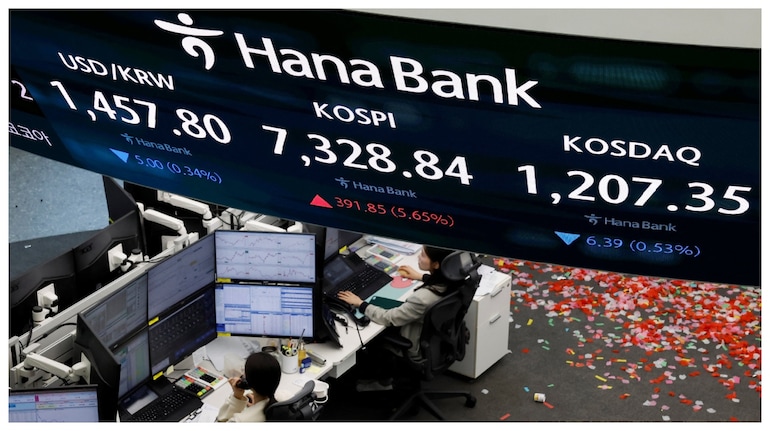
Individual investors net-purchased 2.626 trillion won, while institutional investors added 1.915 trillion won in net buys. This combined 4.5 trillion won defense effectively absorbed the foreign sell-off, preventing further volatility. Analysts at Shinhan Investment Corp. noted that while the index recovered, the intensity of the foreign sell-off indicates that market sentiment remains fragile.
The rapid shift in market leadership and the massive divergence between foreign selling and domestic buying highlight a period of heightened sensitivity. While the rebound is technically supported by bargain hunting, the underlying fragility suggests that investors should prioritize portfolio diversification to mitigate risks associated with sudden, large-scale capital outflows.
KOSDAQ Performance and Biotechnology Gains
The KOSDAQ index followed the KOSPI’s upward trend, closing at 909.31, a 2.00% rise. Institutional buying was the primary force behind this growth, with institutions purchasing 334.5 billion won in shares. In contrast, both individual and foreign investors were net sellers in the KOSDAQ market.
Biotechnology stocks led the gains on the index. Alteogen surged 11.56%, acting as a catalyst for other sector performers, including HLB at 5.89% and Kolon TissueGene at 6.20%. Despite the overall positive momentum, some technology-related stocks, such as Jusung Engineering, saw minor declines of 0.98%.
Future Market Outlook
Market analysts interpret the current movement as a technical rebound following the previous day’s extreme volatility. While the AI and semiconductor growth cycle remains a central theme, the speed at which market sentiment shifted—changing the top market cap position in 24 hours—suggests that volatility could persist. Investors are advised to monitor for continued swings and avoid over-concentration in specific large-cap stocks as the market adjusts to the massive foreign liquidity shifts.

Frequently Asked Questions
What caused the KOSPI to rise on June 24?
The index rose 3.26% primarily due to strong institutional and individual buying, which absorbed a 4.655 trillion won sell-off by foreign investors. Samsung Electronics’ 9.84% rebound also played a significant role in the recovery.
Which sectors led the recovery on the KOSDAQ?
The biotechnology sector was the primary driver of the KOSDAQ’s 2% gain. Key stocks like Alteogen, HLB, and Kolon TissueGene recorded significant increases, supported by institutional net-buying.
Why is there caution regarding future market stability?
Analysts point to the record-level foreign selling as a potential ongoing burden. Because market leadership changed so rapidly, there is a risk of continued short-term volatility and concerns over investor sentiment becoming overly concentrated in specific large-cap stocks.
How do you plan to adjust your investment strategy given the recent market volatility?