
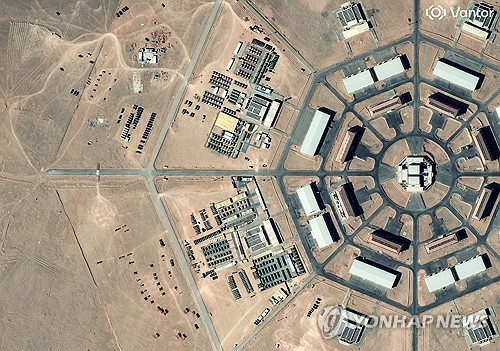
Satellite Imagery Reveals China Expanding Nuclear Missile Infrastructure in Xinjiang
China’s Desert Fortresses: The Strategic Shift in Global Nuclear Deterrence
Recent satellite imagery has pulled back the curtain on a massive military expansion in the deserts of Northwest China. In the Hami region of the Xinjiang Uyghur Autonomous Region, a sprawling network of missile launchers, armored bunkers, and advanced communication nodes is emerging. This isn’t just a routine base upgrade. it is a signal of a fundamental shift in how China views its strategic survival.
The discovery of over 80 launch pads and distinctive octagonal military facilities suggests that Beijing is moving toward a more resilient, diversified nuclear posture. For global security analysts, this raises a critical question: Is the world entering a new, more volatile era of the nuclear arms race?
The Pivot to ‘Survivable’ Nuclear Arsenals
For decades, nuclear strategy relied heavily on static silos—deep underground tubes that house Intercontinental Ballistic Missiles (ICBMs). While powerful, silos are “sitting ducks” if their coordinates are known to an enemy. The new infrastructure in Xinjiang suggests a pivot toward hybrid survivability.

By integrating mobile missile launchers with fixed silos, China is creating a “shell game” for adversary intelligence. If a significant portion of the arsenal is mobile or hidden in armored bunkers across thousands of square kilometers of desert, it becomes nearly impossible for an opponent to neutralize the entire force in a single preemptive strike.
This trend mirrors historical shifts seen during the Cold War, where the U.S. And Soviet Union moved toward “triad” systems—combining land-based missiles, submarine-launched missiles, and strategic bombers to ensure that no single attack could wipe out their retaliatory capacity.
Understanding ‘Second-Strike Capability’
At the heart of this expansion is the concept of Second-Strike Capability. In simple terms, this is the ability of a country to absorb a massive nuclear attack and still possess enough firepower to retaliate and destroy the attacker.
When a nation possesses a guaranteed second-strike capability, it creates a state of Mutual Assured Destruction (MAD). This paradoxically acts as a stabilizer; if both sides know that attacking first results in total annihilation, neither side is likely to pull the trigger.
The construction of communication nodes and bunkers in the Hami region is designed to protect the “brain” of the operation. Without secure command-and-control (C2) infrastructure, the missiles are useless. By hardening these nodes, China is ensuring that its leadership can authorize a counter-attack even after a primary strike.
The Geopolitical Chessboard: Taiwan and Beyond
While these facilities are located deep in the interior, their strategic purpose is often linked to coastal tensions. Many analysts argue that a strengthened nuclear deterrent is a tool to prevent external intervention—specifically from the United States—during a potential conflict over Taiwan.
By projecting a “nuclear umbrella” that is too risky to penetrate, Beijing may hope to discourage foreign powers from intervening in regional disputes. This “nuclear coercion” strategy aims to create a sanctuary where China can pursue its regional goals without fear of a direct superpower confrontation.
Data from the U.S. Department of Defense supports this trajectory, with projections suggesting China could possess as many as 1,000 nuclear warheads by 2030. This rapid scaling is unprecedented in the history of nuclear proliferation.
The End of Secrecy: The Age of Satellite Intelligence
One of the most fascinating trends in modern warfare is the democratization of intelligence. In the past, only superpowers had the satellites to monitor these sites. Today, private companies like Planet Labs and Vantor provide high-resolution imagery that allows journalists and independent analysts to track construction in real-time.
This transparency creates a new kind of instability. When a nation’s “secret” deterrent is exposed via satellite, it may feel pressured to accelerate deployment or change its strategy, leading to a cycle of rapid escalation. The “cat-and-mouse” game has moved from the ground to the thermosphere.
For more on how satellite imagery is changing modern warfare, check out our analysis on the rise of open-source intelligence (OSINT).
Frequently Asked Questions
What is a missile silo?
A missile silo is a vertical cylindrical structure built underground to house an ICBM. It protects the missile from environmental elements and provides some shielding against enemy attacks.
Why is China building these in the desert?
The vast, remote terrain of Xinjiang provides natural cover and distance from borders, making it an ideal location for strategic assets that need to be hidden and protected.
Does this mean a nuclear war is imminent?
Not necessarily. Most military experts view this as “deterrence building.” The goal is typically to prevent war by making the cost of aggression prohibitively high, rather than preparing for an immediate attack.
For further reading on international security, visit the Arms Control Association to track global treaty compliance and warhead counts.