
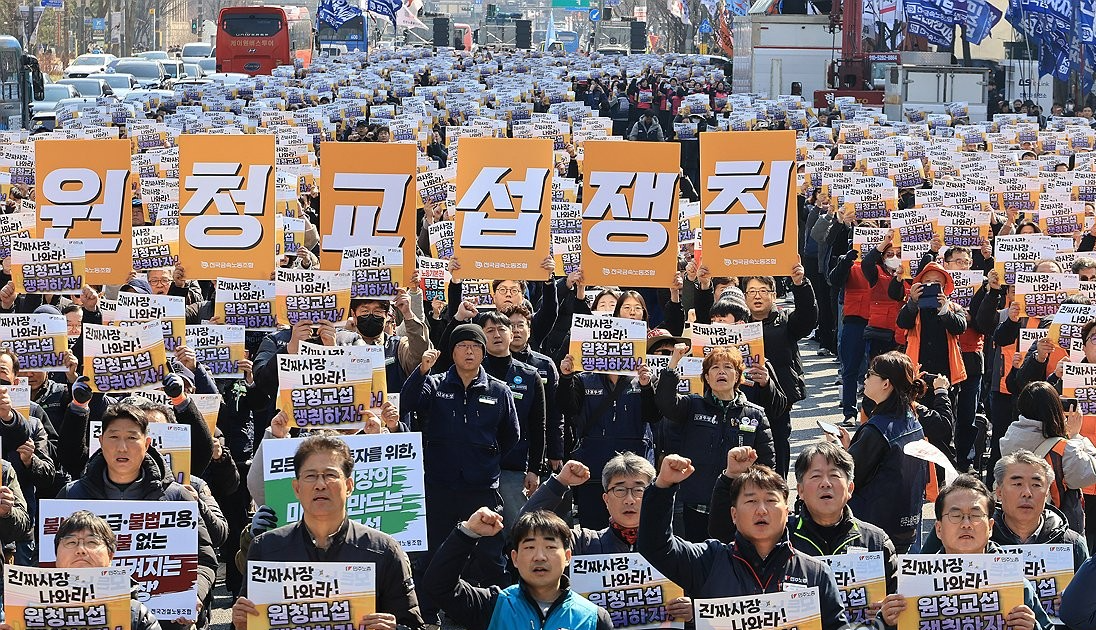
South Korea Eyes Replacement Labor Law Amid Wave of Union Strikes
A wave of coordinated labor strikes is set to hit South Korea, beginning with the metropolitan ready-mixed concrete transport union and the Kakao union. These industrial actions occur as political tensions rise over the “Yellow Envelope Law” and the legal boundaries of replacement labor during strikes.
Critical Infrastructure and Tech Sectors Under Pressure
The metropolitan ready-mixed concrete transport union has announced a suspension of operations starting on the 8th. This action is particularly significant as it directly impacts the construction sites of national core semiconductor production plants, including those operated by Samsung and SK.
There are concerns that this disruption could potentially expand into a broader semiconductor supply chain issue, mirroring tensions seen during previous strikes at Samsung Electronics.
Simultaneously, the Kakao union is preparing for the first headquarters strike in the company’s history. Scheduled for the 10th, the action will include a four-hour partial strike and a street march around Pangyo Station starting at 10:00 AM.
Expanding Labor Unrest
The volatility extends beyond these two sectors. The Samsung Biologics union continues its “compliance struggle” and autonomous negotiations over wage increases and performance bonus system improvements. Because the gap between management and labor remains wide, further industrial action is a possibility.
Adding to the tension, the Korean Confederation of Trade Unions (KCTU) has announced a general strike scheduled for July 15, intensifying fears of a wider industrial conflict.
The Legislative Push for Replacement Labor
In response to the current climate, legislation is being proposed to supplement the “Yellow Envelope Law” (the revised Trade Union Act Articles 2 and 3). These proposed bills, led by opposition parties, aim to allow replacement labor to perform duties during strike periods.
Academic and business leaders argue that such measures are necessary “safety devices” to balance the expanded powers granted to unions under the Yellow Envelope Law. Professor Park Ji-soon of Korea University School of Law emphasized that allowing replacement labor is critical in sectors like construction, railways, and hospitals to prevent major accidents caused by a lack of safety personnel.
Potential Future Scenarios
- Supply Chain Disruptions: If the concrete transport strike persists, the construction of critical semiconductor facilities may face delays, which could impact the broader tech supply chain.
- Escalation of Tech Strikes: Depending on the outcome of negotiations, the Kakao union may increase the intensity of its strike actions beyond the initial partial strike.
- Legislative Shift: The passage of supplementary legislation could fundamentally alter the balance of power in labor disputes by granting employers a “minimum right of defense” through replacement labor.
Frequently Asked Questions
Which key industrial sites are at risk due to the concrete transport strike? The strike directly affects national core semiconductor production plant construction sites, specifically those involving Samsung and SK. What are the specifics of the Kakao union’s planned action? The union plans a four-hour partial strike and a street march in the Pangyo Station area starting at 10:00 AM on the 10th. What is the primary goal of the proposed legislative supplements to the Yellow Envelope Law? The proposed legislation seeks to allow the use of replacement labor during strikes to ensure the continuity of essential services and prevent safety accidents in critical sectors. Do you believe allowing replacement labor is a necessary safety measure for critical infrastructure, or does it undermine the fundamental right to strike?