
Spatial Transcriptomic Profiling of Alzheimer’s Disease Pathology in Human Brain Tissues
A comprehensive study of postmortem human brain tissue has provided a detailed look at the cellular changes associated with Alzheimer’s disease. Researchers analyzed 56 individuals from the Netherlands Institute for Neuroscience and the Dutch 100-plus Study to map how specific protein buildups correlate with gene expression and cognitive health.
Mapping the Architecture of Disease
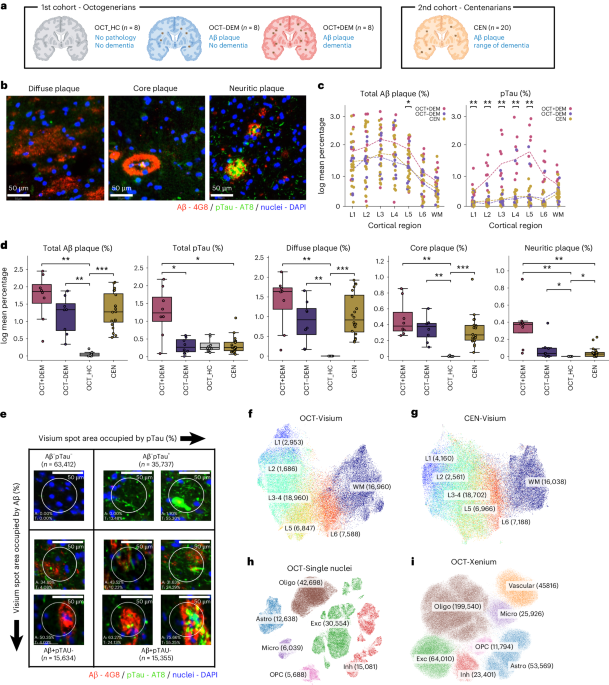
The study focused on the superior frontal gyrus, examining samples from cognitively normal individuals and those with varying degrees of cognitive impairment. By utilizing advanced techniques such as single-nuclei RNA sequencing and spatial transcriptomics, the team was able to observe how amyloid-beta plaques and phosphorylated tau (pTau) proteins distribute within the brain’s cortical layers.
A key finding involves the morphological differences in pTau protein accumulation. In individuals with cognitive impairment, pTau was strongly associated with neurofibrillary tangles and dystrophic neurites near amyloid plaques. In contrast, cognitively healthy individuals displayed a more diffuse, soma-localized pattern of pTau, suggesting that the structural nature of these protein deposits is a critical factor in how the brain functions.
The Significance of Cellular Trajectories
Understanding these cellular trajectories is essential for identifying why some brains show significant pathology without corresponding cognitive decline. The data revealed that while amyloid-beta plaque density was high across all study groups with pathology, the presence of neuritic plaques was significantly higher in those with cognitive impairment.

This distinction underscores that the mere presence of protein aggregates may not be the sole driver of dementia. The way these proteins interact with local gene expression profiles—which were found to differ substantially between individuals with and without dementia—points toward a complex, localized response to disease progression.
What Lies Ahead
Future research may build upon these findings to further refine how we categorize the stages of Alzheimer’s disease. By applying the predictive models developed in this study to broader datasets, scientists could potentially improve the accuracy of identifying which pathological patterns are most likely to lead to cognitive decline.
the identification of specific gene co-expression networks associated with different types of plaques may offer new avenues for investigating how cells respond to the environment created by these aggregates. These insights could eventually inform the development of more targeted diagnostic or therapeutic strategies that focus on the specific biological mechanisms active in the early stages of the disease.
Frequently Asked Questions
What criteria were used to select the study participants?
The study selected 56 individuals with an RNA integrity number above 6.8, ensuring high-quality tissue for analysis. Participants included healthy controls, individuals with mild-to-severe amyloid-beta and tangle deposition, and a cohort of centenarians.
How were the different types of amyloid plaques classified?
Plaques were identified as core plaques, characterized by a compact central core and a diffuse halo, or as diffuse plaques, which were defined as sharply delineated aggregates without a core. All other ill-defined or anatomically specific aggregates were labeled as unclassified.
Did the researchers find a difference in plaque density between cognitively normal and impaired individuals?
While amyloid-beta plaque density was significantly higher in all pathology groups compared to healthy controls, there was no significant difference in total plaque load between the pathology groups themselves. However, individuals with cognitive impairment had significantly more neuritic plaques than those without.
How might these findings change the way we approach the study of brain aging in the future?