
Taiwan Conflict: The Dangerous Economic Blind Spot for the EU
A Chinese military drone flight over Pratas Island on January 17 has intensified European concerns over Taiwan’s security and global economic stability. According to Bloomberg Economics, a conflict between the U.S. and China over Taiwan could cost the EU economy $2 trillion in the first year, with Germany’s GDP potentially shrinking by 14%.
The incident occurred just before dawn when a Chinese reconnaissance aircraft entered Taiwanese airspace over a disputed coral reef in the South China Sea. Taipei described the maneuver as “provocative and irresponsible,” while Beijing characterized the flight as a “normal” training mission. European officials view this as a “grey zone” tactic—actions that stop short of war but gradually erode Taiwanese control over its territory.
Why the Pratas Island incident signals a shift in strategy
The flight over Pratas Island, located 440 kilometers from Taiwan’s southern tip, represents a calculated escalation. Marcin Jeżewski, head of the European Centre for Values in Security Policy in Taipei, describes Taiwan as a “dangerously blind spot” for the European Union.
These maneuvers allow China to test boundaries without triggering a full-scale military response. European officials worry that if these incursions remain unchallenged, they provide a blueprint for Beijing to eventually force a unification with the mainland.
How a Taiwan conflict would impact EU economies
The economic fallout of a U.S.-China war over Taiwan would likely exceed the damage caused by the 2009 financial crisis or the Covid-19 pandemic. Bloomberg Economics projects a global GDP contraction of over 8%.
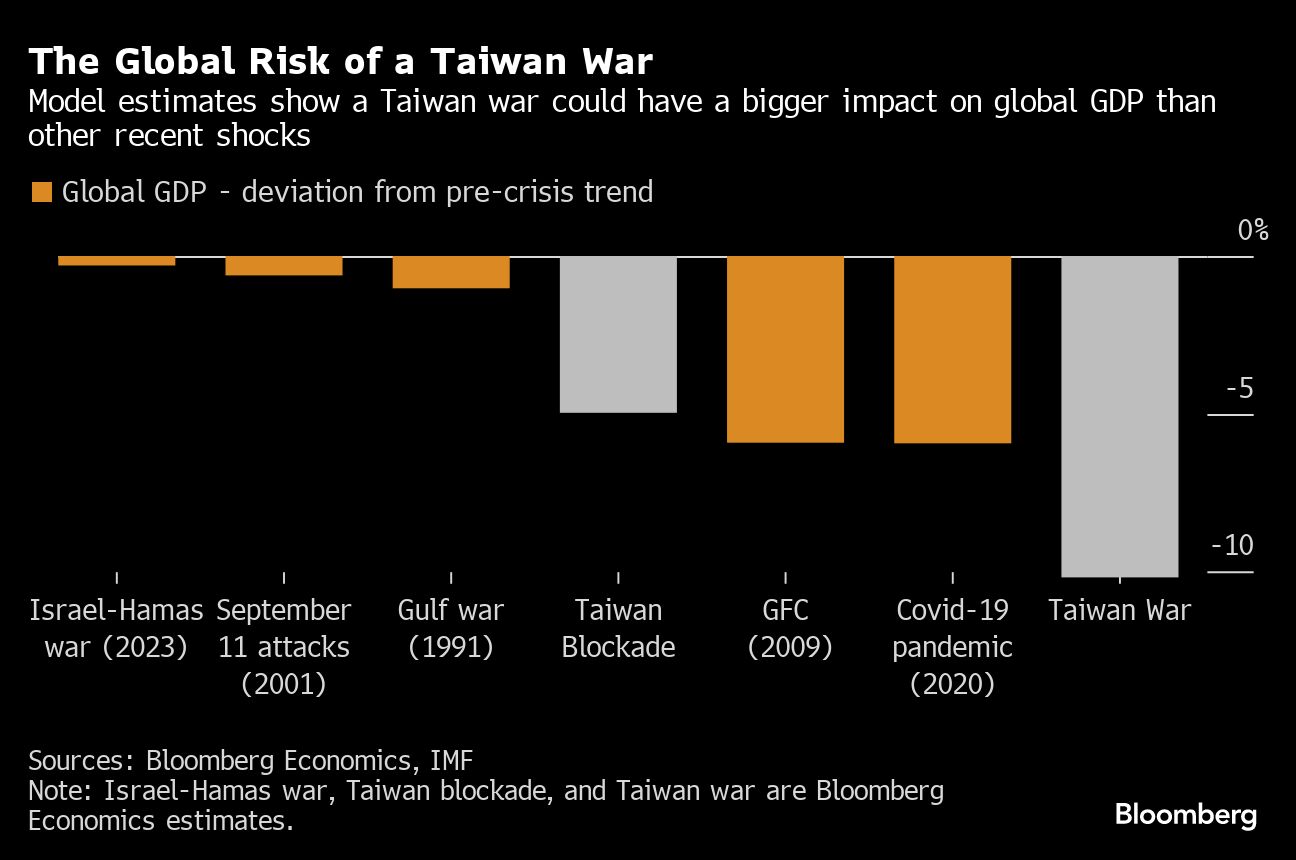
The impact would be uneven across Europe, hitting manufacturing hubs the hardest. Germany faces the steepest decline due to its heavy reliance on Taiwanese semiconductors and Chinese rare earth elements. The projected GDP drops include:
- Germany: 14% decrease
- Italy: 8.8% decrease
- Spain: 7% decrease
- France: 6.5% decrease
This disparity shows that while the U.S. may dictate the geopolitical rules, Europe often pays the highest economic price. This mirrors previous tensions involving U.S. actions toward Iran, where European markets bore significant brunt.
What happens if U.S. support for Taiwan wavers?
Taipei has traditionally relied on Washington as its primary security guarantor. However, recent political shifts have created anxiety in both Taipei and Brussels. Donald Trump has expressed a desire to restore ties with President Xi Jinping, leading to fears that Beijing may receive a “green light” for further incursions.
While Defense Secretary Pete Hegseth maintains that U.S. policy remains unchanged, other factors suggest vulnerability. U.S. weapon stockpiles were significantly depleted during the conflict with Iran. Meanwhile, China continues to invest heavily in its military, narrowing the gap with American capabilities.
Trump’s suggestion that he might discuss arms sales for Taiwan directly with Xi Jinping has caused particular alarm, as it treats Taiwanese security as a bargaining chip rather than a strategic constant.
Why is the EU struggling to form a unified Taiwan strategy?
The EU’s internal structure makes a cohesive response difficult. Reaching a consensus among 27 member states with diverging interests often leads to paralysis. Some member states are more inclined to align with Beijing’s position to protect trade interests.
Cyprus, serving as the bloc’s rotating chair until next month, has routinely vetoed discussions on Taiwan. According to sources familiar with the matter, Cyprus fears that supporting Taiwan could set a precedent that affects its own territorial disputes with Turkey.
The role of Taiwan in AI and European re-industrialization
Beyond security, Taiwan is a critical economic engine for Europe’s future. The EU is currently Taiwan’s largest source of foreign direct investment and its fifth-largest trading partner.

Taiwan is positioning itself as a non-Chinese supply chain for high-tech defense goods, including advanced drones. Foreign Minister Lin Chia-lung recently told European audiences that the island is an “irreplaceable partner” for Europe’s efforts to re-arm and re-industrialize.
As the world moves toward an AI-driven economy, the EU’s dependence on Taiwanese silicon makes the island’s stability a matter of European national security, regardless of the distance.
Frequently Asked Questions
What happened at Pratas Island on January 17?
A Chinese military drone flew into Taiwanese airspace over the Pratas Island coral reef for several minutes, prompting warnings from Taipei.
How would a Taiwan conflict affect the global economy?
According to Bloomberg Economics, global GDP would shrink by over 8%, which is more severe than the impacts of the 2009 financial crisis and the Covid-19 pandemic.
Why is Germany more at risk than France or Italy?
Germany’s economy is more heavily dependent on Taiwanese semiconductors and Chinese rare earth elements for its industrial manufacturing.
Does the EU provide military support to Taiwan?
No. While the EU is a major investor and trading partner, Taiwan relies on the United States for military defense and arms.
Do you think the EU should take a more active role in Taiwan’s security, or should it remain focused on economic ties?
Share your thoughts in the comments below or subscribe to our newsletter for deep dives into global geopolitical risks.