
The Capability Of CSST In Characterizing Planetary Atmospheres. I. Transmission Spectroscopy Of Hot Jupiters
The Chinese Space Station Telescope (CSST) will characterize exoplanet atmospheres by detecting atomic species and metal-bearing molecules in the ultraviolet and optical ranges. According to a study by Zibo Liu et al. accepted for publication in The Astrophysical Journal, the CSST provides complementary data to the James Webb Space Telescope (JWST) by probing wavelength ranges where infrared telescopes are less sensitive.
How does the CSST compare to the Hubble Space Telescope?
The CSST is expected to achieve atmospheric constraints comparable to, or slightly weaker than, the Hubble Space Telescope (HST). Zibo Liu and colleagues found that this performance depends heavily on the noise level and the specific observing strategy used.
The researchers simulated slitless spectroscopic observations of hot gas planets across the ultraviolet-to-near-infrared range. They determined that multi-band observations using three wavelength channels—with two transits each—can place meaningful constraints on key atmospheric parameters. However, the study notes that these results vary when accounting for correlated “red” noise, which can impact the accuracy of the data.
What makes the CSST different from the James Webb Space Telescope?
While the JWST specializes in infrared sensitivity to detect molecular species, the CSST focuses on the UV and optical spectrum. This difference allows the two telescopes to work as a pair rather than competitors.
According to the paper, the CSST will provide unique constraints on:
- Atomic species: Elements that are more easily detected at shorter wavelengths.
- Metal-bearing molecules: Chemical compounds that leave signatures in the UV/optical range.
- Scattering processes: Physical properties of the atmosphere that affect how light bounces or disperses.
By combining CSST’s optical data with JWST’s infrared data, astronomers can build a more complete profile of a planet’s thermal properties and chemical makeup.
How will the CSST identify exoplanet chemical compositions?
The telescope uses a process called atmospheric retrieval. Researchers generate theoretical spectra of hot gas planets and compare them against simulated CSST data to see if the telescope can accurately recover the input parameters.
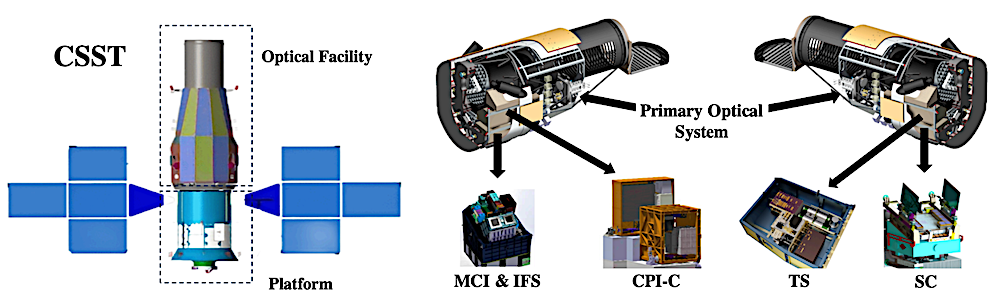
The CSST’s design includes a primary optical system and five scientific instruments: the SC, MCI, IFS, CPI-C, and TS. The SC (Survey Camera) is particularly vital, as it is planned for wide-field and deep-field surveys covering thousands of square degrees of the sky.
What are the technical specifications of the CSST mission?
The CSST is designed for versatility. Its platform can rendezvous and dock with the Chinese Space Station (CSS) for on-orbit servicing, a feature that extends the operational life of the hardware.
The telescope’s survey strategy includes:
- A 17,500 deg2 wide-field survey.
- A 400 deg2 deep-field survey.
- Priority observations in areas previously surveyed by the Euclid mission.
- Specific focus on the Galactic bulge for microlensing observations.
This broad coverage ensures that the telescope doesn’t just look at a few targets, but maps a significant portion of the sky to find new candidates for atmospheric study.
Frequently Asked Questions
What is transmission spectroscopy?
It is a method of studying a planet’s atmosphere by measuring the light from a star that passes through the atmosphere during a transit. Different gases absorb different wavelengths of light, revealing the atmosphere’s composition.
Can the CSST find life on other planets?
The study focuses on “hot gas planets” and their chemical compositions. While it helps identify the building blocks of atmospheres, the current research emphasizes chemical and physical constraints rather than direct biosignature detection.
Why is UV and optical light important?
Some atoms and molecules don’t leave strong signatures in the infrared range. UV and optical observations are necessary to see these specific species, which provides a fuller picture of the planet’s chemistry.
What do you think about the coordination between the CSST and JWST? Share your thoughts in the comments below or subscribe to our newsletter for more space exploration updates.