
The Joshua Cache: Mysterious Discovery of Ancient Stone Tools in Ohio
The Joshua Cache: How a Chance Discovery is Rewriting Ohio’s Archaeological Playbook
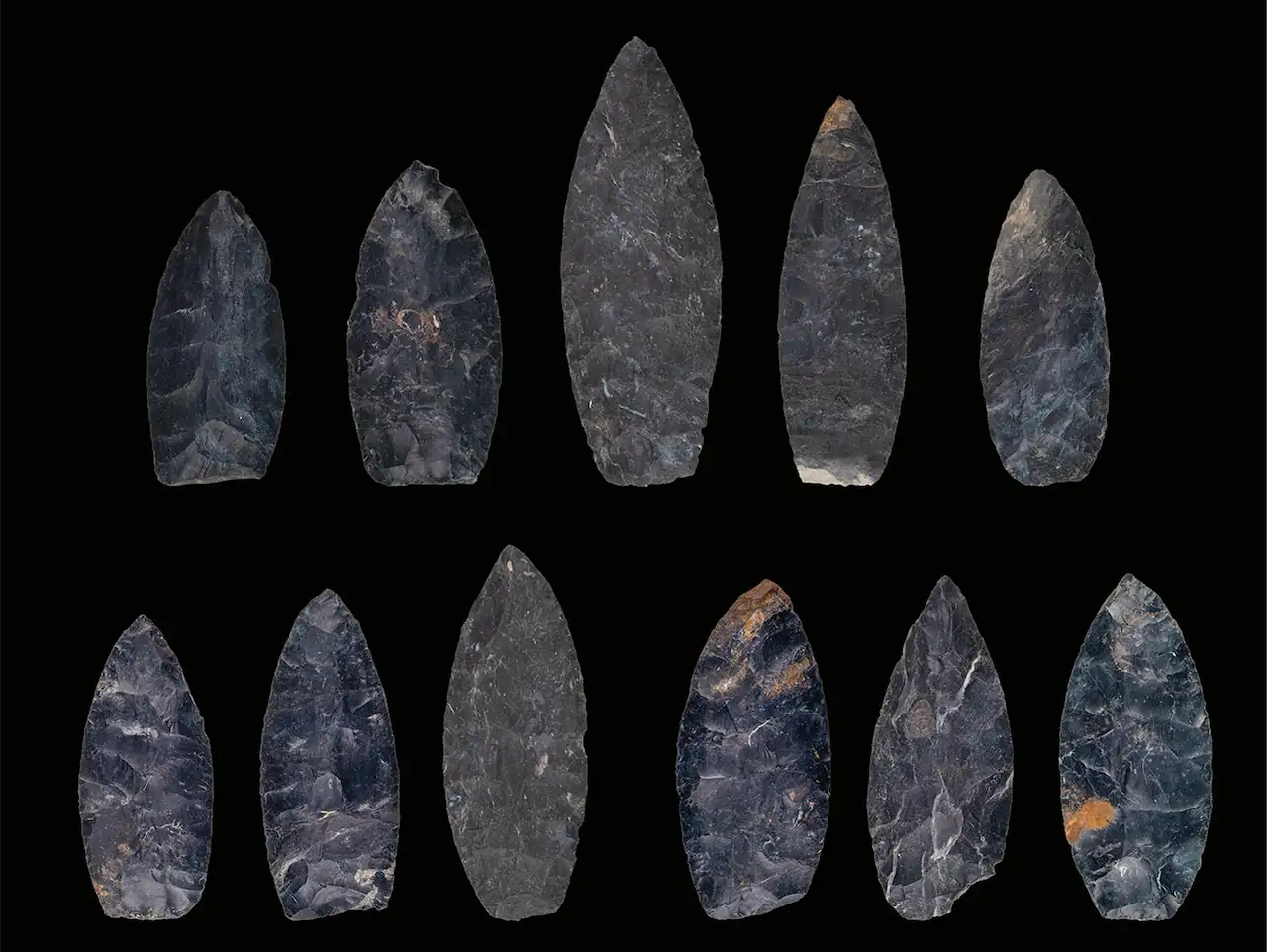
In early 2021, while exploring a construction site near a golf course pond in Sugarcreek, Ohio, 11-year-old Joshua Fetter stumbled upon something that would eventually captivate the scientific community. What began as a casual afternoon of hunting for stray golf balls turned into the discovery of the “Joshua Cache”—a collection of eleven masterfully crafted stone bifaces that are now challenging how we understand ancient North American tool-making.
Following five years of rigorous analysis by researchers at Kent State University, the findings—published in the Journal of Archaeological Science: Reports—highlight both the brilliance of prehistoric craftsmanship and the inherent difficulties of modern archaeology.
The Mystery of the Unused Tools
At first glance, these leaf-shaped stone tools appear to be lethal hunting implements. However, microscopic “micro-wear” analysis tells a different story. The absence of edge damage or striations suggests that these bifaces were never used for cutting, scraping, or as projectiles. Instead, the tools were likely transported and cached as a pristine collection.

The Joshua Cache tools were crafted from “Upper Mercer” chert, a high-quality stone that likely originated from an outcrop over 40 kilometers away. This suggests that ancient people were highly mobile and valued specific, high-quality materials for their toolkits.
The Dating Dilemma: Science vs. Site Disturbance
Archaeologists face a significant hurdle when sites are disturbed by modern machinery. While radiocarbon dating of charcoal found near the artifacts pointed to the European Middle Ages, researchers remain skeptical. The site’s prior leveling for residential development likely shifted the sediment, potentially mixing modern organic matter with ancient artifacts.
By using geometric morphometrics—a method of analyzing shape mathematically—researchers compared the Joshua Cache to over 300 other known artifacts. The data points strongly toward the Early Woodland period, specifically the Adena culture, which thrived in Ohio between 2,500 and 1,900 years ago.
Future Trends in Archaeological Discovery
The Joshua Cache serves as a case study for the future of “salvage archaeology.” As urban expansion continues, more sites will inevitably be uncovered by non-professionals. The partnership between the Fetter family and Kent State University experts like Metin I. Eren and Michelle R. Bebber sets a gold standard for how the public can contribute to scientific discovery.

- Citizen Science: The role of amateur enthusiasts in identifying potential sites before construction destroys them is becoming critical.
- Non-Invasive Tech: Portable X-ray fluorescence (pXRF) is becoming the industry standard for identifying the chemical signatures of stone tools without damaging them.
- Digital Preservation: Museums are increasingly shifting toward 3D modelling and digital archives, ensuring that artifacts like the Joshua Cache are preserved for global research, even if the original site is lost.
If you find a potential artifact, do not move it. Document the location with photos and GPS coordinates, then contact your local university’s archaeology department or state historical society. Context is everything in archaeology; moving an object can destroy the “story” it holds.
Frequently Asked Questions (FAQ)
- Why are these tools called “bifaces”?
- A biface is a stone tool that has been flaked on both sides, creating a sharp edge. They are often considered “preforms” or intermediate stages in the creation of more specialized tools like arrowheads or knives.
- Where can I see the Joshua Cache?
- The collection has been donated to the Cleveland Museum of Natural History, where it will be preserved for future study and public exhibition.
- Why couldn’t researchers definitively date the site?
- The site was compromised by construction equipment. Because the earth had been moved and leveled, the relationship between the charcoal samples and the stone tools could not be verified, forcing scientists to rely on stylistic comparisons instead.
Have you ever discovered something unusual while hiking or gardening? Share your story in the comments below or subscribe to our newsletter for more deep dives into the hidden history beneath our feet.