
The Mass of TOI-1883 b: A Low Density Super-Neptune In The Ridge Regime Transiting An Early-M dwarf
Astronomers using the Subaru Telescope’s InfraRed Doppler (IRD) instrument have identified TOI-1883 b as a low-density super-Neptune orbiting an M-dwarf star. According to the study led by Izuru Fukuda and published in the Publications of the Astronomical Society of Japan (PASJ), the planet’s mass of approximately 13.7 Earth masses suggests a complex history of orbital migration and atmospheric erosion.
Why is the “Neptune Desert” important for finding new worlds?
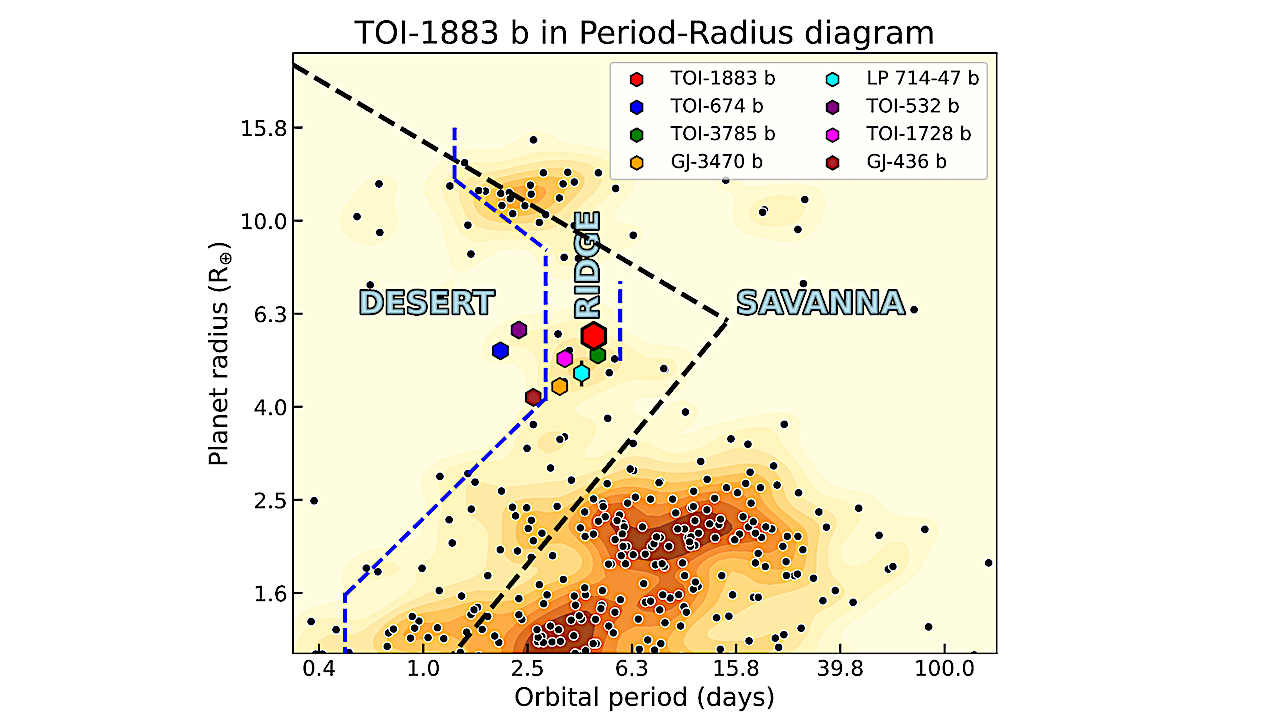
The “Neptune desert” is a region in planetary distribution where few Neptune-sized planets exist close to their stars. For years, this gap was well-documented around FGK-type stars (Sun-like stars). However, the research by Fukuda et al. confirms that M-type stars—smaller, cooler red dwarfs—show a similar deficiency region.
TOI-1883 b sits in the “ridge region” with an orbital period of about 4.51 days. This positioning is a clue. It suggests that while many planets in this zone are stripped of their atmospheres, some manage to survive. By studying these “survivors,” scientists can map the exact boundary where a planet either keeps its gas or becomes a bare rocky core.
How did TOI-1883 b avoid becoming a rocky core?
Most planets this close to an M-dwarf should have lost their envelopes. TOI-1883 b, however, maintains a mean density of 0.4 g cm^-3. The researchers point to the host star’s high metallicity—measured at [Fe/H] = 0.32 +/- 0.18—as a primary reason.

High metallicity in the parent star often means the original protoplanetary disk was rich in heavy elements. According to the study, this chemistry likely suppressed “runaway gas accretion.” Instead of ballooning into a Jupiter-sized giant, the planet stayed a super-Neptune. This size allowed it to survive early photoevaporation without losing its entire atmosphere, leaving us with the low-density world we see today.
What does the TSM score mean for the future of astronomy?
The study highlights a Transmission Spectroscopy Metric (TSM) of over 140 for TOI-1883 b. In plain English: this planet is an ideal candidate for atmospheric sampling. When the planet passes in front of its star, the starlight filters through the planet’s atmosphere, leaving a chemical fingerprint.
With a TSM this high, TOI-1883 b is a prime target for the James Webb Space Telescope (JWST). Future observations will likely focus on detecting water vapor, methane, or carbon dioxide. This will tell us if the planet’s composition matches the “disk-driven migration” theory proposed by Bourrier et al. (2025), which suggests the planet moved from the cold outer reaches of its system to its current scorching orbit.
Comparing M-Dwarf Planets to Sun-like Systems
The discovery changes how we view planetary evolution. In systems orbiting FGK stars, the Neptune desert is a stark divide. In M-dwarf systems, the boundaries are similar, but the drivers differ. M-dwarfs are more active in their youth, blasting their planets with far more XUV radiation than our Sun did.

This means a super-Neptune around an M-dwarf has to be “tougher” or more massive to survive. The fact that TOI-1883 b’s mass exceeds the conventional critical core mass explains why it didn’t simply vanish into a rocky pebble. You can read more about these planetary classifications in our comprehensive guide to exoplanet types.
Frequently Asked Questions
What is a super-Neptune?
A super-Neptune is a planet with a mass significantly higher than Neptune (which is about 17 Earth masses) but smaller than a gas giant like Saturn or Jupiter.
Why are M-dwarf stars targeted for study?
M-dwarfs are the most common stars in the galaxy. Because they are smaller and dimmer, it is easier for telescopes like TESS and Kepler to detect small planets crossing in front of them.
What is disk-driven migration?
This is the process where a planet interacts with the gas and dust disk it was born in, causing its orbit to spiral inward toward the star over millions of years.
Want to stay updated on the search for alien worlds?
From the depths of the Neptune desert to the edges of the habitable zone, we track the discoveries that redefine our place in the cosmos.
Subscribe to Our Space Newsletter
Or join the conversation: Do you think low-density worlds like TOI-1883 b could hold the secrets to planetary formation? Let us know in the comments!