
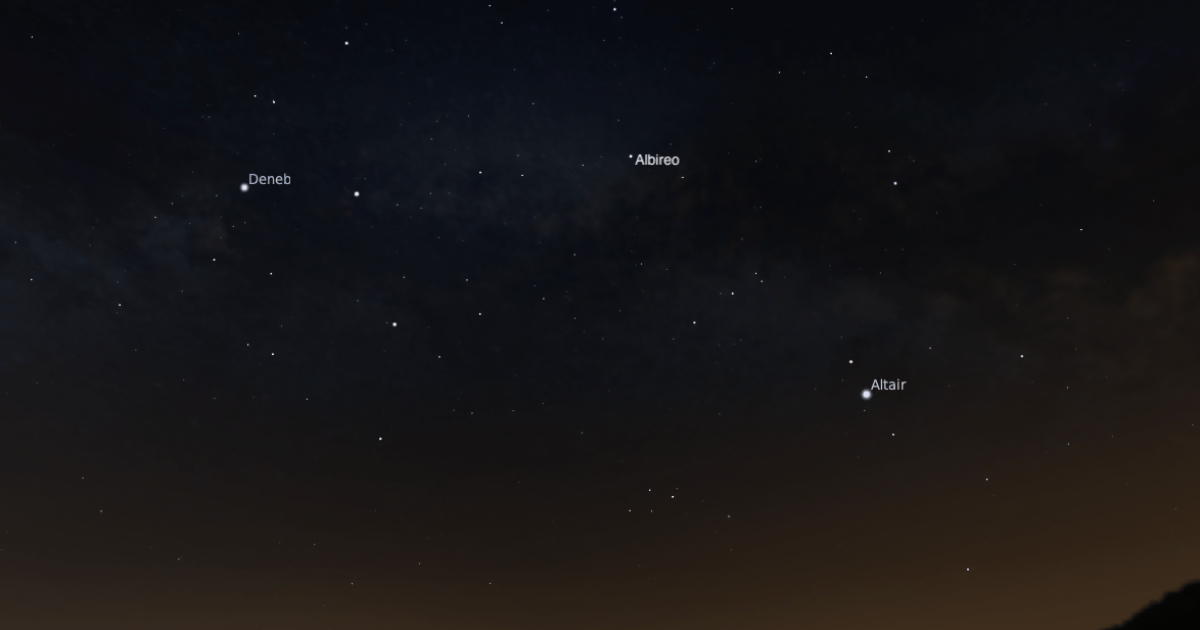
The Sky Today on Saturday, June 6: Albireo returns
The Celestial Dance: Why Albireo Remains an Amateur Astronomer’s favourite Target
For those who look to the night sky, few sights are as rewarding as the double star system Albireo. Located in the constellation Cygnus, the Swan, this stellar pair acts as a perfect gateway for anyone moving from simple stargazing to more detailed telescopic observation. As the Summer Triangle rises to dominate the evening sky, Albireo serves as the “head” of the celestial bird, offering a vibrant, high-contrast spectacle that never fails to impress.
Understanding the Beauty of Beta Cygni
Albireo, formally known as Beta Cygni, is more than just a pinprick of light. To the naked eye, it appears as a single star, but a small telescope or even a pair of well-stabilized binoculars reveals its true nature: a stunning binary system. The primary star, a magnitude 3.1 giant, glows with a distinct yellow-gold hue, while its fainter magnitude 5.1 companion offers a striking blue contrast.
The Future of Amateur Astronomy: Technology Meets Tradition
As we look toward the future of amateur astronomy, the way we engage with objects like Albireo is evolving. The rise of “smart telescopes” and AI-driven image stacking software is allowing hobbyists to capture professional-grade images from their own backyards. These tools help bridge the gap for beginners, making it easier to resolve tight binaries that were once considered challenging targets.
the interest in celestial mechanics continues to grow. Citizen science projects and databases like those maintained by the International Astronomical Union provide a platform for enthusiasts to contribute to our understanding of star systems. Whether Albireo is a true gravitationally bound binary or merely an optical double (a line-of-sight alignment) remains a topic of ongoing discussion, reminding us that there is always more to learn about our universe.
Did You Know?
The Northern Cross, a prominent asterism, is actually contained within the constellation Cygnus. Albireo marks the base of this cross, making it incredibly easy to locate once you have identified the primary stars of the Summer Triangle: Vega, Deneb, and Altair.
Frequently Asked Questions (FAQ)
- Is Albireo a true binary star system?
- While it is widely observed as a pair, astronomers are still debating whether the two stars are physically orbiting each other or if they are simply an optical double appearing close together from our perspective on Earth.
- What is the best equipment to view Albireo?
- You can often split the pair with high-quality, stabilized binoculars, but a small telescope (even a modest 3-inch aperture) will provide the clearest, most vibrant color contrast.
- When is the best time of year to see Albireo?
- Albireo is best observed from June through September when the constellation Cygnus is high in the northern sky during the evening hours.
Join the Conversation
Have you spent an evening tracking down the gold and blue hues of Albireo? We want to hear about your experience! Share your tips for finding the Swan in the night sky or show off your latest astrophotography in the comments below. If you found this guide helpful, consider subscribing to our newsletter for weekly updates on the best celestial events coming to a sky near you.