
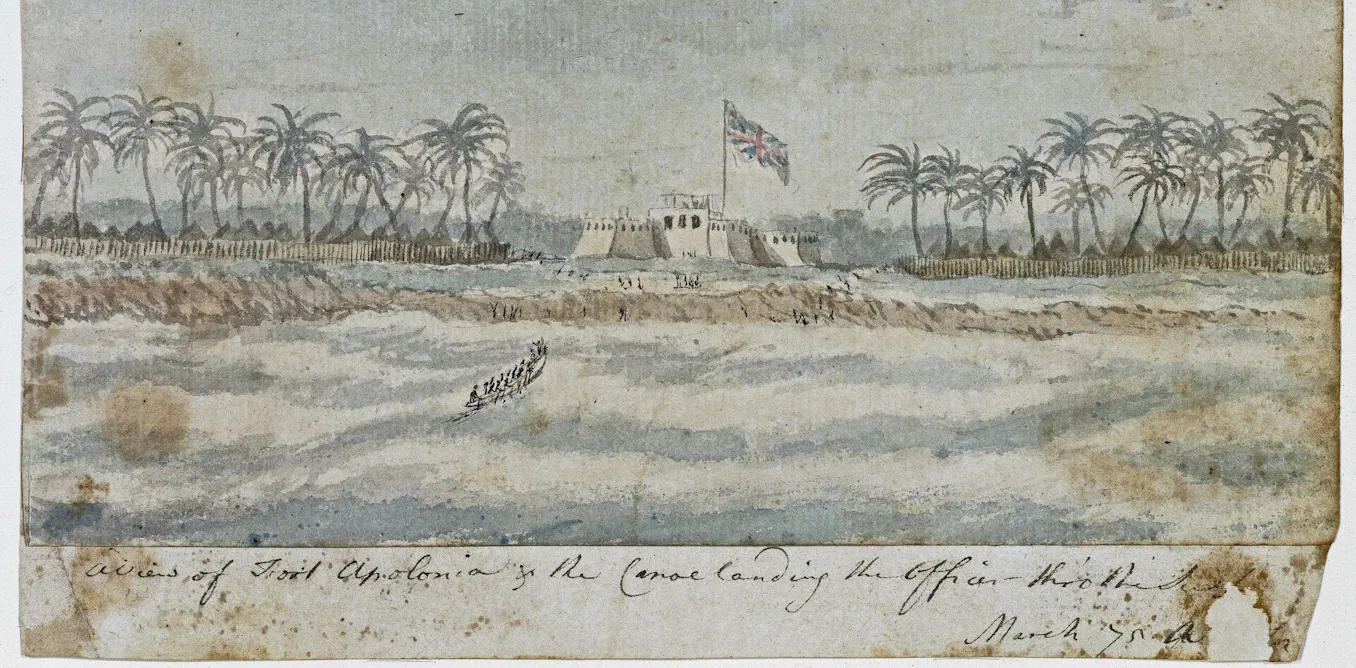
the story of an African kingdom that resisted the Atlantic slave trade
The Kingdom of Appolonia, located in present-day Ghana, exported only 352 enslaved individuals during the transatlantic slave trade, according to research by historian Nana Kesse. This figure represents 0.0028% of total African transports, contrasting sharply with nearby Gold Coast ports like Anomabo, which exported 168,348 people per the SlaveVoyages database.
Why did Appolonia export so few enslaved people?
Appolonia’s minimal participation in the human trade stemmed from a combination of economic priorities and strict social laws. According to Nana Kesse, the kingdom’s economy relied primarily on the trade of gold and ivory rather than captives.
The kingdom also enforced the “amonle covenant,” a sacred ritual that banned the sale of Appolonian subjects. This ritual involved the human sacrifice of royals and the mixing of their blood with a herbal concoction, which rulers and migrants drank as a binding oath. Kesse reports that this covenant cursed anyone who broke the oath, effectively dismantling any internal system for producing enslaved people for sale.
How does Appolonia’s data compare to other Gold Coast ports?
Data from the SlaveVoyages database reveals a massive disparity between Appolonia and its neighbors. While Appolonia functioned as a geographical outlier, other ports in the Gold Coast region became central hubs for the transatlantic trade.

| Port Town | Estimated Population (1700s) | Slave Exports |
|---|---|---|
| Anomabo | 8,750 | 168,348 |
| Cape Coast | ~5,000 | 100,434 |
| Elmina | ~25,000 | 85,636 |
| Appolonia | 15,600–19,600 | 352 |
The contrast is stark. Anomabo exported nearly 20 times its own estimated population. Appolonia, despite having a larger population than Anomabo or Cape Coast, shipped a fraction of the captives. This suggests that high export numbers weren’t simply a result of local population size, but a deliberate economic and political choice by the ruling elites.
What does this mean for the future of historical reparations?
The existence of outliers like Appolonia complicates the legal and moral framework for reparative justice. Most reparations models assume a clear line between a known perpetrator and a known victim. However, the Appolonia case introduces a “grey zone” where identities are lost to time.
Kesse notes that the identities of the 352 victims exported from Appolonia remain unknown. There’s no historical record suggesting the people of Appolonia captured these individuals for resale. This raises a difficult question: should a society that largely resisted the trade be expected to offer reparations for a handful of untraceable victims?
Conversely, the question of whether Appolonia can seek justice from the Europeans who purchased those 352 captives remains an open ethical debate. These complexities don’t diminish the scale of the atrocity, but they suggest that future reparations frameworks may need to move beyond binary narratives to account for the nuanced roles of various African states.
How does this fit into global human rights trends?
The study of Appolonia aligns with a broader global movement to categorize the transatlantic slave trade as a systemic crime. This is underscored by a March 2026 United Nations resolution that officially declared the trade the “gravest crime against humanity.”
By highlighting societies that said “no,” historians can better understand the internal African political mechanisms that resisted commodification. This shifts the narrative from one of universal participation to one of varied responses, where some states leveraged sacred covenants and alternative economies to limit the trade’s reach.
Frequently Asked Questions
Was Appolonia completely free of slavery?
No. According to Nana Kesse, while the kingdom largely resisted the Atlantic slave trade, indigenous African slavery was still practiced within the kingdom.
What was the amonle covenant?
It was a sacred ritual in the Appolonian Kingdom involving human sacrifice and a blood oath that forbade the sale of local subjects and refugees to European traders.
Where is Appolonia located today?
It is located in southwestern Ghana, near the border with Côte d’Ivoire, in a region historically known as the Gold Coast.
Join the Conversation on Historical Justice
Does the existence of historical outliers like Appolonia change how we should approach reparations? We want to hear your perspective.