
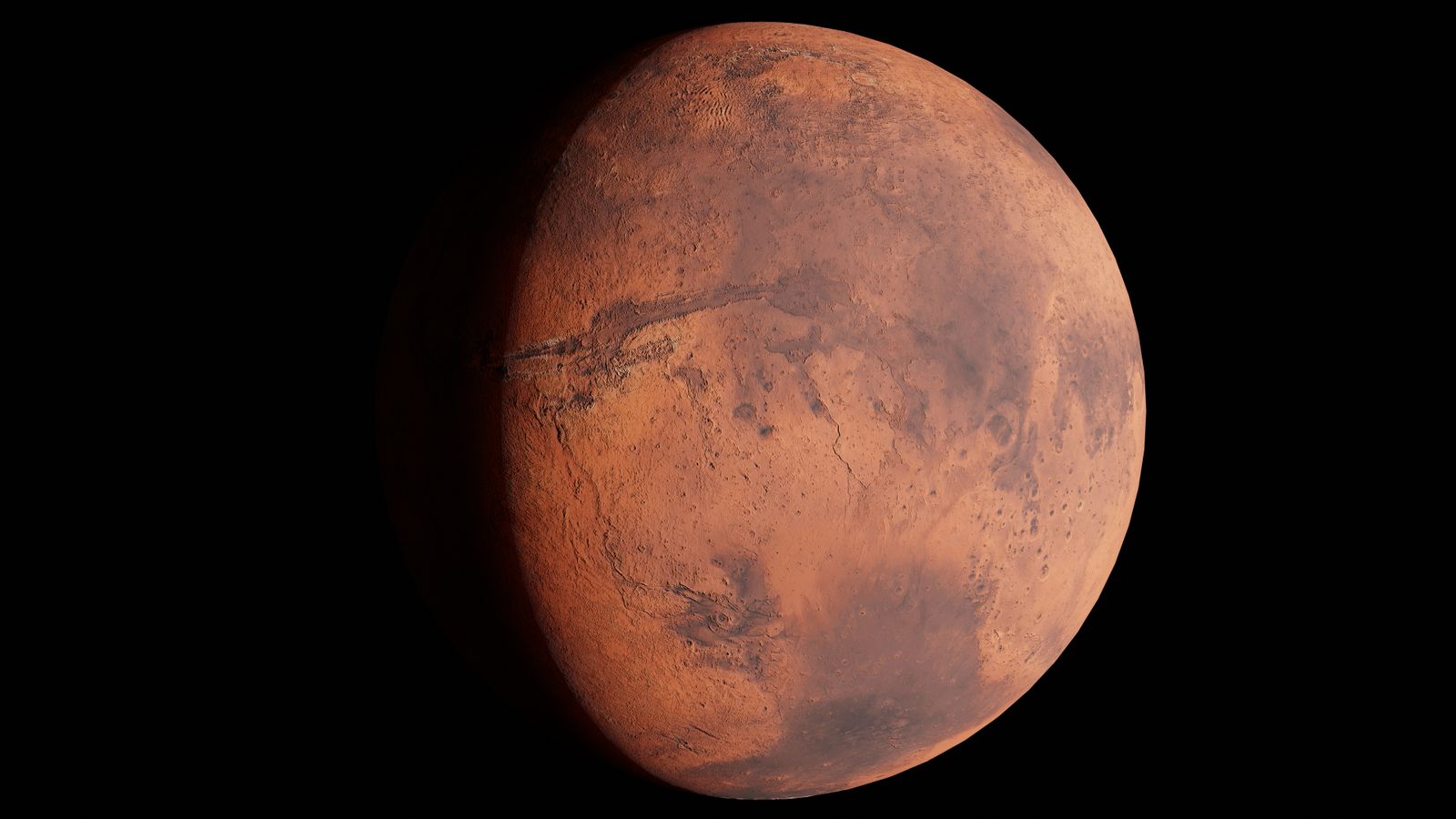
The tallest volcano in the solar system is so wide that from most places on its slopes, you would never see a dramatic summit rising ahead of you – Olympus Mons is broader than some countries, and its gentle flanks curve away with Mars long before the mountain looks like a mountain at all.
Olympus Mons is the solar system’s tallest volcano, standing approximately 22 kilometers high and spanning 600 kilometers across. According to data from Space.com and Astronomy.com, its immense width and gentle slopes mean the summit remains hidden below the Martian horizon for anyone standing on its flanks.
The mountain’s scale dwarfs Earth’s highest peaks. It reaches roughly two and a half times the height of Mount Everest, yet it doesn’t look like a mountain from the ground. Instead, it functions as a massive, gently tilting plain that defeats the human eye.
Why is Olympus Mons so much larger than Earth’s volcanoes?
The size of Olympus Mons stems from the fundamental difference in how Mars and Earth are built. Earth’s crust is divided into tectonic plates that drift over the planet’s hot interior. This movement prevents a volcanic hotspot from staying under one patch of surface for long, creating chains of smaller volcanoes like the Hawaiian islands.
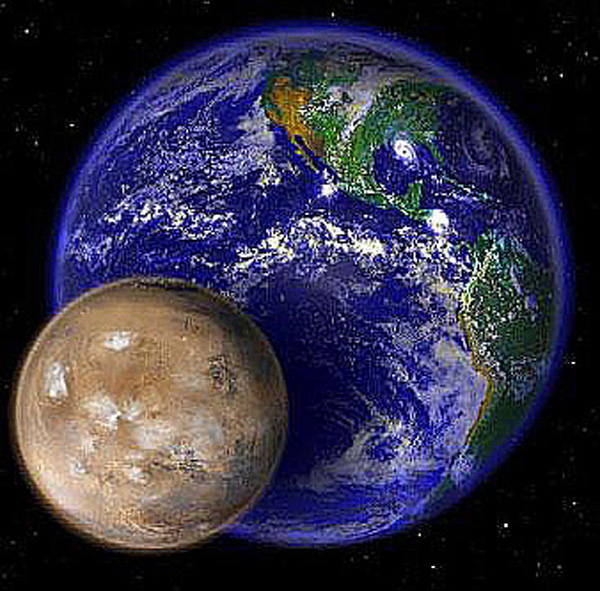
Mars lacks these moving plates, Astronomy.com reports. Its crust remains stationary over internal heat sources. This allows lava to pile up in a single location for millions of years, stacking a colossal shield volcano rather than spreading the output across a chain.
Lower Martian gravity also plays a role. The reduced pull allows piles of rock to stand significantly taller before the structure collapses under its own weight.
How does the scale of the volcano hide it from view?
The mountain’s profile is a “shield” design, created by runny lava flows rather than explosive eruptions. This results in slopes that rise at only a few degrees. Because the mountain is so wide and the slopes so shallow, the curve of the planet actually hides the summit from anyone standing on the flanks.
Mars is smaller than Earth, which brings the horizon closer to the observer. Space.com notes that Olympus Mons is wider than that horizon. A traveler on the slopes wouldn’t see a peak ahead; they’d see a faintly tilted plain stretching into the distance.
Where is the most dramatic terrain on Olympus Mons?
The most vertical terrain isn’t at the top, but at the edge. The volcano is encircled by a steep escarpment—a cliff that reaches several kilometers in height in some areas. This rim marks the point where the gentle flanks end abruptly and drop to the surrounding plains.
At the very summit, the landscape changes again. The top features a complex of overlapping craters, which are the collapsed calderas of past eruptions. These calderas span roughly 80 kilometers across.
Scale Comparison: Olympus Mons vs. Earth’s Peaks
| Feature | Olympus Mons (Mars) | Mt. Everest (Earth) |
|---|---|---|
| Height | ~22 km | ~8.8 km |
| Base Width | ~600 km | Varies (much smaller) |
| Slope Profile | Gentle Shield | Steep Alpine |
What does this mean for future Mars exploration?
The geology of Olympus Mons provides a roadmap for understanding planetary cooling. Because the volcano grew in one spot, it serves as a vertical record of Martian volcanic history. Future missions targeting the rim or the calderas could uncover data on the planet’s interior that isn’t available on the flatter plains.
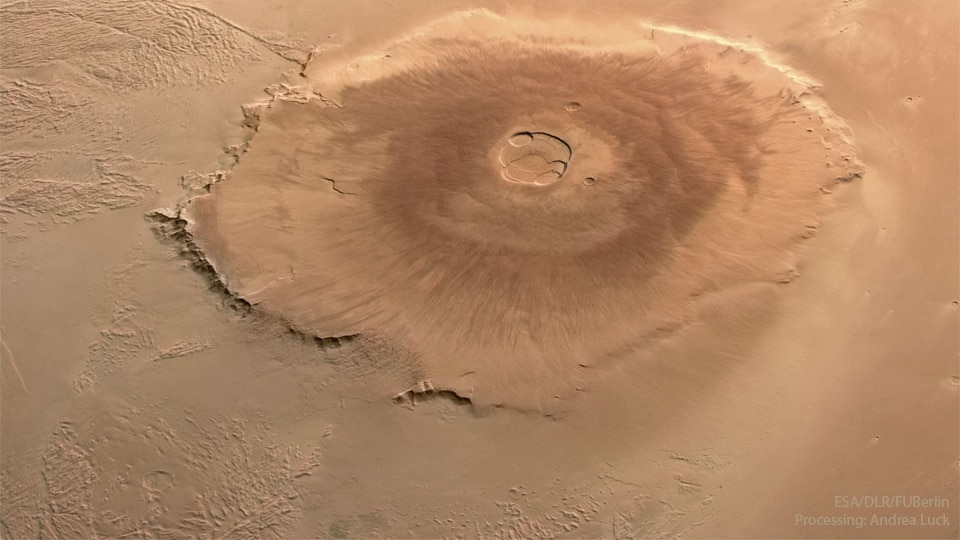
For future astronauts, the “invisible” nature of the mountain presents a navigation challenge. Without orbital data, a ground crew might not realize they’re ascending the largest volcano in the solar system until they hit the massive cliff at the rim.
Frequently Asked Questions
Could a human climb Olympus Mons?
Yes, but it wouldn’t feel like a traditional climb. Most of the ascent is a gentle slope. The most difficult part would be the sheer cliff at the outer rim.
Why isn’t it as steep as Mount Everest?
It’s a shield volcano. According to Space.com, it was built from runny lava that spread out in thin layers rather than the explosive, ash-heavy eruptions that create steeper peaks.
Is Olympus Mons still active?
While it’s the largest volcano in the solar system, there’s no current evidence of active eruptions, though its formation lasted for a vast geological timeframe.
Want to explore more of the Red Planet? Share your thoughts on Martian exploration in the comments below or subscribe to our newsletter for the latest space discoveries.