
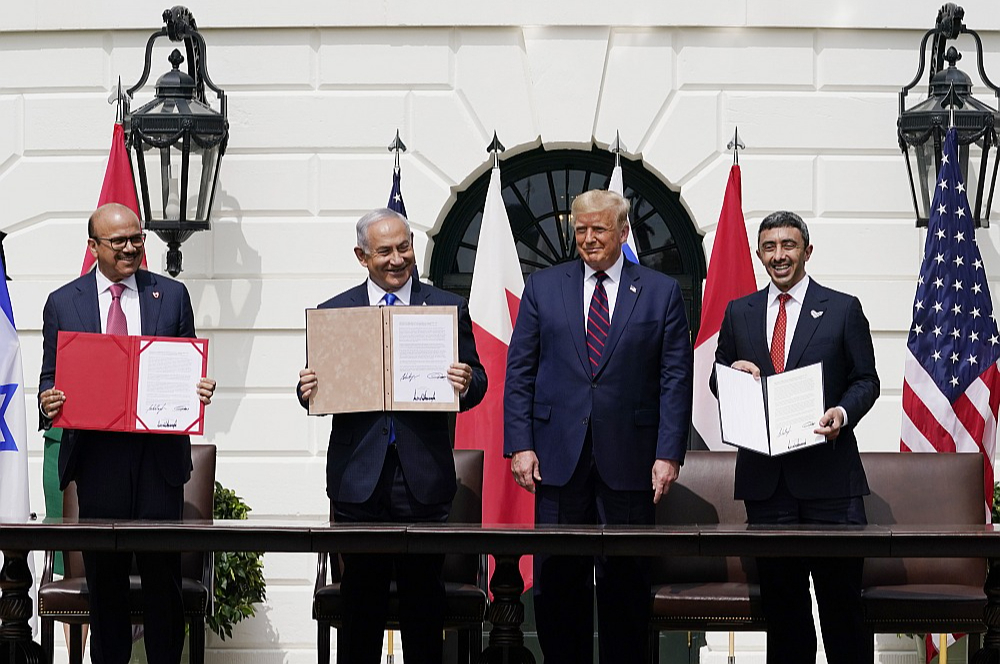
Trump Links Iran Peace Talks to Expansion of Abraham Accords
The New Architecture of the Middle East: Beyond the Abraham Accords
For decades, the blueprint for peace in the Middle East was simple: solve the Palestinian-Israeli conflict first, and the rest of the region would follow. But the emergence of the Abraham Accords flipped this script on its head. By prioritizing security and economic interests over ideological disputes, we’ve entered an era of “outside-in” diplomacy.
The current push to expand these agreements—potentially linking them to a broader deal with Iran—suggests a shift toward a regional security architecture. Instead of isolated peace treaties, we are seeing the seeds of a formal alliance system designed to counter Iranian influence while integrating Israel into the regional fabric.
The Saudi Wildcard: The Pivot Point for Regional Stability
While smaller nations have already signed on, Saudi Arabia remains the “big prize.” Riyadh’s hesitation isn’t born of a lack of interest—on the contrary, the Kingdom’s Vision 2030 requires the very stability and technological partnership that normalization with Israel provides.
However, the trend here is the “Palestinian Pivot.” Unlike the UAE or Bahrain, Saudi Arabia has signaled that any deal must include a credible path toward a Palestinian state. This creates a fascinating tension: the US wants a regional bloc to contain Iran, but the Arab street demands justice for Palestine.
Future trends suggest that we may see a “tiered” normalization process. Saudi Arabia might engage in quiet security cooperation and economic ties before making a formal diplomatic splash, allowing them to manage internal religious sensitivities while still reaping the strategic benefits.
The Iran Paradox: Can a “Grand Bargain” Exist?
Linking the expansion of the Abraham Accords to a deal with Iran is a high-stakes gamble. On one hand, a “Grand Bargain” that settles the nuclear issue and integrates Iran into a regional security framework would be the geopolitical achievement of the century.
the trust deficit is cavernous. Iran views the Abraham Accords not as peace treaties, but as a US-led military encirclement. For Tehran to join any regional framework, the US would likely have to offer concessions that would be politically toxic in Washington, such as lifting sweeping sanctions or recognising Iran’s regional sphere of influence.
The more likely trend is a “Cold Peace”—a state of managed tension where Iran and the Accords nations avoid direct conflict through third-party mediators (like Oman or Qatar) without ever reaching a formal diplomatic embrace.
The Non-Arab Factor: Turkey and Pakistan
The conversation is no longer limited to the Arab world. The inclusion of Turkey and Pakistan in the diplomatic discourse signals a move toward a pan-Islamic security dialogue. However, these nations face a different set of hurdles: domestic populist politics.
In Pakistan, the commitment to the Palestinian cause is deeply woven into the national identity. Any move toward normalization would be viewed by religious parties as a betrayal. Similarly, Turkey’s leadership often balances strategic interests with a role as a protector of Muslim rights globally.
We can expect these nations to play the role of “hedgers.” They are unlikely to sign formal accords in the near term but will likely maintain “back-channel” economic ties with Israel, mirroring the pragmatic approach currently seen in various parts of Asia. For more on this, see our analysis on global hedging strategies.
Future Outlook: From Bilateralism to Regionalism
The overarching trend is the move away from the US acting as the sole “policeman” of the Middle East. We are seeing a transition toward regional autonomy, where Middle Eastern powers settle their own disputes through a mix of economic incentives and security pacts.
Whether these efforts are driven by a specific US administration or organic regional needs, the trajectory is clear: the Middle East is moving toward a pragmatic, interest-based diplomacy. The “all-or-nothing” approach to the Palestinian conflict is being replaced by a “piece-by-piece” strategy of stabilization.
Frequently Asked Questions
They are a series of normalization agreements between Israel and several Arab nations (UAE, Bahrain, Morocco, and Sudan) aimed at improving diplomatic, economic, and security ties.
Saudi Arabia seeks a more comprehensive deal that includes progress toward a Palestinian state and stronger security guarantees from the US to counter Iran.
While theoretically possible, it is highly unlikely in the current climate due to deep ideological divides and conflicting regional goals. Most experts view this as a long-term aspiration rather than a short-term reality.
The Accords allow the US to reduce its direct military footprint in the region by fostering a self-sustaining security alliance between its partners.
What do you think? Is a regional “Grand Bargain” including Iran a realistic goal, or is the trust gap too wide to bridge? Share your thoughts in the comments below or subscribe to our Geopolitical Insights Newsletter for weekly deep dives into the world’s most complex conflict zones.