

TSB Report: Engineering Faults and Lack of Oversight Caused Titan Submersible Implosion
The Transportation Safety Board of Canada (TSB) attributed the June 2023 Titan submersible implosion to engineering faults and a lack of regulatory oversight. According to the TSB, OceanGate’s company structure hindered risk management, while the submersible’s carbon fiber hull failed progressively due to damage accumulated during repeated dives.
Why did the Titan submersible implode?
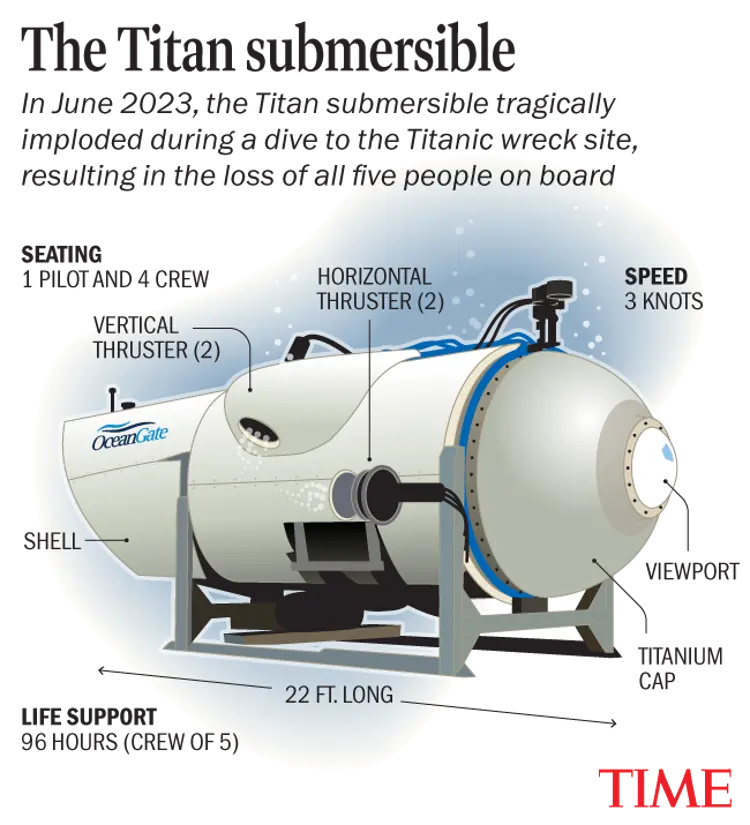
The Titan’s pressure hull failed because its design and construction didn’t follow standard engineering practices, according to the TSB. The submersible used a carbon fiber cylinder, a “novel” choice for deep-ocean exploration. Standard deep-sea vessels typically use spheres to better withstand extreme water pressure.
TSB laboratory analysis found that the carbon fiber cylinder had reduced compressive strength. The report notes that defects introduced during manufacturing, operations, storage, and transport likely caused the hull to fail progressively. Each dive cycle added damage until the structure finally imploded on June 18, 2023, during a mission to the Titanic wreck.
How did regulatory gaps contribute to the disaster?
A lack of regulatory oversight increased the risk to everyone involved in the Titan’s operations, the TSB report states. While Transport Canada (TC) knew the Titan operated from St. John’s and used Canadian support vessels, the agency didn’t know the submersible wasn’t registered with any flag state.

The TSB noted that the Titan received no oversight from Transport Canada. The report describes this situation as “relatively common” for vessels in Canada. Because OceanGate operated outside these frameworks, there was no independent verification of the hull’s structural integrity over time.
What changes are being recommended for deep-sea exploration?
The TSB issued six specific recommendations to prevent similar disasters. These target both the Canadian government and international maritime bodies to close safety gaps in the commercial vessel industry.
New Oversight Criteria
The TSB recommends that the Department of Transport develop risk-based oversight criteria specifically for Canadian uncertified commercial vessels and those registered outside of port state control. This would ensure that “novel” designs are scrutinized before they enter service.
International Standardization
The report urges Canada to advocate for the International Maritime Organization (IMO) to incorporate specific guidelines into international codes. Specifically, the TSB points to the Maritime Safety Committee Circular 981 (MSC 981), which covers the design, construction, and operation of passenger submersibles.
Operational Coordination
To prevent safety gaps, the TSB suggests that groups working on Canadian vessels use “bridging documents.” This would force better coordination between the submersible operators and the support ships, such as the Polar Prince, which supported the Titan.
How does this compare to industry standards?
The TSB report draws a sharp contrast between OceanGate’s approach and established engineering. While OceanGate touted its carbon fiber hull as an innovation, the TSB found that the company couldn’t actually determine how long the hull would remain intact after repeated dives.
Unlike certified vessels that undergo rigorous non-destructive testing between missions, the Titan’s “progressive failure” went undetected. This highlights a fundamental conflict between the “move fast and break things” tech culture and the high-stakes environment of deep-sea pressure.
Frequently Asked Questions
What caused the Titan to implode?
According to the TSB, a combination of a non-standard cylindrical carbon fiber hull, manufacturing defects, and damage accumulated over multiple dives led to the structural failure.
Did Transport Canada oversee the Titan?
No. The TSB report confirms the Titan received no oversight from Transport Canada, partly because it wasn’t registered with any flag state.
What is the MSC 981?
It is a set of guidelines from the International Maritime Organization (IMO) regarding the safe design and operation of submersibles that carry passengers.
Want to stay updated on maritime safety?
Join our newsletter for deep dives into engineering failures and the regulations shaping the future of exploration.