
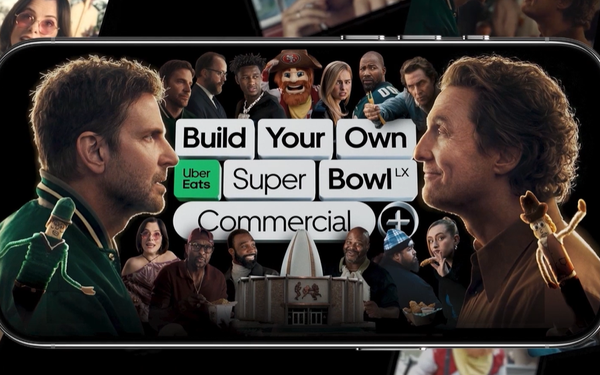
Uber Eats’ ‘Build Your Own Super Bowl’ Wins Lions Media Grand Prix 06/25/2026
Uber Eats secured the Cannes Lions Media Grand Prix for the “Build Your Own Super Bowl” campaign, which converted its commerce app into an interactive ad creation tool. Uber Eats reports the campaign generated over $290 million in earned media value and beat previous Super Bowl sales records by more than $36 million.
How did Uber Eats convert users into creators?
The campaign, developed by Los Angeles-based agency Special with media placement by PHD and production by Biscuit Filmworks, reconfigured the Uber Eats app. One week before the Super Bowl, the platform allowed fans to navigate to a dedicated section—appearing as a standard restaurant—to build their own commercials.
Users browsed an interactive menu of “ingredients” to assemble bespoke films. These choices determined the jokes, celebrity casts, and conspiratorial evidence featured in the final video. According to Uber Eats, the system supported over 1,000 seamless combinations.
Once completed, these fan-made films stayed within the app and were shared across social media to drive new traffic back to the platform. Participation wasn’t just for show; creating a commercial unlocked special food delivery deals for Game Day.
The “Build Your Own Super Bowl” experience wasn’t just for loyalists. Over 40% of the users who engaged with the tool were not regular Uber Eats customers, proving the campaign’s power to drive new user trials.
What data proves the success of “Build Your Own Super Bowl”?
The results shifted the conversation from “brand awareness” to direct revenue. Uber Eats reported a record-breaking Super Bowl week, smashing its previous sales record by more than $36 million. This growth was supported by 3.7 million incremental app visits during the event week.

Engagement metrics show a high level of intent. Around 325,000 users participated in the commercial builder, spending a combined 800,000 minutes within the experience. This led to a 38% deal redemption rate, which Uber Eats claims was 10x more effective at conversion than their previous promotions.
From a visibility standpoint, the earned media value topped $290 million. This figure represents a 30% increase over the company’s previous best-ever performance in a single campaign.
| Metric | Campaign Result |
|---|---|
| Earned Media Value | $290M+ (30% increase vs. previous best) |
| Sales Growth | +$36M over previous record |
| App Traffic | 3.7M incremental visits |
| Conversion Power | 10x more effective than past promos |
Why is the “collapsed funnel” the future of media?
Sindhuja Rai, Chief Client Officer at WPP Media, APMEA, and Media Lions Jury President, described the effort as “transformative.” Rai noted that the campaign stopped using communications to drive consumers toward a product and instead turned the product itself into the communications platform.
This approach effectively “collapses the traditional funnel.” In a standard marketing funnel, a user sees an ad (awareness), considers the brand (interest), and then goes to an app to buy (action). By integrating the ad creation and the discount delivery into the purchasing app, Uber Eats removed the friction between seeing an ad and making a purchase.
This shift mirrors a broader trend in performance marketing where the line between content and commerce disappears. When the experience of “playing” with a brand happens exactly where the “buying” happens, conversion rates naturally spike.
Stop treating your app or website as just a checkout counter. Treat it as a destination. Integrating gamified elements—like the “ingredients” menu used by Special—increases “time spent,” which is a leading indicator for higher conversion rates.
How will interactive commerce evolve?
The Uber Eats model suggests a future where static advertisements are replaced by “utility-based creativity.” Instead of watching a 30-second spot, users will likely interact with brand tools that provide immediate value or entertainment within the transaction flow.

We can expect more brands to leverage “modular content.” By creating a library of scenes and assets—similar to the 1,000+ combinations used by Biscuit Filmworks—companies can offer personalized experiences at scale without needing to film a unique ad for every single customer.
Furthermore, the success of this campaign in driving “re-engagement” (bringing back lapsed users) indicates that interactivity is a stronger hook than traditional discounting. A 38% redemption rate suggests that users are more likely to use a coupon if they’ve “earned” it through an experience.
Frequently Asked Questions
Who won the Cannes Lions Media Grand Prix for Uber Eats?
The award went to the “Build Your Own Super Bowl” campaign, created by agency Special, with media handled by PHD and production by Biscuit Filmworks.
What was the “Build Your Own Super Bowl” concept?
Uber Eats allowed users to create their own customized Super Bowl commercials within the app using an interactive menu of “ingredients,” which then unlocked food delivery deals.
What were the financial results of the campaign?
Uber Eats reported over $290 million in earned media value and exceeded previous Super Bowl sales records by more than $36 million.
What does “collapsing the funnel” mean in this context?
According to Sindhuja Rai of WPP Media, it means turning the product (the app) into the communication platform, combining awareness, engagement, and purchase into one seamless experience.
What do you think about the shift toward “product-as-platform” marketing? Does interactivity drive you to buy more, or do you prefer traditional ads? Let us know in the comments below or subscribe to our newsletter for more deep dives into the future of advertising.