
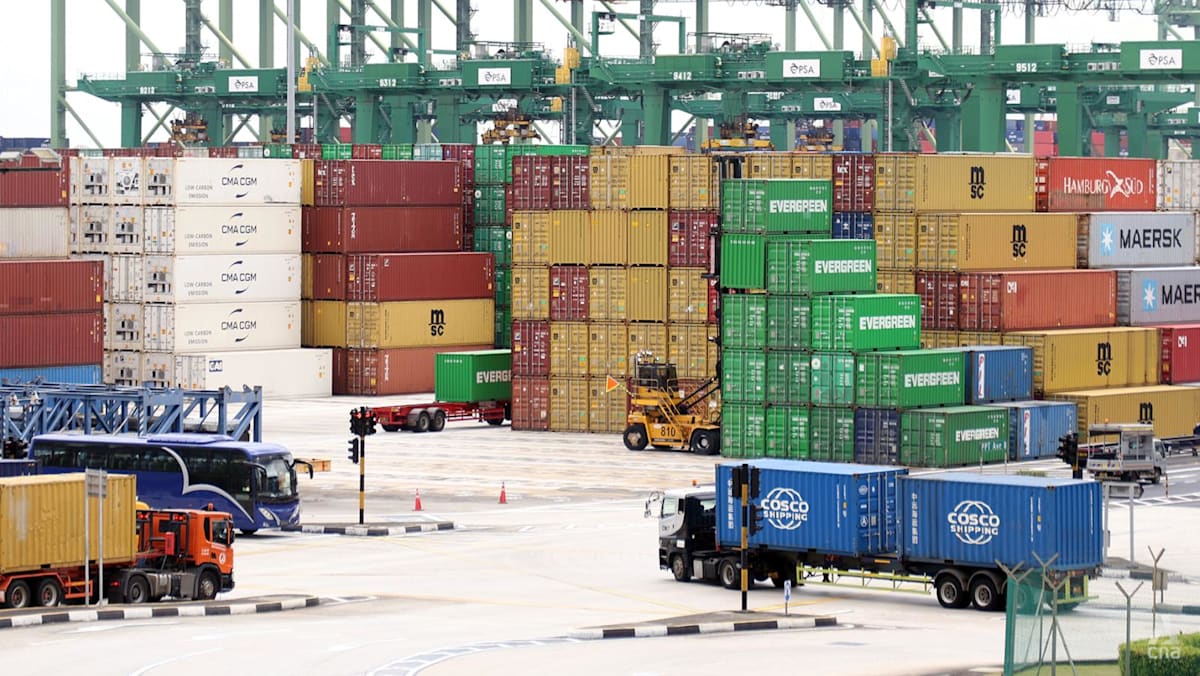
Unprecedented’ AI buildout drove Singapore’s sharpest non-oil exports surge in over two decades: Analysts
Singapore’s non-oil exports grew 38.4% year-on-year in May, driven largely by a surge in AI infrastructure, data centers, and high-performance computing demand. According to Mr. Wong, this growth is closely tied to the capital spending decisions of a small group of large tech companies, or hyperscalers, who drive order flows for servers and networking hardware.
Which markets drove the export growth in May?
Non-oil export figures rose for nine of Singapore’s top 10 markets. Taiwan led the growth with a 135.2% year-on-year increase, followed by the US at 80.9% and China at 31%.
Mr. Ang attributed Taiwan’s performance to the continued scale-up of the global chip supply chain and the island’s central role in advanced semiconductor packaging and manufacturing. Demand in the US is closely linked to AI infrastructure investment, as the country houses many leading cloud service providers and AI chip designers.
Despite geopolitical restrictions, China continues to require electronic components and storage for industrial, enterprise, and consumer applications, according to the report.
Why is AI infrastructure impacting Singapore’s economy?
Singapore serves as a connected node in the global supply chain for memory, storage, equipment, and specialty manufacturing. Mr. Wong stated that the current AI buildout requires hardware refreshes at a pace faster than any previous technology cycle.
This demand feeds directly into Singapore’s strengths as an advanced manufacturing and electronics hub. Mr. Wong noted that when hyperscalers raise their spending guidance, the resulting order flow moves upstream quickly.
What happens next for electronics exports?
Analysts expect non-oil export growth to remain positive in the near term, though the current pace may not be sustainable. Mr. Wee warned that the 38.4% increase may be difficult to repeat as base effects rise in the second half of the year.
Potential volatility could stem from capacity constraints, tariffs, geopolitics, and inventory cycles. Mr. Wong suggested that exports look durable as long as hyperscaler capital spending holds.
However, a vulnerability exists if these companies revise their spending downward. In such a scenario, Mr. Wong said the impact would likely be felt quickly.
Why did exports to Indonesia decline?
Indonesia was the only major market to see a contraction, with exports falling 26.9%. Ms. Ling of OCBC attributed this drop to weak domestic demand, which was likely compounded by volatility in the Indonesian rupiah.

Frequently Asked Questions
Which three markets saw the highest year-on-year export growth in May?
Taiwan (135.2%), the US (80.9%), and China (31%) recorded the highest growth.
What specific technologies are driving the current demand?
Demand is linked to AI infrastructure, data centers, high-performance computing, and advanced memory and storage.
What risks could slow down this export growth?
Growth could be impacted by inventory cycles, geopolitical tensions, tariffs, capacity constraints, or a downward revision in hyperscaler spending.
Do you think the current AI hardware buildout is a sustainable long-term trend or a short-term cycle?