
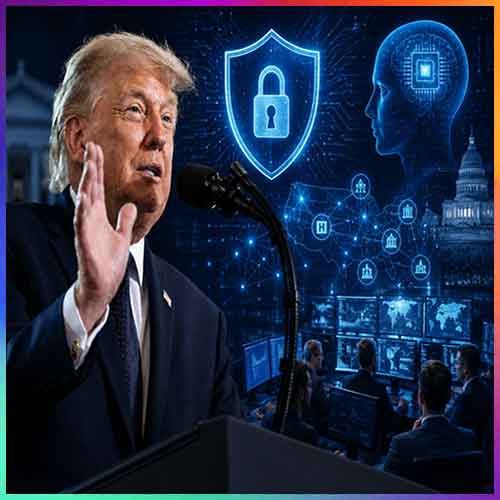
US Pushes AI Innovation and Cybersecurity
The U.S. government is accelerating AI adoption through a new executive order that removes regulatory barriers and establishes an AI Cybersecurity Clearinghouse. This strategy aims to secure federal networks and critical infrastructure by blending private-sector innovation with government oversight to maintain a global technological edge.
The shift isn’t just about faster computers; it’s about survival in a digital landscape where the enemy is an algorithm. By prioritizing the modernization of national security and civilian networks, the administration is betting that AI-enabled defense is the only way to counter AI-enabled attacks.
How will AI-driven defense change the nature of cyber warfare?
We’re moving from reactive patching to predictive shielding. Traditionally, a company waits for a breach, analyzes the “patient zero” file, and then pushes a patch. According to the latest executive order, the U.S. intends to flip this script by deploying AI-enabled defensive tools that anticipate attacks before they happen.

This mirrors the evolution of missile defense. Instead of just building thicker walls, the government is building an “intelligent” perimeter. If an AI can detect a pattern of unauthorized access attempts across multiple federal agencies in real-time, it can shut down those vectors globally before a single server is compromised.
The risk, however, is the “automation paradox.” As defenses become automated, attackers use AI to find the gaps in those very automations. It’s a constant loop of escalation. For more on this, see our analysis of real-time cyber defense trends.
What happens when AI starts finding its own vulnerabilities?
The creation of the AI Cybersecurity Clearinghouse is the most significant move here. This isn’t just another government database; it’s a hub for coordinated remediation. The goal is to identify software flaws and distribute security patches across critical sectors—like banks and hospitals—simultaneously.
In the past, a vulnerability in a common piece of software could leave thousands of utilities exposed for months. By centralizing the discovery process, the government reduces the “window of vulnerability.” We’ve seen the cost of failure before; the SolarWinds attack proved that a single compromised update can jeopardize the entire federal government.
Can a voluntary framework actually secure frontier AI models?
The administration is introducing a voluntary framework for “frontier” AI models. This allows developers to share their most advanced systems with the government for risk assessment under strict confidentiality. It’s a delicate balance: the U.S. wants the innovation of the private sector but can’t afford a “black box” that contains national security risks.
Critics argue that “voluntary” is a weak word in the face of trillion-dollar valuations. However, this approach avoids the heavy-handed regulation that often kills startups. By creating a “trusted partner” ecosystem, the government gets a peek under the hood of the next GPT or Claude before it hits the public market.
If these voluntary measures fail to stop the creation of “dual-use” AI—tools that can design both medicine and bio-weapons—expect these guidelines to become mandatory laws very quickly. You can read more about NIST’s AI Risk Management Framework to see how these standards are being shaped.
Where will the new wave of cybersecurity talent come from?
You can’t run AI defenses with a workforce trained on 2010-era firewalls. The executive order explicitly directs agencies to expand talent pipelines. We’re seeing a shift where “cybersecurity” is no longer just a computer science degree; it’s becoming a hybrid of data science and intelligence analysis.
The government is now competing with Silicon Valley for the same pool of experts. To win, they’re leaning into funding for AI-driven vulnerability research. This creates a feedback loop: better funding attracts better talent, which builds better tools, which secures the nation.
| Feature | Old Security Model | AI-Driven Model (New EO) |
|---|---|---|
| Response Time | Days/Weeks (Manual) | Milliseconds (Automated) |
| Vulnerability Fixes | Siloed/Individual | Centralized (Clearinghouse) |
| Regulation | Restrictive/Slow | Accelerated/Collaborative |
Frequently Asked Questions
What is the AI Cybersecurity Clearinghouse?
It’s a government-industry partnership designed to find software vulnerabilities and coordinate the distribution of security patches across critical infrastructure and federal agencies.
Will this executive order slow down AI development?
No. In fact, it specifically aims to reduce regulatory barriers to accelerate innovation, provided that the innovation is deployed securely.
Who benefits most from these new policies?
Critical infrastructure operators—such as hospitals, banks, and utility companies—benefit from the expanded access to AI-enabled defensive tools and faster vulnerability remediation.
Is your organization ready for the AI security shift?
The line between “innovation” and “risk” is thinning. Join the conversation in the comments below or subscribe to our newsletter for weekly deep dives into the intersection of AI and national security.