

US Youth Tobacco Use Hits 25-Year Low
Tobacco product use among U.S. middle and high school students hit its lowest level in 25 years in 2024, according to the National Youth Tobacco Survey (NYTS). Data analyzed by the Centers for Disease Control and Prevention (CDC) and the U.S. Food and Drug Administration (FDA) shows 2.25 million students used tobacco products in 2024, down from 2.80 million in 2023.
Why is youth tobacco use declining?
At least half a million fewer students used tobacco products in the past year. This progress is largely due to a drop in e-cigarette use, which fell from 2.13 million youth in 2023 to 1.63 million in 2024, according to the NYTS.
Hookah use also saw a significant decline, dropping from 290,000 users in 2023 to 190,000 in 2024. Cigarette smoking reached the lowest level ever recorded by the survey, with only 1.4% of students reporting current use in 2024.
Which tobacco products are students using most?
E-cigarettes remain the top choice, used by 5.9% of youth who reported current tobacco product use. Nicotine pouches became the second most common product at 1.8%, according to the 2024 data.
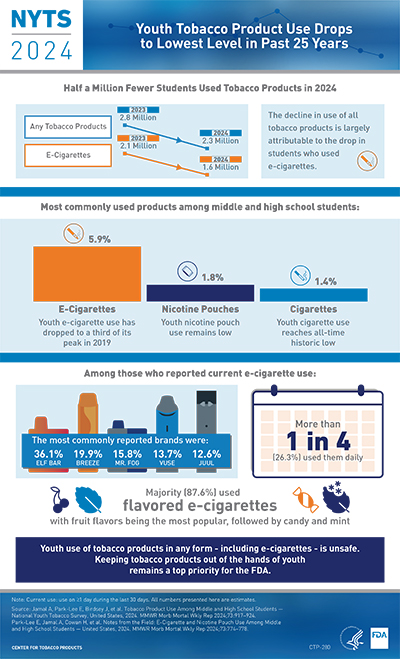
Other products follow in descending order of use: cigarettes (1.4%), cigars (1.2%), smokeless tobacco (1.2%), other oral nicotine products (1.2%), heated tobacco products (0.8%), hookahs (0.7%), and pipe tobacco (0.5%).
How does tobacco use differ across student groups?
Progress varies by population. Current use of any tobacco product, e-cigarettes, and multiple tobacco products declined significantly among female students and Hispanic students, according to the report.
Conversely, use of any tobacco product, e-cigarettes, oral nicotine, combustible tobacco, and multiple tobacco products increased among American Indian or Alaska Native students. Use of nicotine pouches also increased among White students.
What drove these changes in youth behavior?
The CDC and FDA attribute the decline to evidence-based strategies at national, state, and local levels. These include price increases and mass media campaigns designed to educate youth on the harms of tobacco.
Comprehensive smoke-free policies that include e-cigarettes also contributed. The FDA further regulates the market through premarket reviews and enforcement tools targeting manufacturers, importers, distributors, and retailers.
What could happen next in youth tobacco prevention?
Public health officials may increase focus on addressing disparities to ensure declines occur across all racial and ethnic groups. Brian King, director of the FDA’s Center for Tobacco Products, stated that continued vigilance is needed to reduce all forms of tobacco use.
Future efforts are likely to maintain a commitment to preventing adolescent nicotine exposure. Because nearly all tobacco use begins during adolescence, officials may continue using enforcement and education to target the most commonly used products, such as e-cigarettes and nicotine pouches.
Frequently Asked Questions
What is the current rate of cigarette smoking among U.S. students?
In 2024, cigarette smoking reached its lowest recorded level, with 1.4% of students reporting current use.
Which group of students saw an increase in tobacco product use?
Current use of any tobacco product, e-cigarettes, oral nicotine products, combustible tobacco, and multiple tobacco products increased among American Indian or Alaska Native students.
How many middle and high school students used tobacco in 2024?
According to the NYTS, 2.25 million students reported current use of any tobacco product in 2024.
Do you think current school policies are doing enough to stop the rise of nicotine pouches among teens?