
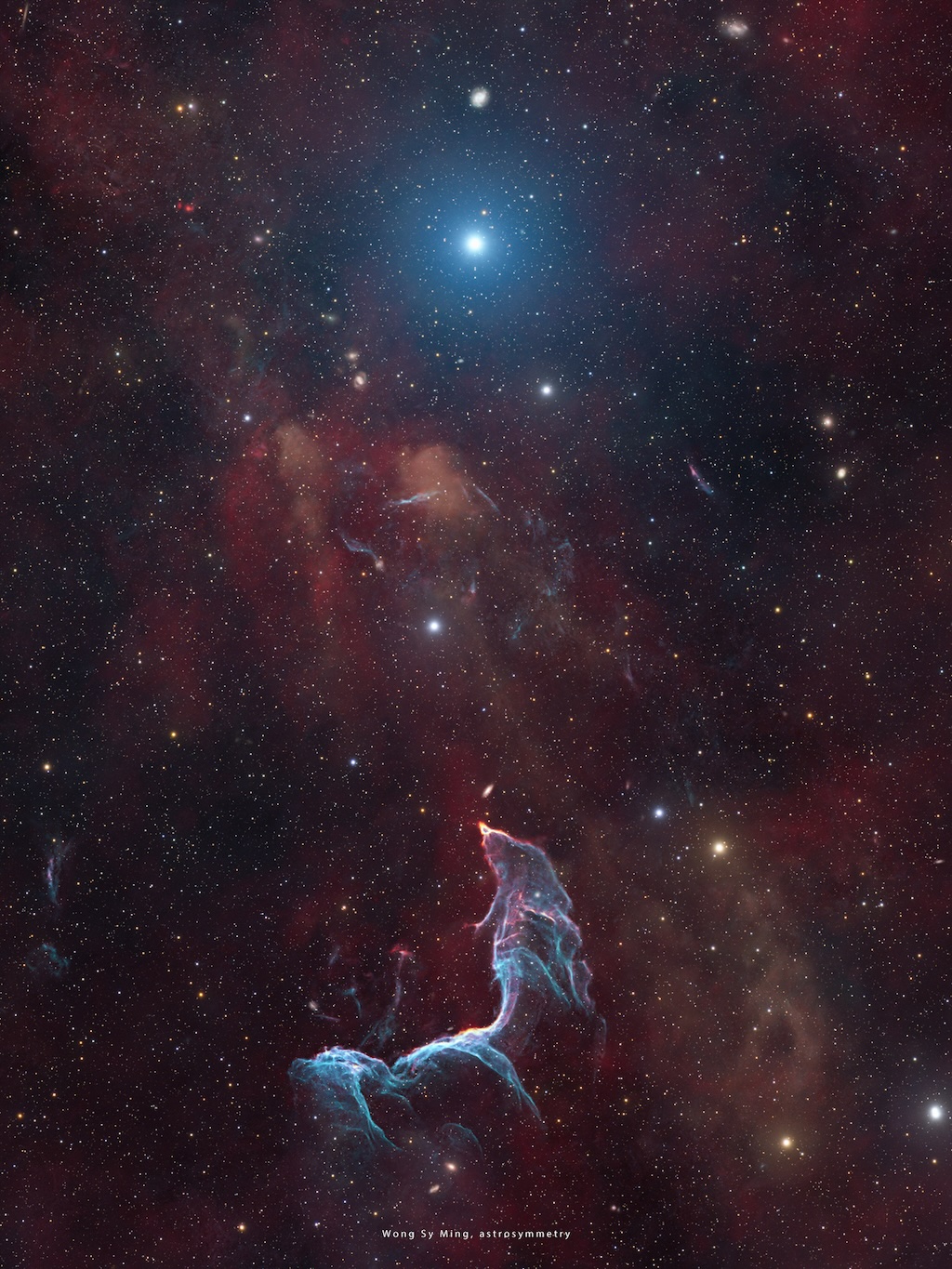
2026 June 11 – The Mermaid Nebula Supernova Remnant
The Mermaid Nebula, also identified as the Betta Fish Nebula, is a supernova remnant designated as G296.5+10.0 that sits a few thousand light-years from Earth. According to Cecilia Chirenti of NASA’s Goddard Space Flight Center, the nebula originated from a massive star explosion approximately 10,000 years ago, leaving behind a young, radio-quiet neutron star known as a pulsar.
Composition and Visual Characteristics
The distinct appearance of the nebula is defined by its chemical composition. Data processed by Guangyan Gao reveals that the blue hues within the nebula are created by doubly ionized oxygen (OIII), while the deep red colors are the result of hydrogen gas emissions. While the nebula is populated by various bright stars, these are unassociated with the remnant itself.

Implications for Pulsar Research
The existence of a radio-quiet pulsar within the G296.5+10.0 remnant provides a specific case study for researchers monitoring stellar debris. Because the pulsar lacks a confirmed optical detection, analysts expect that continued monitoring in the X-ray spectrum will be necessary to better understand the star’s rotation and energy output. If the pulsar remains radio-quiet, it may represent a common but difficult-to-track phase in the lifecycle of neutron stars following a supernova event.
Frequently Asked Questions
What is the Mermaid Nebula?
The Mermaid Nebula, or Betta Fish Nebula, is the G296.5+10.0 supernova remnant, formed by a massive star explosion roughly 10,000 years ago.
Why is the pulsar difficult to see?
The pulsar is radio-quiet and does not have a confirmed detection in visible light, meaning it can only be identified through X-ray observation.
What creates the colors in the nebula?
According to data acquisition by Sy Ming Wong, the blue light is emitted by doubly ionized oxygen, while the deep red light originates from hydrogen gas.
How might advancements in X-ray detection change our understanding of radio-quiet neutron stars in the coming years?