

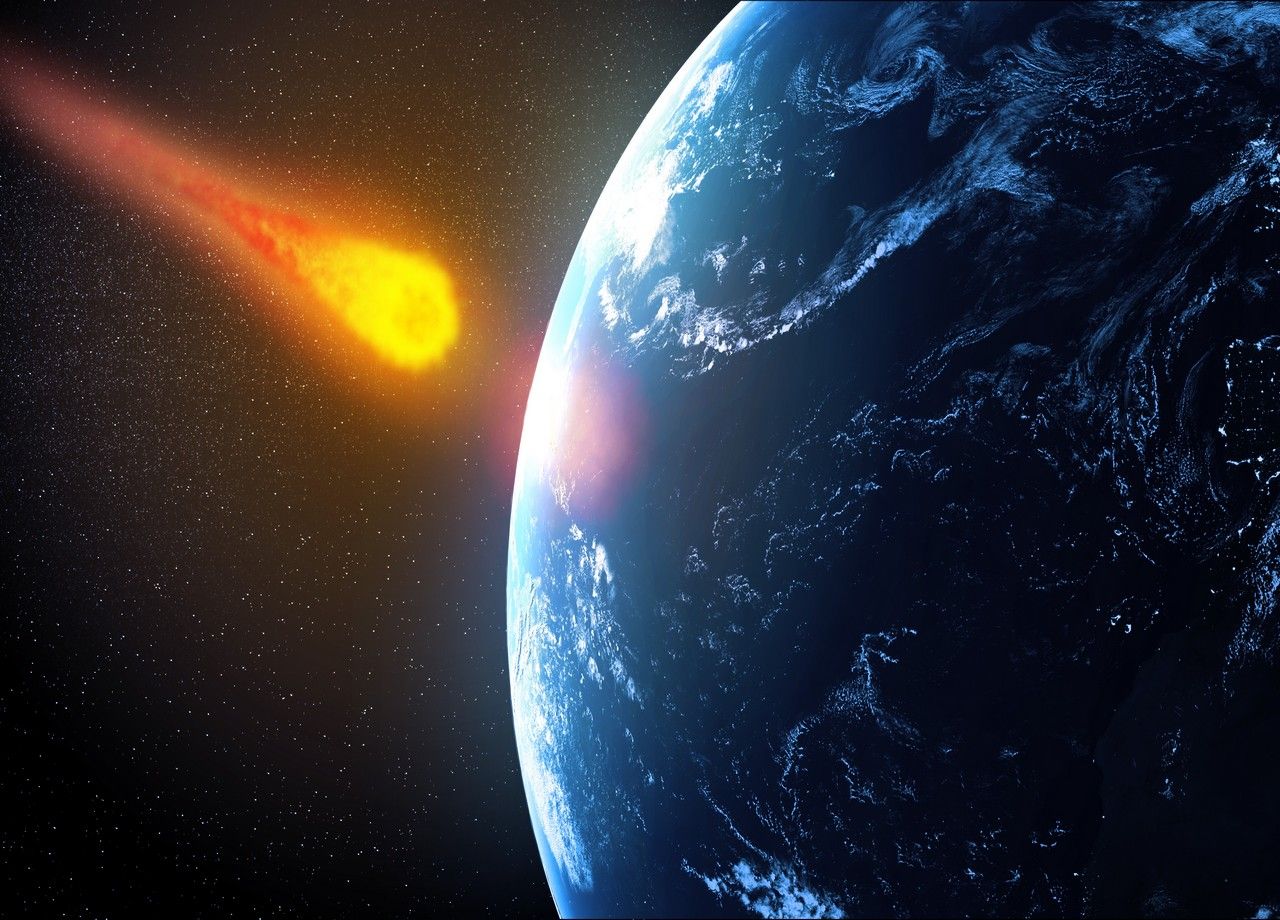
About 66 million years ago an asteroid roughly 10-15 km wide struck off Mexico’s Yucatan, gouging a crater some 180 km across – and the extinction that followed wiped out the non-avian dinosaurs and around 75% of all species
A 10-15 kilometer asteroid striking Earth can release 3 × 10²³ Joules of energy—roughly 5 billion Hiroshima-sized bombs—according to Physics Today. This collision, which created the Chicxulub crater, triggered a global “impact winter” that eliminated three-quarters of Earth’s species by blocking sunlight and collapsing food webs.
How does a single asteroid cause a global extinction?
The destruction started with a regional strike on the northern Yucatán Peninsula but turned global within hours. Simulations cited by Physics Today indicate the impact excavated a hole more than 20 kilometers deep almost instantly.
This wasn’t just a local explosion. A 2022 review in Nature Reviews Earth & Environment reports that several thousand gigatonnes of asteroid and Earth material were ejected at speeds exceeding 5 kilometers per second. This created a fast-moving cloud of dust, soot, and sulfate aerosols that wrapped around the entire planet before the first day ended.
What actually drove the “impact winter”?
The immediate strike was survivable for many, but the subsequent darkness was not. According to Nature Reviews Earth & Environment, the primary killing mechanism was the blockage of sunlight, which caused abrupt global cooling.
Scientists are still debating exactly what kept the planet dark. A 2016 study in Scientific Reports argued that soot from oil-rich rocks at the impact site drove the cooling. However, a 2025 paper in Nature Communications by Katerina Rodiouchkina and colleagues revised sulfur estimates downward. This suggests sulfur played a smaller role than previously thought, potentially altering which species survived the first few years.
The duration of this winter is also unsettled. Nature Reviews notes that the darkness could have lasted a few months or more than a decade. This distinction is critical; a few months is a lean season, but a decade is a total collapse of the global food web.
Who survives a planetary reset?
Survival wasn’t random; it was tied to size and diet. Analysis from Scientific Reports shows that only about 12% of land-dwelling forms survived. Large-bodied land animals were almost entirely wiped out.
Freshwater environments told a different story. Roughly 90% of freshwater species survived. This is because they relied on detritus—dead organic matter—rather than the living plants and plankton that perished when the sun disappeared.
Survival Comparison: Land vs. Water
| Environment | Estimated Survival Rate | Primary Reason |
|---|---|---|
| Land Animals | ~12% | Size and reliance on live vegetation |
| Freshwater Species | ~90% | Reliance on detritus (decaying matter) |
How was the “smoking gun” finally found?
For years, the asteroid theory was just a hypothesis. Glen Penfield and Antonio Camargo first detected the crater structure in the late 1970s, but the link to the mass extinction wasn’t confirmed until 1990 and 1991. Alan Hildebrand tied iridium-rich deposits—rare on Earth but common in asteroids—to the buried Yucatán structure.
In 2016, an international drilling project bored into the crater’s peak ring. They recovered shocked minerals and granite that had been ejected from deep within the Earth within minutes of the strike, confirming the physics of the collision.
Frequently Asked Questions
How big was the asteroid that killed the dinosaurs?
The asteroid was approximately 10 to 15 kilometers in diameter, according to Physics Today.
Did the asteroid kill everything instantly?
No. While the initial impact was brutal, the mass extinction was driven by a long-term “impact winter” caused by soot and aerosols blocking the sun, as detailed in Nature Reviews Earth & Environment.
Why did freshwater animals survive better than land animals?
According to Scientific Reports, freshwater species relied on detritus, which remained available even after the darkness killed off living plants and plankton.
Want to stay updated on the latest in planetary science and Earth’s history? Subscribe to our newsletter or leave a comment below telling us if you think humanity could survive a similar impact today.