
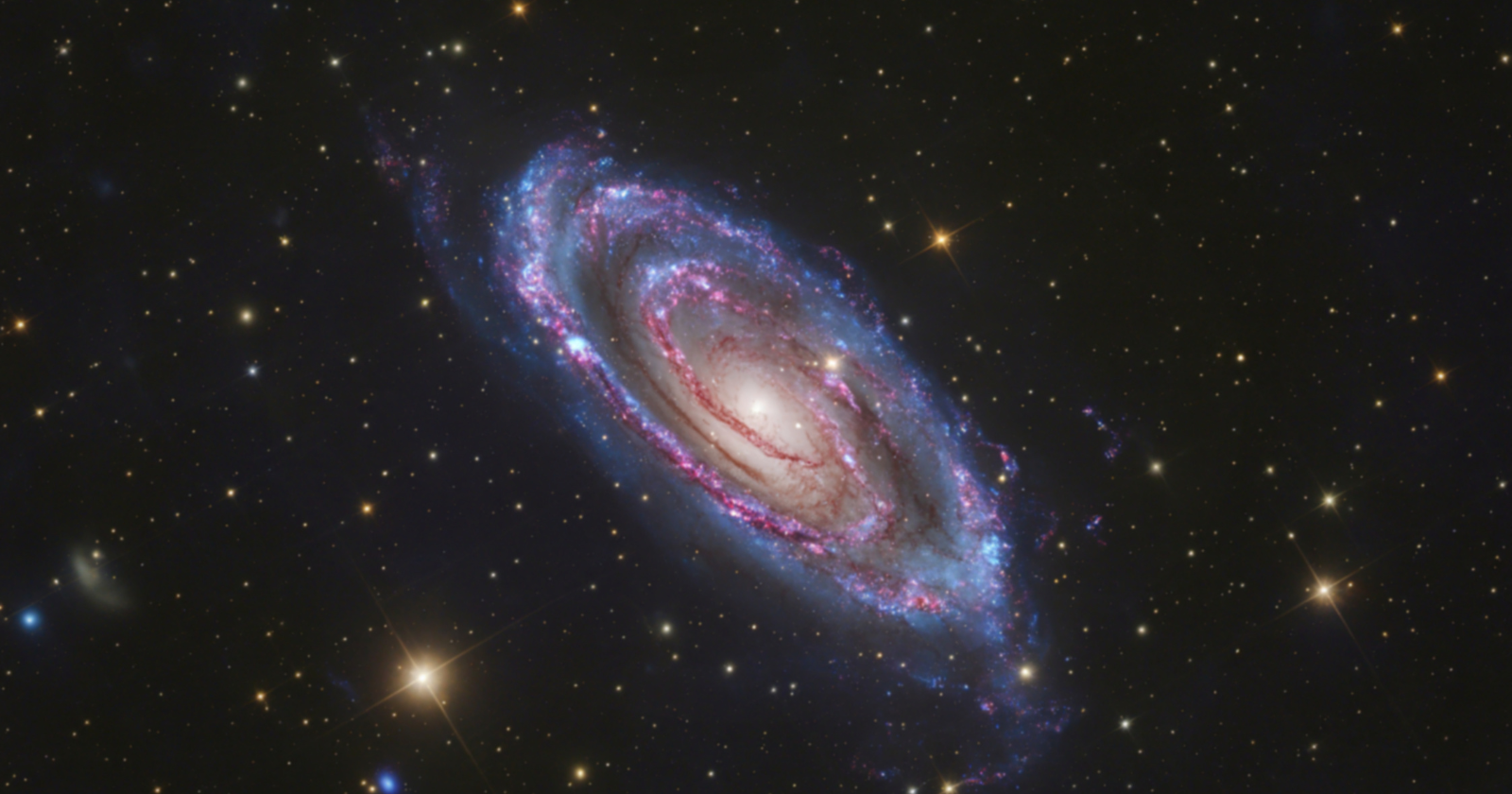
An AI trawled through 35 years of Hubble images and found more than 800 strange objects that had never been documented before, showing that one of astronomy’s most famous archives is still hiding discoveries in plain sight
For 35 years, the Hubble Space Telescope has served as humanity’s eyes on the deep universe. Yet, for all its brilliance, the sheer volume of data it produced created a paradox: we had more images than we could possibly study. It took a leap in artificial intelligence to finally turn that massive “haystack” of 99.6 million image cutouts into a treasure map of cosmic anomalies.
The AI-Human Partnership: Redefining Discovery
Researchers David O’Ryan and Pablo Gómez of the European Space Agency recently demonstrated that the future of astronomy isn’t just about bigger telescopes—it’s about smarter data processing. Their tool, AnomalyMatch, didn’t “discover” anything on its own. Instead, it performed a systematic, rapid-fire ranking of millions of images, flagging those that deviated from the “norm.”
The heavy lifting—the actual scientific validation—remained a human endeavor. By narrowing down millions of candidates to a manageable shortlist, the AI allowed astronomers to confirm over 1,300 visually anomalous objects. More than 800 of these had never been documented in scientific literature. This workflow marks a critical shift: AI acts as the ultimate research assistant, clearing the noise so experts can focus on the signal.
What’s Hiding in the Hubble Archive?
The catalogue produced by O’Ryan and Gómez offers a glimpse into the chaotic beauty of the cosmos. The findings span 18 distinct classifications, including:
- Merging Galaxies: Objects caught in the violent, beautiful process of galactic collision.
- Gravitational Lenses: 86 new candidates where the light of distant stars is warped by massive foreground objects.
- Jellyfish Galaxies: Rare formations with trailing filaments of gas stretching through space.
- Unclassified Anomalies: Several dozen objects that defy current categorization, representing the most exciting frontier for future research.
The Scalability Challenge: Preparing for the Next Generation
Hubble’s archive is immense, but it is finite. The real test for AI-driven discovery lies in the upcoming wave of “Big Data” observatories. Missions like ESA’s Euclid and the Vera C. Rubin Observatory will generate data volumes that dwarf anything Hubble has produced to date. Manual inspection is no longer just impractical—it is impossible.
The success of AnomalyMatch serves as a proof-of-concept for these future missions. If One can successfully train algorithms to spot “needles in the haystack” of the next generation of deep-space surveys, we may find that the universe is far stranger and more active than we previously dared to imagine.
Frequently Asked Questions
Does “undocumented” mean these objects are brand new discoveries?
Not necessarily. “Undocumented” means these objects had not been previously described in published scientific literature. They have existed for eons; they were simply hidden in plain sight within the massive archives of the Hubble telescope.
Is AI now doing the work of professional astronomers?
No. AI is acting as a filter. The final step—verifying if a candidate is a gravitational lens or a unique galactic structure—requires the trained eye of an astrophysicist and, in many cases, further spectroscopic follow-up.
Why is this method important for the future of science?
As we enter the era of massive sky surveys, the sheer volume of data will overwhelm human capacity. Developing AI that can efficiently rank and prioritize data is the only way to ensure we don’t miss rare, ground-breaking cosmic events.
What do you think is the most exciting potential discovery waiting in our archives? Join the conversation in the comments below, or subscribe to our newsletter to stay updated on the latest breakthroughs in space exploration and AI technology.