
Asteroid Donaldjohanson is Wobbly, Peanut-Shaped Object with Watery Past, Scientists Say
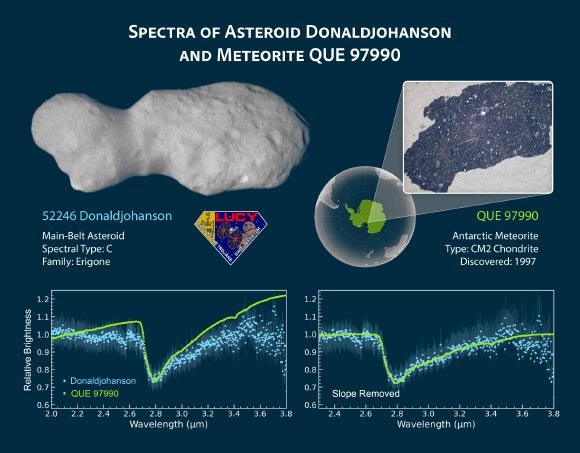
NASA’s Lucy spacecraft found that the asteroid Donaldjohanson is a bilobed fragment that wobbles on two axes. According to a June 18 report in Science, the object contains iron-rich clay minerals, indicating it’s a piece of a water-rich world that shattered 155 million years ago.
The Lucy spacecraft flew past the main-belt asteroid on April 20, 2025. This encounter served as a critical test run for the mission’s primary objective: exploring the Trojan asteroids that orbit the Sun alongside Jupiter. Dr. Simone Marchi, Lucy deputy principal investigator and researcher at the Southwest Research Institute, stated that the flyby revealed several “surprising things” about the object’s physical state and history.
Why does Donaldjohanson’s rotation matter?
Unlike many asteroids that roll through space in a steady pattern, Donaldjohanson tumbles. Data from the Lucy spacecraft shows the asteroid rotates on two different axes. It turns end-over-end once every 10.5 Earth days and wobbles around its horizontal axis once every 26.5 days.

This complex rotation provides a window into the asteroid’s violent past. According to the Science study, the object is a fragment of the Erigone asteroid family. This group formed when a catastrophic collision destroyed a larger parent body 155 million years ago. The resulting debris, including Donaldjohanson, retained the scars of that event in the form of heavy cratering.
What does the asteroid’s composition reveal about the early Solar System?
Lucy detected iron-rich clay minerals on the asteroid’s surface. These minerals only form in the presence of liquid water. This discovery suggests Donaldjohanson originated from a carbon- and water-rich parent body, supporting theories about how water-rich worlds migrated through the early Solar System.
The asteroid’s dimensions—8.8 km by 4.4 km by 3.1 km—and its bilobed structure were confirmed by Lucy’s images. While Earth-based telescopes had suggested an elongated shape, the close-up flyby provided the concrete evidence of the “peanut” morphology. This structure is common among objects born from high-energy collisions or the merging of two smaller bodies.
How does Donaldjohanson compare to other asteroids?
Scientists are using Donaldjohanson as a benchmark to understand other known space rocks. Dr. Marchi noted that comparing this asteroid to Bennu and Ryugu is essential because “every subtle difference is another clue to our origin story.”

| Feature | Donaldjohanson | Bennu / Ryugu |
|---|---|---|
| Rotation | Tumbling (Two axes) | Generally steady rotation |
| Composition | Iron-rich clays | Carbonaceous/Water-rich |
| Structure | Bilobed (Peanut) | Top-shaped / Rubble pile |
While Donaldjohanson shares some similarities with Bennu and Ryugu, its tumbling motion and specific mineral markers set it apart. These distinctions help researchers refine their models of how planetary materials were distributed during the Solar System’s formation.
What happens next for the Lucy mission?
The encounter with Donaldjohanson serves as a technical rehearsal. The mission is now heading toward the Trojan asteroids, two swarms of ancient objects that lead and trail Jupiter. Scientists believe these Trojans have remained largely undisturbed since the dawn of the Solar System.

According to Dr. Marchi, the data gathered from the Trojans is expected to challenge existing understandings of solar system formation. By contrasting the “modern” fragments of the main belt, like Donaldjohanson, with the primordial Trojans, NASA aims to map the migration of materials across the early cosmic neighborhood.
Frequently Asked Questions
What is the Erigone asteroid family?
It’s a group of asteroids created 155 million years ago when a large parent body was shattered by a catastrophic collision.
Why is the presence of clay minerals important?
Iron-rich clay minerals indicate that liquid water was once present on the parent body, helping scientists track the history of water in space.
What are Trojan asteroids?
These are ancient asteroids that share Jupiter’s orbit around the Sun, located in the L4 and L5 Lagrangian points.
Do you think these “water-rich” fragments prove that Earth’s oceans came from asteroids? Share your thoughts in the comments below or subscribe to our newsletter for more space discoveries.