

Average Weekly Working Hours in Europe: Which Countries Work the Most?
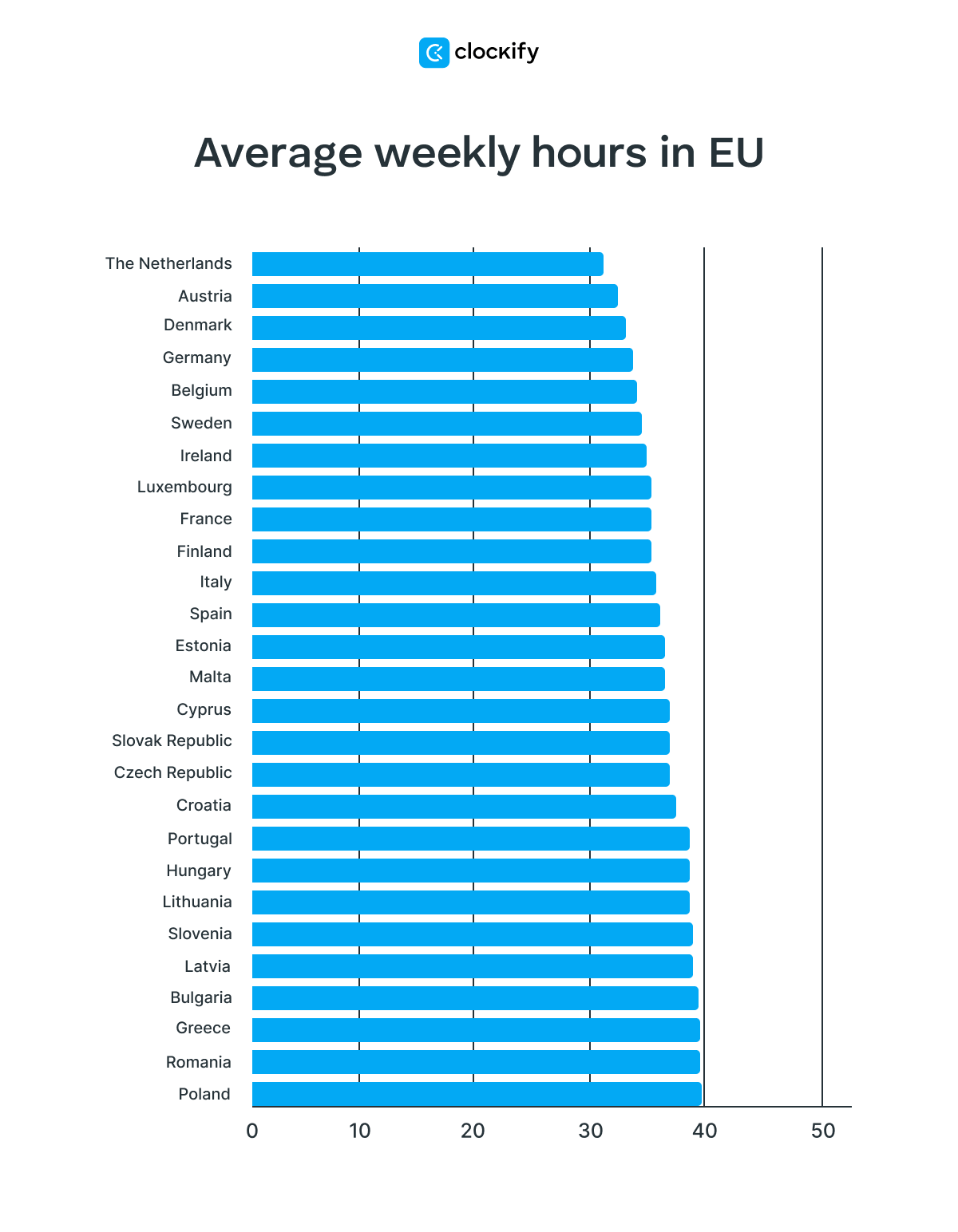
Latvia ranks seventh in the European Union for average weekly working hours at 37.9, according to 2025 data. While Turkey leads among EU candidate nations with 42.4 hours, the Netherlands maintains the shortest workweek in Europe at 31.9 hours, driven largely by a high prevalence of part-time employment.
Which European countries work the most and least?
Turkey records the longest average workweek in Europe at 42.4 hours when including EU candidate countries. Bosnia and Herzegovina and Serbia also report averages exceeding 40 hours per week.
The Netherlands has the shortest average workweek at 31.9 hours. Germany, Norway, and Denmark follow with an average of 33.9 hours.
How do the largest EU economies compare?
Germany maintains the shortest workweek among the four largest European Union economies. France averages 35.6 hours, Italy 36.1 hours, and Spain 36.3 hours.
In contrast, Estonia’s average of 36.2 hours places the country near the middle of the EU rankings, significantly lower than Latvia’s 37.9 hours.
What factors determine the number of working hours?
David Spensers, a professor at the University of Leeds, states that economic productivity and employee influence over working conditions drive these figures. He notes that employers largely influence the work-time models, as employees rarely choose their own hours.
Spensers attributes Germany’s shorter workweek to collective labor agreements and the influence of strong trade unions.
Jorge Cabrita, a researcher at the European Foundation for the Improvement of Living and Working Conditions (Eurofound), adds that labor market structure is critical. According to Cabrita, actual working hours are typically lower in countries where collective bargaining and unions have more influence.
What may happen to workweek trends next?
Future shifts in workweek length could depend on the prevalence of part-time employment across other EU member states. If more countries adopt the Dutch model of high part-time utilization, average hours may drop.
Changes in the strength of trade unions or the adoption of new collective agreements could also lead to a reduction in hours in countries like Latvia.
Frequently Asked Questions
Which country has the longest workweek in Europe?
Turkey has the longest average workweek at 42.4 hours.
Why does Germany have a shorter workweek than other large EU economies?
According to Professor David Spensers, this is partly due to collective labor agreements and strong union influence.
How does Latvia compare to Estonia in working hours?
Latvia averages 37.9 hours per week, ranking seventh in the EU, while Estonia averages 36.2 hours.
Do you think a shorter workweek increases overall economic productivity?