
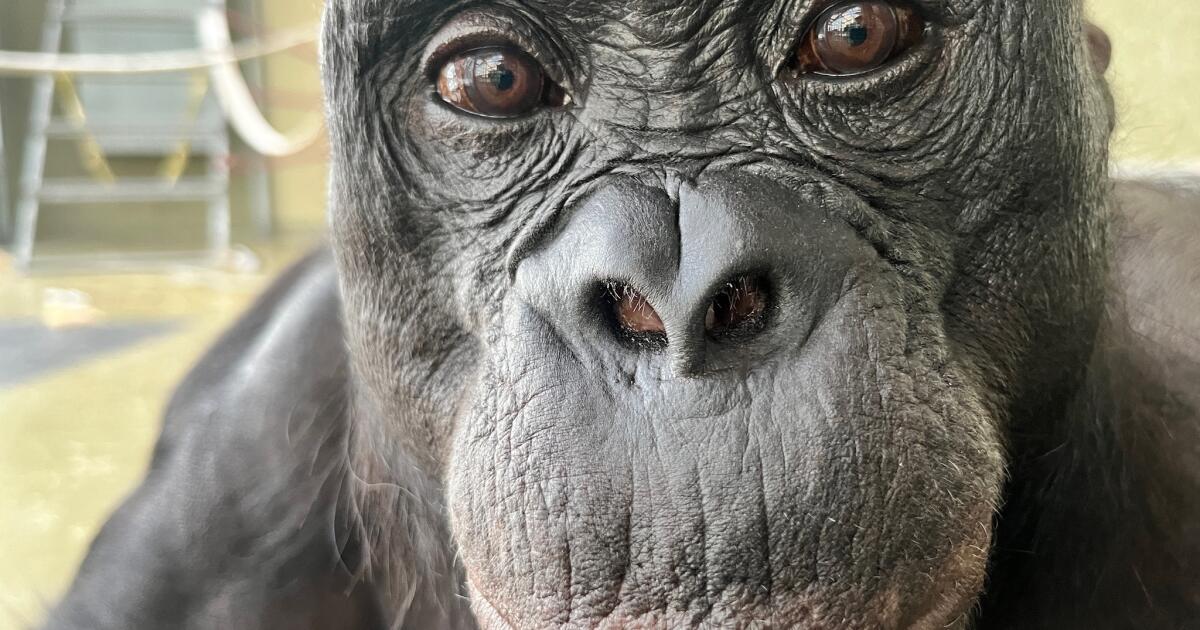
Can apes play pretend? Scientists use an imaginary tea party to find out
Beyond Kanzi: The Expanding Horizon of Animal Imagination and Cognition
The recent study featuring Kanzi, the bonobo who demonstrated an understanding of “pretend” juice, isn’t just a fascinating glimpse into the mind of an ape. It’s a potential turning point in how we understand animal cognition, and a signal of where future research will likely focus. For decades, imagination was considered a uniquely human trait. Now, the lines are blurring, prompting a re-evaluation of intelligence across the animal kingdom.
The Rise of Comparative Cognition: What’s Driving the Research?
Interest in animal cognition isn’t new, but it’s accelerating. Several factors are at play. Firstly, advancements in neuroscience allow us to observe brain activity in animals during complex tasks, offering tangible evidence of cognitive processes. Secondly, a growing ethical consideration for animal welfare is pushing researchers to understand animals not just as subjects of study, but as sentient beings with rich inner lives. Finally, the realization that understanding animal intelligence can offer insights into the evolution of our own minds is a powerful motivator.
Dr. Irene Pepperberg, renowned for her work with Alex the African grey parrot, demonstrated that parrots possess cognitive abilities comparable to a human child. Her research, spanning decades, showed Alex could identify colours, shapes, and even understand the concept of “same” and “different.” This paved the way for further investigation into avian intelligence. Learn more about Alex’s legacy.
Future Research: From Apes to Octopuses and Beyond
Kanzi’s case opens doors to exploring imagination in other species. Researchers are already turning their attention to:
- Corvids (Crows, Ravens, Jays): These birds are renowned for their problem-solving skills, tool use, and even planning for the future. Studies suggest they possess a “mental time travel” ability, remembering where they cached food and anticipating future needs.
- Octopuses: These cephalopods exhibit remarkable intelligence, including camouflage, problem-solving, and even playful behavior. Recent observations suggest they may experience something akin to dreaming. Smithsonian Magazine on Octopus Dreams
- Elephants: Known for their complex social structures and emotional depth, elephants demonstrate self-awareness (passing the mirror test) and exhibit behaviors suggesting empathy and grief.
- Dolphins and Whales: These marine mammals possess large, complex brains and demonstrate sophisticated communication skills. Research is ongoing to decipher their language and understand their cognitive abilities.
The methodology used with Kanzi – adapting child development studies for animal subjects – is likely to become more common. Expect to see more experiments involving “false belief” tests (understanding that others have different knowledge than oneself) and tests of counterfactual thinking (imagining “what if” scenarios).
The Role of Artificial Intelligence in Understanding Animal Minds
AI isn’t just a tool for studying human intelligence; it’s becoming crucial for deciphering animal communication and behavior. Machine learning algorithms can analyze vast datasets of animal vocalizations, movements, and social interactions to identify patterns that humans might miss. For example, researchers are using AI to decode whale songs and understand the information they convey. Wired: Decoding Whale Songs with AI
Pro Tip: Look for research utilizing bioacoustic analysis and machine learning when evaluating studies on animal cognition. These methods offer a more objective and data-driven approach.
Challenges and Ethical Considerations
Despite the exciting progress, significant challenges remain. Anthropomorphism – attributing human qualities to animals – is a constant risk. Researchers must carefully design experiments to avoid bias and ensure that observed behaviors are genuinely indicative of cognitive abilities, not simply learned responses or instinctual actions.
the ethical implications of studying animal cognition are paramount. As we gain a deeper understanding of animal minds, our responsibility to protect their welfare increases. Research must be conducted with minimal disruption to their natural behaviors and environments.
FAQ: Animal Imagination and Cognition
- Q: Does this mean animals are as intelligent as humans?
A: Not necessarily. Intelligence is multifaceted. While animals may demonstrate specific cognitive abilities previously thought unique to humans, the overall complexity and scope of human intelligence remain distinct. - Q: How can we be sure animals aren’t just mimicking behavior?
A: Researchers employ rigorous experimental designs, including control groups and tests that require animals to demonstrate understanding beyond simple imitation. - Q: What are the implications of understanding animal cognition?
A: It can lead to improved animal welfare, more effective conservation strategies, and a deeper understanding of the evolution of intelligence.
Did you know? New Caledonian crows are famous for crafting tools from twigs and leaves to extract insects from crevices – a skill that requires planning and problem-solving.
The story of Kanzi is just the beginning. As technology advances and our understanding of the animal kingdom deepens, we can expect even more surprising discoveries about the cognitive abilities of our fellow creatures. This ongoing exploration promises to reshape our relationship with the natural world and challenge our very definition of intelligence.
Want to learn more? Explore our articles on animal behavior and conservation efforts. Share your thoughts in the comments below – what animal do *you* think is the most intelligent, and why?