

Controlling the Nonlinear Hall Effect for Battery-Free Electronics
The End of Batteries? How Quantum Physics is Rewiring Our Future
We have spent decades tethered to the wall, waiting for our devices to charge. But what if your smartphone, wearable tracker, or IoT sensor never needed a battery again? A breakthrough in quantum physics is turning this science-fiction dream into a tangible reality.
An international team of researchers, led by the Queensland University of Technology (QUT) and Nanyang Technological University, has unlocked a new method to control the nonlinear Hall effect (NLHE). By mastering this quantum phenomenon, we are inching closer to a world where electronics harvest energy directly from the ambient signals around them.
Beyond the Battery: Understanding the Nonlinear Hall Effect
In traditional electronics, we rely on bulky diodes and rectifiers to convert alternating current (AC) into the direct current (DC) required for our gadgets. This process is inefficient and limits how small You can make our devices.
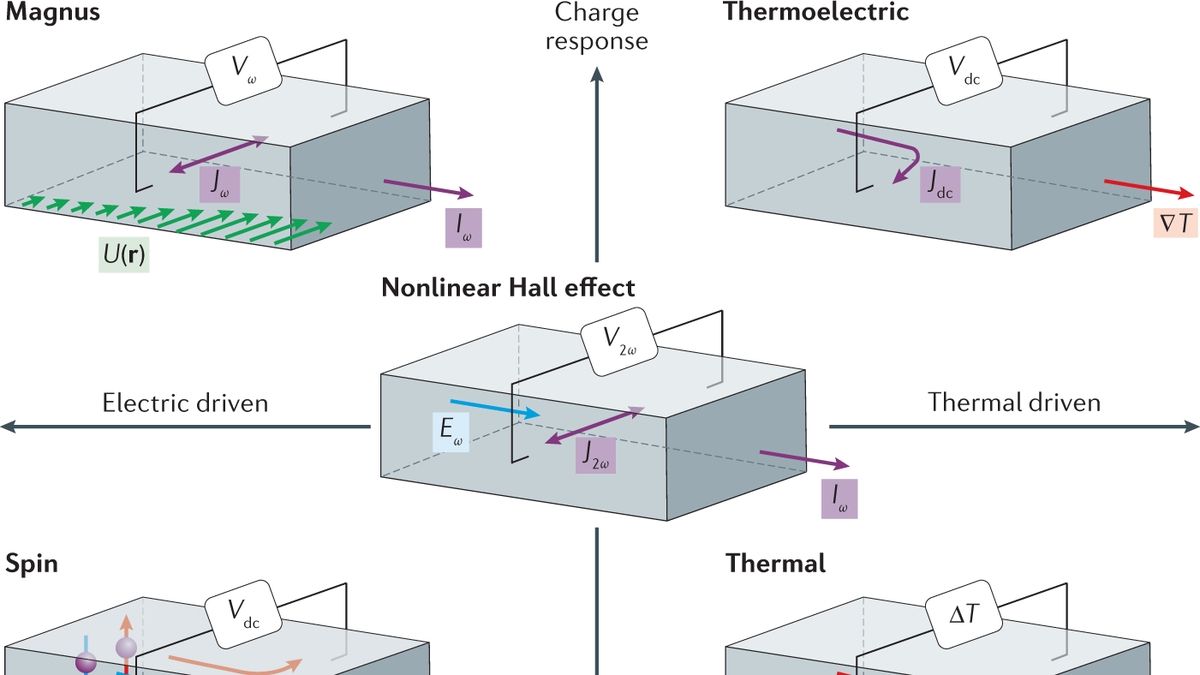
The nonlinear Hall effect changes the rules of the game. It allows a material to convert alternating signals—like Wi-Fi, radio waves, or ambient electromagnetic noise—directly into usable DC power. Because this happens at a quantum level, it bypasses the need for the heavy, energy-sapping components currently found in every circuit board.
Room-Temperature Quantum Stability
One of the biggest hurdles in quantum research has always been the “cryogenic trap.” Most quantum effects only appear near absolute zero, making them useless for consumer electronics. However, the team successfully demonstrated that this effect remains stable at room temperature.
This stability is the “holy grail” for commercializing quantum materials. By observing how atomic vibrations—or phonons—interact with the material, researchers have found a “switch” to control the voltage direction. This discovery effectively turns the material into a self-regulating energy harvester.
The Future of Self-Powered Technology
If we can harvest energy from the environment, the implications for the Internet of Things (IoT) are massive. Imagine:
- Wearables: Smartwatches that stay charged indefinitely by pulling energy from ambient cellular signals.
- Structural Health Monitoring: Sensors embedded in bridges or aircraft that never need a battery swap.
- Ultra-Fast Computing: Next-generation chips that operate with significantly less heat and higher efficiency.
Pro Tips for Understanding Quantum Materials
If you’re tracking the evolution of advanced materials science, keep an eye on “topological insulators.” These are the specific classes of materials where electrons behave in highly predictable, exotic ways. They are the building blocks of the next generation of energy-efficient hardware.
Frequently Asked Questions
- Will this replace my phone battery tomorrow?
- Not yet. While the science is proven, scaling this into consumer-grade chips will take time. We are currently in the laboratory phase of material optimization.
- What is the biggest advantage of the NLHE?
- The primary advantage is efficiency. It allows for direct energy conversion without the energy loss associated with traditional, bulky rectification components.
- Can this technology work anywhere?
- It relies on ambient signals. In areas with high electromagnetic activity (like cities), these devices would be highly efficient at “scavenging” power from the air.
Are we entering the age of perpetual power? What part of your life would change most if you never had to charge your devices again? Share your thoughts in the comments below or subscribe to our tech newsletter to stay updated on the latest breakthroughs in quantum engineering.