
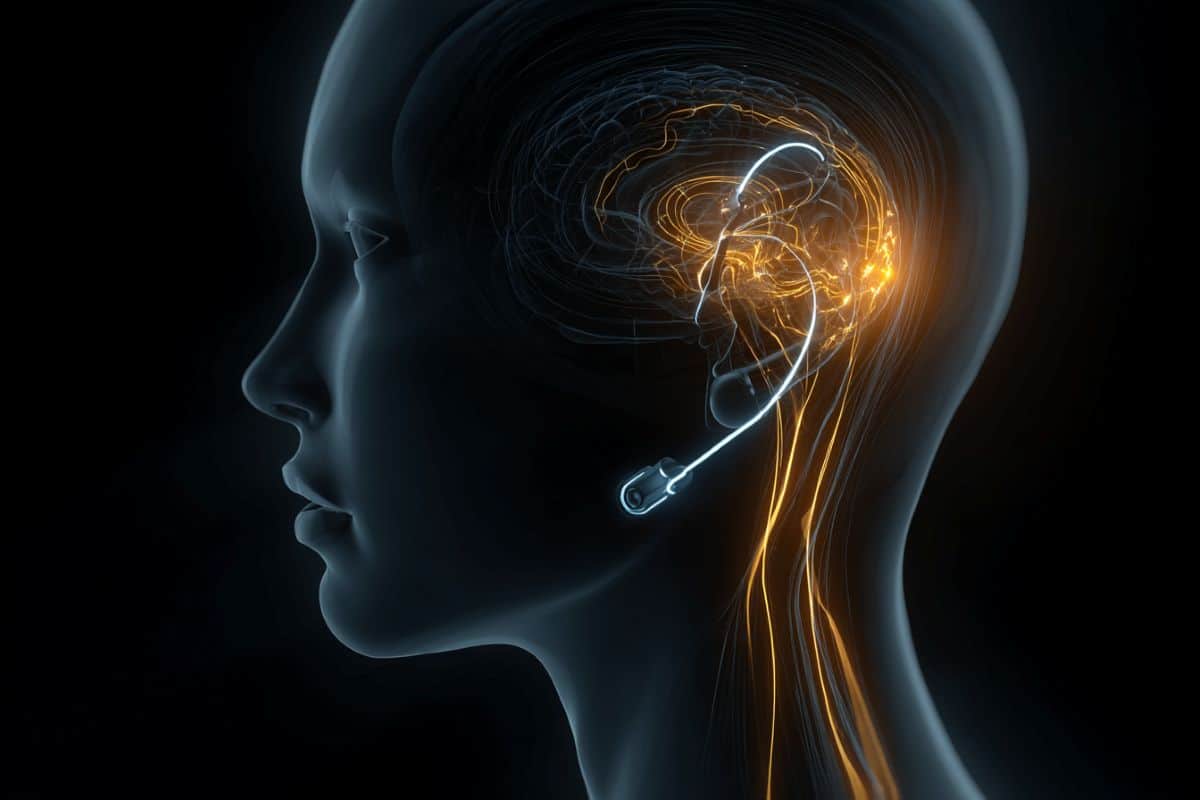
Ear-Based Vagus Stimulation Boosts Brain Motor Zones
A breakthrough in neuroengineering has provided the first localized evidence of how noninvasive vagus nerve stimulation interacts with human motor pathways during active movement. Researchers at the Federal Institute of Technology Zurich have successfully demonstrated that pairing brief electrical bursts with voluntary movement can isolate and drive specific activity in the brain’s motor cortex.
The study, which investigated transcutaneous auricular vagus nerve stimulation (taVNS), addresses a long-standing “vagal-motor blind spot.” While the vagus nerve acts as a bidirectional superhighway connecting the brain to major organs, scientists previously lacked a clear understanding of how these electrical signals interact with motor networks in real time during physical activity.
Precision and Anatomical Specificity
In a series of trials involving 36 healthy volunteers, investigators delivered taVNS to participants as they engaged in computer-cued finger tapping tasks. The results showed that when stimulation was paired with movement, there was an immediate, measurable increase in activity within movement-related brain regions. Crucially, when the stimulation device was moved to a different location on the ear, this cortical boost failed to occur, confirming the extreme spatial precision of the technique.
Researchers also utilized pupillary dilation tracking to observe how the nervous system responded during these stimulation blocks. The data revealed that the vagal signals promoted a focused state of physiological arousal, effectively priming the brain for motor tasks without triggering broad, nonspecific side effects elsewhere in the body.
Implications for Rehabilitation
This study represents a significant step toward optimizing physical therapy protocols, particularly for patients recovering from strokes or managing mobility challenges. By proving that taVNS can target specific motor circuitry without causing “collateral drift”—or unwanted changes to heart rate and other somatic functions—the findings offer a safer, more targeted approach to neurorehabilitation.
Future Clinical Directions
Looking ahead, researchers are focused on determining whether these localized neural interactions correlate with long-term motor recovery. A possible next step involves integrating these stimulation protocols into standardized rehabilitation regimens to see if they consistently improve physical performance over time. Analysts expect that future studies will refine how taVNS is delivered, potentially allowing for highly personalized stimulation patterns tailored to an individual’s specific brain response.

Frequently Asked Questions
How can zapping a nerve inside the ear help someone with mobility issues move their hand or fingers better?
Because the vagus nerve is a massive electrical conduit linking the body directly to the brain, sending targeted taVNS bursts through the ear at the exact moment of movement acts like an external signal amplifier. This boosts electrical activity in the brain’s primary movement control zones, facilitating better motor output.
Why is the eye’s pupil a major indicator of how well a physical therapy patient is progressing?
The pupil acts as a window into the brain’s internal focus engine. The study found that movement-paired taVNS triggers a specific pupillary response, proving that the vagal signals drive the brain into a state of hyper-focused arousal that primes the nervous system to learn or rebuild motor paths.
Does this electrical stimulation run the risk of altering heart rate or other random bodily functions during exercise?
The study proved that taVNS does not produce broad, generic physiological changes. While it sharpens focus and ramps up activity in movement-related brain zones, it leaves all non-movement-related bodily systems and autonomic metrics completely untouched.
Could this precise method of neural stimulation eventually become a standard component of routine physical therapy for patients with mobility impairments?