
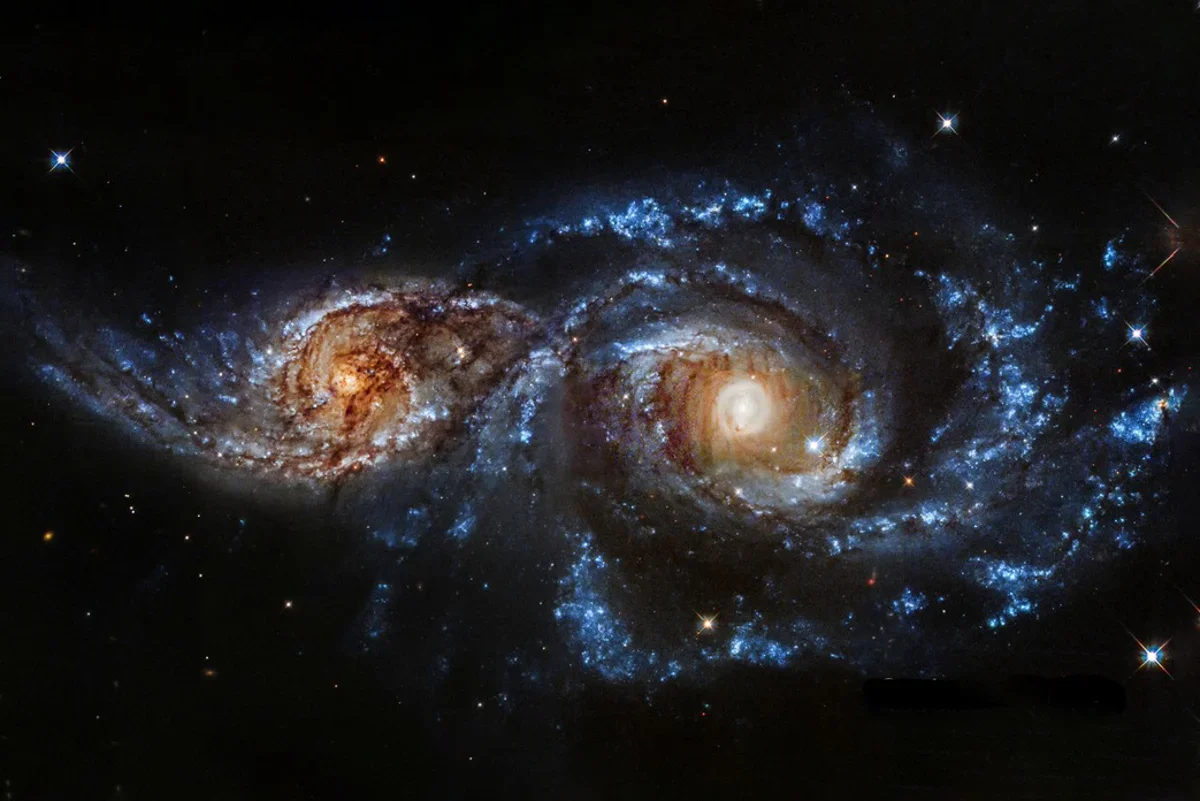
Early galaxy collisions may explain why giant galaxies died young
The New Era of Cosmic Archaeology: Rewriting the History of the Early Universe
For decades, astronomers have looked at the early Universe and seen a paradox. On one hand, they found “cosmic graveyards”—massive galaxies that had completely stopped forming stars while the Universe was still in its infancy. On the other, they saw “stellar factories”—dusty, chaotic systems churning out stars at a rate that makes our own Milky Way look stagnant.
The missing link has always been the how. How does a galaxy go from a frantic burst of creation to total silence in a cosmic blink of an eye? Recent findings from the University of São Paulo and international collaborators suggest we are finally uncovering the blueprint of this dramatic transformation.
From Stellar Factories to Cosmic Graveyards: The Lifecycle Trend
The prevailing trend in galactic evolution is no longer seen as a slow, steady climb. Instead, the research indicates a “live fast, die young” trajectory for the most massive systems in the early Universe.
These galaxies typically begin as Dusty Star-Forming Galaxies (DSFGs). Shrouded in thick clouds of cosmic dust, they are nearly invisible to optical telescopes but glow brilliantly in infrared and submillimeter wavelengths. This phase is characterized by an almost violent level of productivity, building up massive stellar populations in a fraction of the time it took the Milky Way.
The Role of the “Cosmic Crash”
What triggers the transition from a factory to a graveyard? The evidence points to a major merger. When two massive galaxies collide, it isn’t a gentle overlap; it is a gravitational catastrophe that forces enormous quantities of cold gas toward the centre of the new, merged system.
This influx of fuel creates a dual-effect: it ignites a final, extreme burst of star formation and simultaneously feeds a supermassive black hole at the galaxy’s core. This “feeding frenzy” is the catalyst for the galaxy’s eventual demise.
Black Holes: The Ultimate Galactic Kill-Switch
The most fascinating trend in this evolutionary path is the role of AGN (Active Galactic Nucleus) feedback. As the central black hole consumes matter, it releases staggering amounts of energy back into the galaxy.
This energy does two things: it consumes the remaining cold gas and heats the surrounding halo gas to temperatures where it can no longer cool down and collapse into new stars. Essentially, the black hole “starves” the galaxy, shutting down star formation in less than a billion years.
Beyond the James Webb: The Next Frontier of Observation
While the JWST has revolutionized our view of the early Universe, it has also revealed that our current models are incomplete. We are seeing more massive, silent galaxies than our simulations predicted, suggesting that the “quenching” process—the shutting down of star formation—might be even more efficient than we imagined.
The next leap forward will come from the Giant Magellan Telescope (GMT). Currently under construction in Chile, the GMT will feature a 24.5-meter primary mirror, allowing it to capture images with three to four times the detail of the JWST.
Future trends in astronomy will shift from merely identifying these galaxies to mapping their internal dynamics. We will be able to watch the “smoking gun” of galactic mergers and observe the exact moment a black hole begins to clear its neighborhood of gas.
Why This Matters for Our Understanding of the Universe
Understanding the lifecycle of these giants isn’t just about ancient history; it’s about understanding the physics of the cosmos. The relationship between dark matter halos, gas cooling, and black hole feedback dictates how every structure in the Universe is built.

By studying these “cosmic graveyards,” scientists can refine the laws of galaxy formation, helping us understand why some galaxies, like the Milky Way, maintained a steady pace of growth while others burned out in a brilliant, brief flash of glory.
Frequently Asked Questions
A quiescent galaxy is one that has stopped forming new stars. It consists mostly of older, cooler stars and lacks the cold gas necessary to create new stellar populations.
Through a process called feedback. The energy released by a growing supermassive black hole heats the surrounding gas, preventing it from cooling and condensing into stars.
Cosmic dust blocks visible light. However, this dust emits radiation at infrared and submillimeter wavelengths, which is why telescopes like ALMA and JWST are essential.
Join the Cosmic Conversation
Do you think we will find evidence of even larger structures in the early Universe? Or is the “live fast, die young” model the rule for all giant galaxies?
Share your thoughts in the comments below or subscribe to our newsletter for the latest updates on the frontiers of space exploration!