
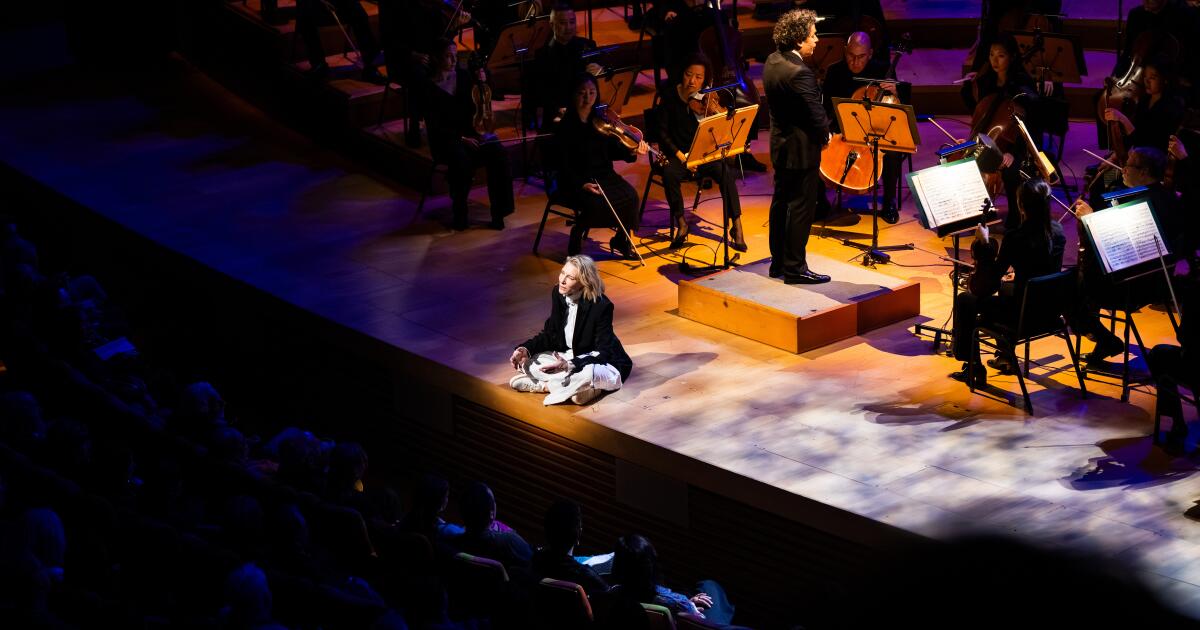
‘Egmont’ for now via Dudamel, Cate Blanchett and Jeremy O. Harris
Gustavo Dudamel’s long tenure as music director of the Los Angeles Philharmonic is entering its final months, marked by a return to the composer who has consistently inspired him: Ludwig van Beethoven. His journey with the orchestra began in October 2009 with a free performance of Beethoven’s Ninth Symphony at the Hollywood Bowl, an event intended to convey a message of unity. Now, as he approaches his departure in August, Dudamel is once again centering Beethoven in his performances.
A Composer of Uplift
Throughout his two decades with the L.A. Phil, Beethoven has served as a source of inspiration for Dudamel. His first major recording featured Beethoven’s Fifth and Seventh Symphonies, performed with the Simón Bolívar Youth Orchestra of Venezuela twenty years ago this month. He will conclude his time with the L.A. Phil in August with another performance of Beethoven’s Ninth at the Hollywood Bowl, mirroring his arrival.
Exploring Beethoven’s Depths
This month, Dudamel is tackling Beethoven’s “Missa Solemnis” for the first time. He will also pair Beethoven symphonies with new works he has premiered in Los Angeles, including Gabriela Ortiz’s “Revolución Diamantina” and the first part of Thomas Adès’ “Dante.”
A Rare Performance of “Egmont”
Dudamel recently began this Beethoven-focused month at Walt Disney Concert Hall with a performance of the complete incidental music to Goethe’s tragedy, “Egmont.” This work, rarely performed in its entirety, explores themes of triumph over injustice. He collaborated with actress Cate Blanchett and playwright Jeremy O. Harris for this production.
Goethe’s “Egmont” centres on a Flemish general navigating political complexities in 16th-century Spain. The play explores themes of love, sacrifice, and the pursuit of glory. Goethe, a polymath who advised the Grand Duke of Weimar, balanced political compromise with artistic expression, admiring liberty while also supporting Napoleon.
Connecting Humboldt and Beethoven
Dudamel opened the program with the premiere of “Humboldt’s Nature” by Venezuelan composer Ricardo Lorenz. The five-part, 25-minute symphonic poem depicts Alexander von Humboldt’s 1799 journey to Venezuela, capturing its natural beauty and the encounter with enslaved Cubans. This piece served as a prelude to Beethoven’s “Egmont,” as Humboldt’s account was written a decade before Beethoven began composing the work.
The performance also featured soprano Elena Villalón, who added a delicate touch to Klärchen’s songs, sung in German. Playwright Jeremy O. Harris created a new text for Cate Blanchett, a call to action delivered with intensity, though sometimes lost due to amplification issues.
Looking Ahead
Dudamel previously performed a concert version of “Egmont” with the Berlin Philharmonic in June, a performance available on the orchestra’s Digital Concert Hall. A performance of Schumann’s Piano Concerto, featuring Yunchan Lim, served as a transition between the two pieces. Dudamel’s remaining performances with the L.A. Phil will continue to explore these themes of uplift and triumph, culminating in his final performance of Beethoven’s Ninth.
Frequently Asked Questions
What was the significance of Dudamel’s first concert as music director?
His first concert, a free performance of Beethoven’s Ninth Symphony at the Hollywood Bowl in 2009, was intended to convey a message of unity, with the conductor stating, “There is no North, South or Central America. We are one.”
Who collaborated with Dudamel on the recent performance of “Egmont”?
Cate Blanchett and playwright Jeremy O. Harris collaborated with Dudamel on the performance of Beethoven’s “Egmont.”
What is the connection between Humboldt and Beethoven in this program?
Ricardo Lorenz’s “Humboldt’s Nature” was premiered as a prelude to Beethoven’s “Egmont,” as Humboldt’s account of his journey to Venezuela was written a decade before Beethoven began composing the work.
As Dudamel prepares to conclude his tenure with the L.A. Phil, what lasting impact will his dedication to Beethoven and his exploration of complex themes leave on the orchestra and its audience?