
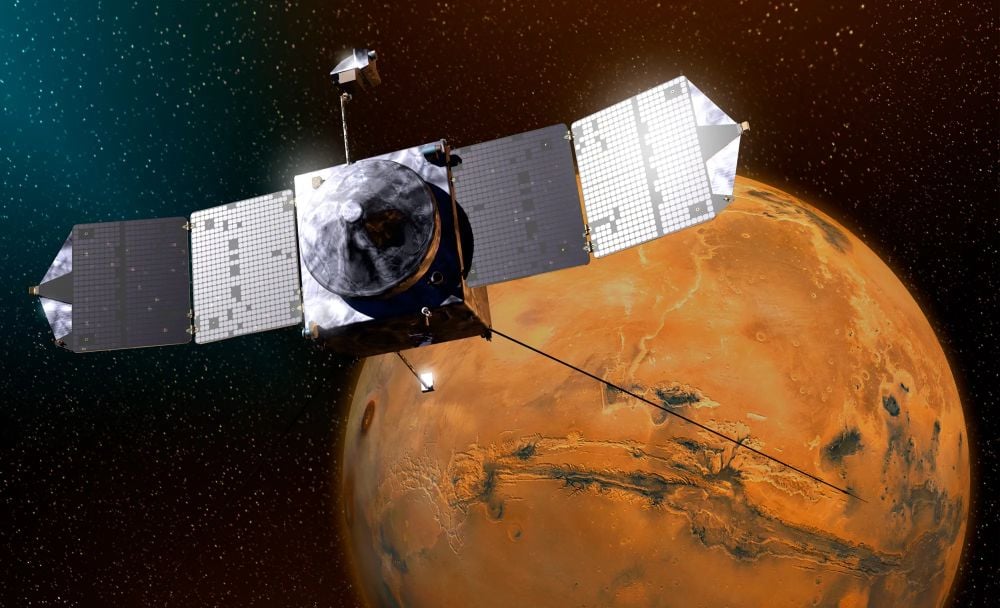
Even Without A Magnetosphere, Mars Can Still Deflect Some Solar Wind
Beyond the Magnetic Shield: Redefining How Planets Survive the Sun
For decades, the scientific consensus was relatively simple: if a planet doesn’t have a strong, internal magnetic shield (a dipole magnetosphere), it is essentially a sitting duck for the solar wind. We looked at Earth’s rotating core as the gold standard for planetary protection, believing that without such a shield, a planet’s atmosphere would be stripped away, leaving it a frozen, irradiated wasteland—much like we thought Mars to be.
However, the recent detection of the Zwan-Wolf effect in the Martian ionosphere is flipping this narrative on its head. By observing how Mars deflects solar plasma even without a global magnetic field, researchers are uncovering a “hidden” layer of planetary defense. This discovery doesn’t just change our understanding of the Red Planet; it fundamentally alters how we view the habitability of worlds across the cosmos.
The New Frontier of Planetary Protection
The Zwan-Wolf effect acts as a cosmic “squeezer,” forcing solar wind plasma to flow around a planet rather than slamming directly into its atmosphere. On Earth, this process is aided by our strong magnetic field. On Mars, the discovery shows that the ionosphere—an electrified outer shell of gas—can step in to perform a similar role.
This suggests that “unmagnetized” planets aren’t as defenseless as we once thought. The trend in planetary science is now shifting toward studying induced magnetospheres. These are temporary or weaker shields created by the interaction between the solar wind and the planet’s own atmospheric gases.
Implications for Venus and Titan
If Mars can exhibit the Zwan-Wolf effect, it is highly probable that other bodies in our solar system do as well. Scientists are now looking toward Venus and Saturn’s moon Titan. Both possess thick atmospheres and lack internal dipoles, making them prime candidates for similar plasma-deflection mechanisms. This opens the door to a new understanding of how these worlds have retained their atmospheres over billions of years.
Safe Passage: Impact on Human Mars Missions
As NASA and private entities like SpaceX eye human footprints on Mars, the Zwan-Wolf discovery provides critical data for astronaut safety. The primary threat to long-term space travel is ionizing radiation and high-energy particles from Coronal Mass Ejections (CMEs).
The research, led by Christopher Fowler and his team, highlighted that the Zwan-Wolf effect becomes significantly more pronounced during solar storms. This creates a paradoxical situation: while a solar storm is dangerous, the planet’s atmospheric response (the amplification of the ZW effect) actually helps divert some of that plasma.
Future trends in mission planning will likely include:
- Dynamic Shielding: Developing spacecraft shielding that complements the natural plasma deflections of the Martian ionosphere.
- Weather-Based Landing Windows: Timing arrivals to coincide with specific solar activity levels that optimize atmospheric protection.
- Radiation Mapping: Using MAVEN’s legacy data to create high-resolution maps of where the ionosphere provides the most “cover” from solar wind.
The “Exoplanet” Effect: Searching for Life Elsewhere
Perhaps the most exciting trend is how this applies to the search for extraterrestrial life. Until now, when astronomers found an exoplanet in a “habitable zone,” the lack of a detected magnetic field was often seen as a dealbreaker for life.
The Zwan-Wolf effect proves that a planet can be “protected enough” to maintain an atmosphere and potentially liquid water, even without a rotating iron core. This expands the number of potentially habitable planets in the galaxy by orders of magnitude. We are no longer looking for “Earth twins” alone; we are looking for any world with a sufficiently active ionosphere.
Protecting Our Digital Infrastructure
While the research focuses on Mars, the physics of plasma deflection are universal. Our modern world relies on a fragile web of satellites for GPS, communication, and banking. These assets are constantly bombarded by the same solar wind that MAVEN studied.
By understanding how the Zwan-Wolf effect operates in tenuous environments, engineers can better predict how “space weather” will affect satellite orbits and electronics. The ability to model these “wiggles” in plasma flow allows for more robust satellite hardening and better early-warning systems for grid failures on Earth.
Frequently Asked Questions
What exactly is the Zwan-Wolf effect?
It is a physical process where electromagnetic forces deflect charged particles (solar wind) around a planetary body, preventing them from stripping away the atmosphere.
Why was this discovery only made now?
The effect is usually too weak to be detected by current instruments. It only became visible because a massive solar storm (CME) in December 2023 amplified the signal, allowing the MAVEN spacecraft to capture it.
Does this mean Mars could become habitable again?
Not necessarily. While the Zwan-Wolf effect provides some protection, it is not as powerful as Earth’s dipole shield. However, it suggests Mars is more resilient than previously thought.
What do you think? Does the idea of “hidden” planetary shields make you more optimistic about finding life on other worlds? Or do you think the risks of solar radiation are still too high for human colonization? Let us know in the comments below or subscribe to our newsletter for more deep dives into the future of space exploration!