
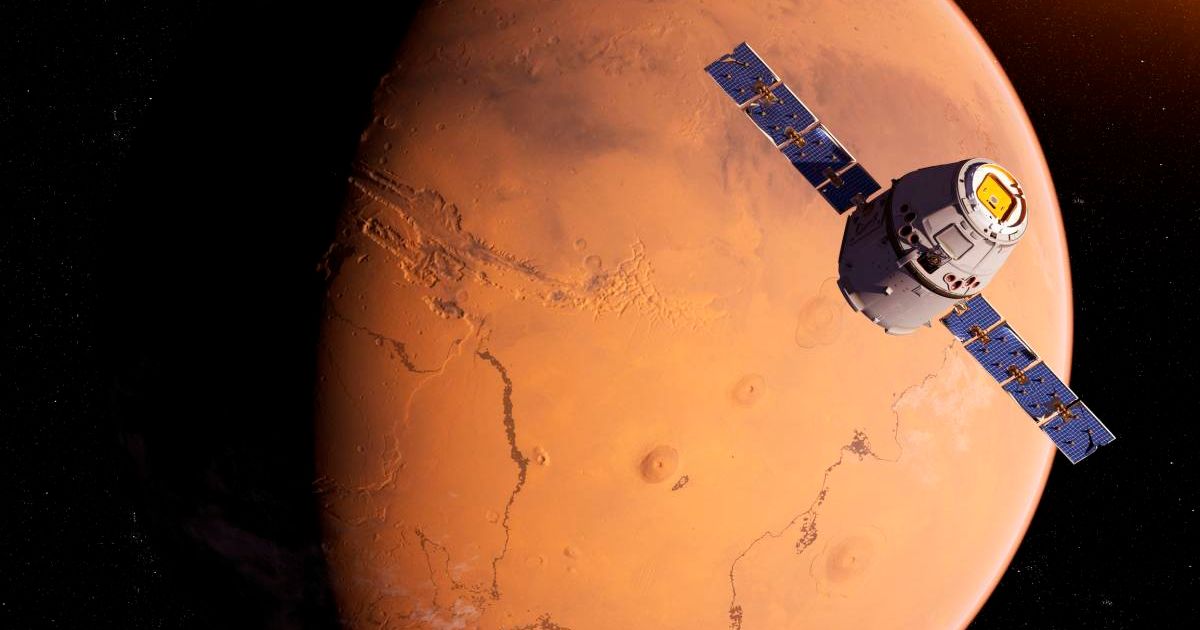
ExoMars rover to search for signs of ancient life in vast Martian clay deposit
For decades, the search for life on Mars has been guided by a simple mantra: “Follow the water.” But as we peel back the layers of the Red Planet’s geological history, the conversation is shifting. We are no longer just asking if water existed, but how that water shaped the environment and whether it left behind the chemical fingerprints of ancient biology.
Recent findings regarding the clay deposits at Oxia Planum suggest that Mars wasn’t just a planet with occasional streams, but potentially a world dominated by a vast, deep ocean. This revelation changes everything for future missions, shifting our focus from simple hydrology to complex astrobiology.
The Shift from ‘Water’ to ‘Biosignatures’
The discovery of extensive phyllosilicate (clay) deposits at Oxia Planum is a game-changer. Clays are exceptional at trapping and preserving organic molecules for billions of years. This is why the ExoMars Rosalind Franklin rover is targeting this specific region.
The future trend in Martian exploration is the pursuit of biosignatures—specific patterns or molecules that can only be produced by living organisms. Instead of looking for “liquid water” in the present, scientists are now analysing “chemical archives” in the soil.
Subsurface Drilling: The New Frontier
Surface radiation on Mars is brutal, meaning any organic traces on the top layer of soil have likely been destroyed. The next era of exploration relies on depth. The Rosalind Franklin rover is equipped to drill deeper than any previous mission, accessing layers that have been shielded from the harsh Martian surface for eons.

This trend toward “deep sampling” will likely lead to the development of autonomous subterranean probes that can “worm” through the Martian crust to find pockets of brine or frozen organics.
The ‘Global Ocean’ Hypothesis and Planetary Evolution
The connection between Oxia Planum and Mawrth Vallis—two regions separated by 300 kilometers but sharing similar clay signatures—suggests a regional or even global water process. This points toward the possibility of a massive ocean several kilometers deep.
If Mars once hosted a global ocean, it implies a much thicker atmosphere and a more stable greenhouse effect than previously thought. This forces us to rethink the planetary habitability index. If a planet can transition from a water-world to a frozen desert, understanding that transition is key to predicting the fate of other exoplanets in the “Goldilocks Zone.”
Coordinated Exploration: A Multi-Rover Network
We are moving away from “lone wolf” missions. In the past, rovers like Curiosity and Perseverance operated largely in isolation. The future trend is inter-mission synergy.
By comparing data from the various rovers currently on Mars, scientists can create a “planetary mosaic.” For instance, linking the findings at Jezero Crater with the clay continuity at Oxia Planum allows researchers to map the flow of water across the entire Martian hemisphere.
AI-Driven Site Selection
Future missions will likely employ advanced AI to analyze hyperspectral data in real-time. Instead of scientists on Earth deciding where a rover should drive, onboard AI will identify “high-value” mineral deposits—like the Fe/Mg-rich phyllosilicates—and divert the rover to sample them autonomously.
From Habitability to Human Footprints
The ultimate goal of studying these clay deposits isn’t just academic; it’s practical. Understanding the water chemistry of the past helps us identify where water ice exists today. For future astronauts, water is the most precious resource—not just for drinking, but for creating oxygen and rocket fuel (methane).
The identification of a “paleosurface”—a period where deposition stopped and the surface was exposed—provides a timeline of Martian climate stability. This data is crucial for evaluating the feasibility of terraforming or establishing long-term human habitats.
Frequently Asked Questions
Why are clay deposits so important for finding life?
Clays are chemically stable and can trap organic molecules, protecting them from the radiation and oxidation that occur on the Martian surface.
What is the difference between Oxia Planum and Mawrth Vallis?
While they are different geographic regions, they share similar mineral signatures. The recent study suggests Oxia Planum’s clays are older, providing a chronological map of how water behaved on Mars.
Could there be life on Mars today?
While the surface is barren, the focus has shifted to the subsurface. If ancient oceans existed, liquid water may still persist deep underground, potentially harboring microbial life.
How does the Rosalind Franklin rover differ from Perseverance?
While both search for signs of life, the Rosalind Franklin rover features a more advanced drill capable of reaching deeper soil layers where biosignatures are more likely to be preserved.
Join the Conversation
Do you believe we will find definitive proof of ancient life on Mars within the next decade, or is the Red Planet a graveyard of “almost” habitable conditions?
Share your thoughts in the comments below or subscribe to our newsletter for the latest updates on the frontier of space exploration!