
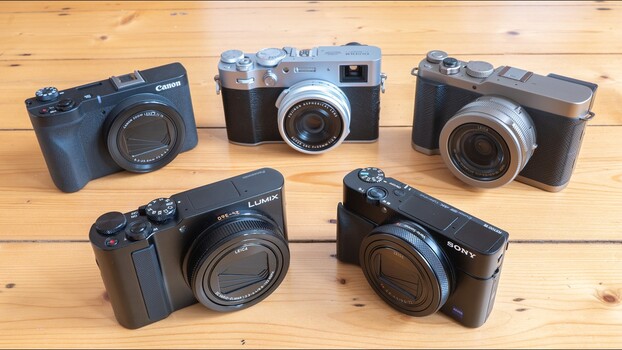
Five Premium Compact Cameras Tested
Premium compact cameras are diverging into specialized tools for vlogging, street photography, and travel. According to side-by-side testing by Gordon Laing, the market now splits between high-resolution APS-C sensors like the Fujifilm X100VI for stills and ultra-wide, feature-rich bodies like the Canon PowerShot V1 for video content creation.
Why is the premium compact market splitting into niches?
Manufacturers have stopped trying to build a single “do-it-all” camera. Instead, they are optimizing hardware for specific workflows. Gordon Laing’s tests show a clear divide: the Canon PowerShot V1 targets vloggers with a 16mm ultra-wide lens and built-in cooling fans, while the Fujifilm X100VI targets photographers with a hybrid viewfinder and dedicated aperture rings.
This specialization changes what buyers prioritize. A vlogger needs the mic and headphone jacks found on the V1. A street photographer requires the high-ISO performance and 40-megapixel APS-C sensor of the X100VI. The “all-rounder” category is shrinking as users move toward tools that solve one specific problem perfectly.
Will high-resolution sensors replace optical zoom?
High megapixel counts are reducing the need for physical zoom in some scenarios. Laing found that the X100VI’s 40-megapixel sensor allows for significant cropping. At a 50mm equivalent, a cropped image from the X100VI still retains roughly 20 megapixels, which matches the resolution of the dedicated zoom cameras in the group.
However, optical glass still wins at long distances. By the time a user needs a 200mm reach, the Sony RX100 VII delivers a noticeably crisper result than a cropped prime. The Panasonic Lumix ZS300 pushes this further with a 15x optical zoom reaching 360mm, a range that digital cropping cannot realistically replicate without massive quality loss.
How is vlogging hardware changing compact camera design?
Video-centric cameras are adopting features previously reserved for cinema rigs. The Canon PowerShot V1 incorporates a built-in ND filter and a cooling fan to prevent overheating during long takes. These additions move the compact camera away from “point-and-shoot” simplicity and toward a dedicated production tool.
The lens choice is also shifting. While traditional compacts favored a 24mm or 28mm starting point, the V1’s 16mm focal length is designed specifically for the “arm’s length” selfie perspective. This trend suggests future compacts will prioritize field-of-view over versatility to accommodate the creator economy.
What are the current price tiers for premium compacts?
A clear price stratification has emerged in the premium segment. High-end “enthusiast” models—including the Fujifilm X100VI, Panasonic Lumix LX10, and Sony RX100 VII—typically cost above $1,300. These devices offer larger sensors, faster lenses, or more robust manual controls.
Entry-premium models, such as the Canon PowerShot V1 and Panasonic Lumix ZS300, sit around the $900 mark. These cameras trade off some raw image quality or autofocus speed for specific utility, like extreme zoom or vlogging ergonomics.
Comparison: Sensor Impact on Performance
| Camera | Sensor Size | Primary Strength |
|---|---|---|
| Fujifilm X100VI | APS-C | Stills & High ISO |
| Sony RX100 VII | 1-inch | Long-range Clarity |
| Canon PowerShot V1 | 1/4-type | Vlogging Utility |
Frequently Asked Questions
Which compact camera is best for vlogging?
According to Gordon Laing, the Canon PowerShot V1 is the top choice due to its 16mm ultra-wide lens, built-in ND filter, and cooling fan.
Does a larger sensor always mean better photos?
Generally, yes. The APS-C sensor in the Fujifilm X100VI provides cleaner high-ISO output and better background blur (bokeh) than the 1-inch sensors found in the Sony RX100 VII or Panasonic ZS300.
Can a prime lens camera replace a zoom camera?
Only for moderate crops. Laing noted that a 40MP sensor can crop to 50mm while maintaining usable resolution, but optical zooms are necessary for focal lengths like 200mm or 360mm.
Which do you prioritize more: extreme zoom or high-resolution stills? Share your setup in the comments below or subscribe to our newsletter for more hardware deep-dives.