

Global Age Verification Laws and Social Media Bans for Minors
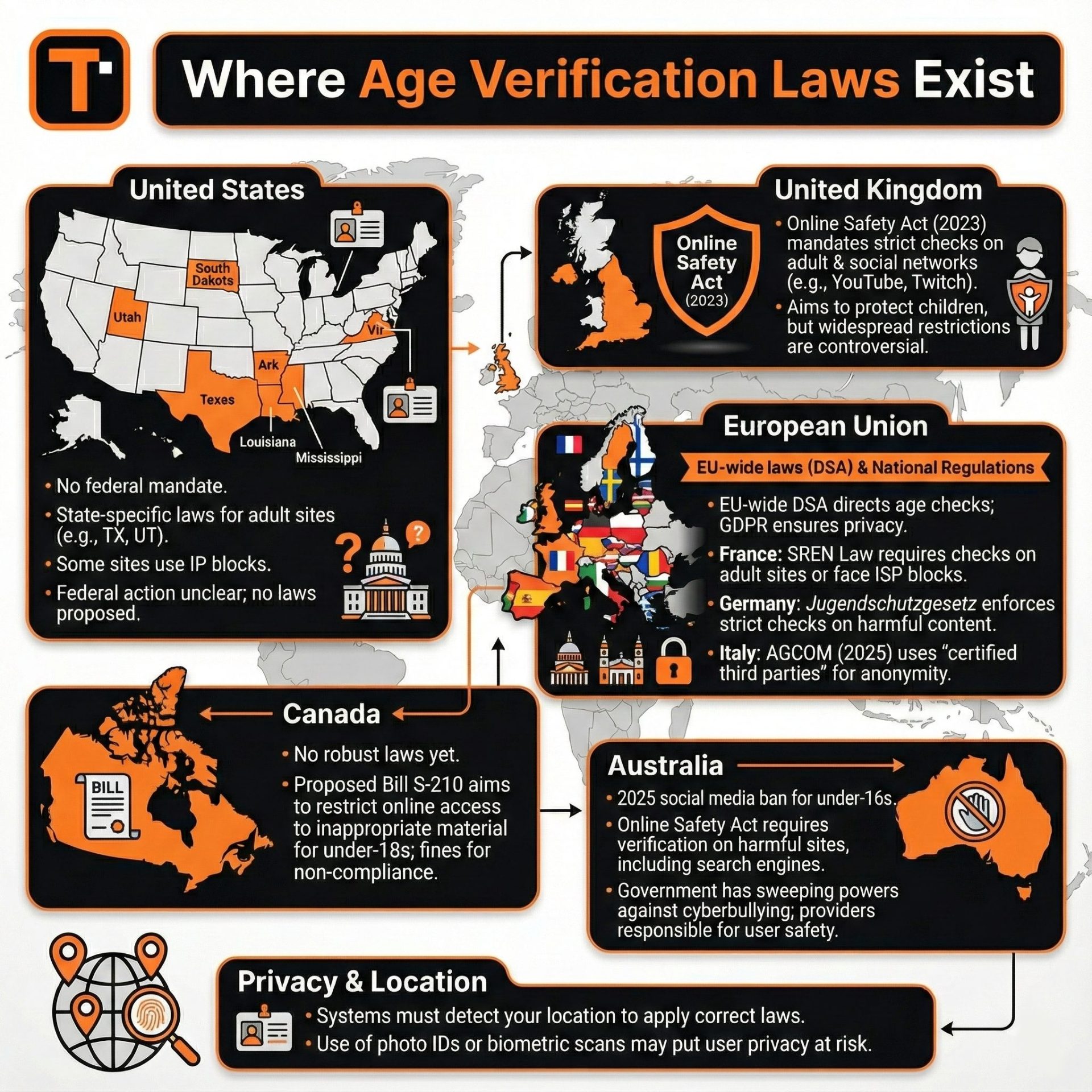
The digital frontier is currently undergoing a seismic shift. What started as a conversation about “online safety” has rapidly evolved into a global movement toward mandatory age verification and sweeping social media bans for minors. From the strict mandates in Australia to the digital identity experiments in the European Union, the goal is ostensibly the same: protecting children. But if you look closer, the trajectory suggests something much more complex.
We aren’t just looking at a few isolated laws; we are witnessing the birth of a new era of internet governance. As an industry observer, it’s clear that the “open web” is being replaced by a gated community where your identity is the ticket for entry.
The Shift Toward a “Permission-Based” Internet
For decades, the internet operated on a principle of anonymity or, at the very least, pseudonymity. You didn’t need a passport to read a blog or join a forum. That era is ending. The trend is moving toward a permission-based model, where access to information is contingent upon government-approved identity verification.
We are seeing a transition from simple “checkbox” age declarations to “Hard AV” (Age Verification). This involves uploading government IDs, using biometric face-scanning, or linking accounts to national digital wallets. When countries like Brazil and the EU push for integrated identity systems, they aren’t just blocking kids—they are building the infrastructure for a permanent digital trail of every adult’s online movement.
AI Biometrics: The New Gatekeeper
As traditional ID uploads face backlash due to privacy concerns, the next trend is AI-driven age estimation. Instead of a passport, platforms are eyeing “face-scanning” technology that guesses a user’s age based on skin texture and facial structure.
While this sounds more convenient, it introduces a terrifying new layer of surveillance. To “protect” a 15-year-old, platforms may end up collecting biometric data from millions of adults. This data is a goldmine for hackers and a tool for state surveillance. Once a biometric template of your face is linked to your online activity, there is no “reset password” button for your identity.
The “Splinternet” for Minors
We are likely heading toward a bifurcated internet. On one side, the “Adult Web,” accessible only via verified ID. On the other, a heavily sanitized “Youth Web,” where algorithms are strictly controlled by government mandates.
The danger here isn’t just censorship; it’s the loss of digital autonomy. For many marginalized youth, the internet is the only place to find community or health information that isn’t available in their immediate physical environment. By cutting off access to platforms like Reddit or YouTube, governments may inadvertently isolate the very children they claim to protect.
The Legal Battleground: Privacy vs. Protection
Expect a wave of high-stakes litigation. We are already seeing platforms and civil liberties groups challenge these laws on constitutional grounds. The core of the legal fight will be the principle of proportionality: Is a total ban on social media a proportionate response to the harms of the internet? Or is it an overreach that violates the fundamental right to seek and receive information?
Case studies from the UK’s Online Safety Act suggest that the technical implementation of these laws is often a mess. When governments demand “reasonable steps” to block users without providing a viable, privacy-preserving technology to do so, they essentially force companies to implement the most invasive surveillance tools available just to avoid massive fines.
Future Outlook: What to Expect Next
- Interoperable Digital IDs: Expect your “Age App” to eventually merge with your banking, health and travel documents.
- Algorithmic Paternalism: Governments will move from banning platforms to dictating exactly what the algorithms show to specific age groups.
- Rise of the “Underground Web”: As official channels close, younger generations will likely migrate to encrypted, decentralized platforms that are harder for governments to monitor or regulate.
Frequently Asked Questions
Will age verification laws end online anonymity?
While anonymity won’t disappear entirely, it will become significantly harder to maintain on mainstream platforms. The trend is moving toward “verified identity” as a prerequisite for access.
Are these laws effective at stopping kids from using social media?
Historically, tech-savvy teens find workarounds—such as VPNs or borrowed IDs. The real impact is often less about “stopping” the kids and more about the data collected from the adults who comply.
What is the difference between age verification and age estimation?
Verification requires a hard document (like a passport) to prove who you are. Estimation uses AI to guess your age based on your appearance or behavior without necessarily knowing your identity.
Join the Conversation
Do you think government-mandated age verification is a necessary safety measure or a dangerous step toward a surveillance state? We want to hear your perspective.
Leave a comment below or subscribe to our newsletter for deep dives into the future of digital rights.