
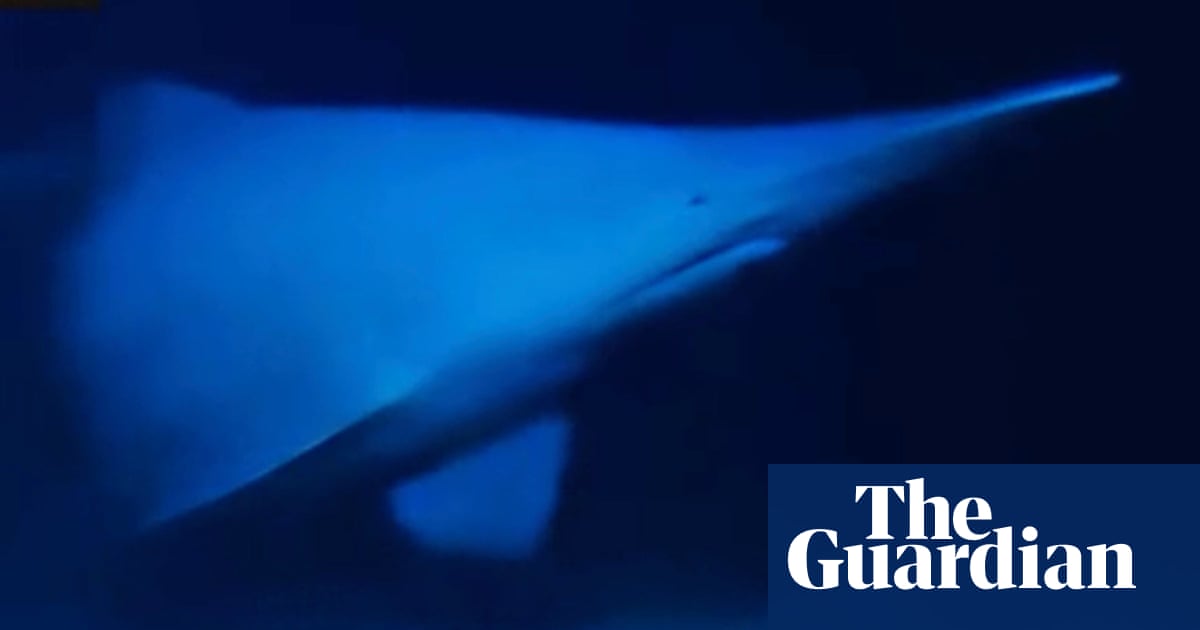
Goblin shark with face ‘not even a mother would love’ seen alive in natural habitat for first time | Sharks
Australian and Hawaiian scientists have recorded goblin sharks alive in their natural deep-sea habitats for the first time, according to a study published in the Journal of Fish Biology. Footage from the Tonga Trench and Jarvis Island confirms the presence of these rare creatures in the central Pacific, significantly expanding their known geographic range.
Researchers previously only encountered goblin sharks when they were accidentally caught on fishing lines. Prof Alan Jamieson, director of the Minderoo-UWA Deep-Sea Research Centre, compared the sharks to the colossal squid, noting they possess an “almost mythological quality” because they are so rarely seen alive.
The discovery resulted from two separate sightings thousands of kilometers apart. In 2024, scientists aboard the R/V Dagon captured video of a shark in the Tonga Trench. Simultaneously, researchers from the University of Hawaii observed another individual near Jarvis Island.
Where were the goblin sharks filmed?
The sightings occurred in the central Pacific, a region where the species had not been formally documented before. One individual was filmed nearly 2,000 meters deep in the Tonga Trench, marking the deepest known recording of the species.
According to the Journal of Fish Biology, goblin sharks were previously thought to inhabit the western coast of the U.S., Japan, Australia, and narrow strips of the Atlantic and Indian Oceans. These new sightings prove the species has a much larger footprint than scientists originally believed.
Prof Jamieson described the findings as a “classic case” of a deep-sea animal that exists in low numbers but maintains a massive geographical range.
What is the “slingshot” feeding mechanism?
The goblin shark is defined by its highly specialized jaw. Prof Jamieson, a co-author of the paper, explained that the shark uses a “slingshot feeding thing” where the mouth protrudes rapidly from the head to capture prey.
However, the video footage revealed a detail often missed in dead specimens: when the shark is alive and not feeding, the mouth remains completely retracted inside the head, leaving the animal with a distinctively pointy snout.
Prof Culum Brown, a fish expert at Macquarie University, described the jaws as “bizarre protrudable jaws” that shoot forward once the shark’s long snout detects prey. Brown likened the animal’s appearance to “something out of a horror movie.”
Why is this sighting a scientific milestone?
The footage provides a rare glimpse into the behavior of a “living fossil.” According to Prof Brown, goblin sharks are an ancient species that has remained relatively unchanged for approximately 125 million years.
Capturing the video required an immense amount of data. Jamieson noted that the 20-second clip was only found after reviewing over 50 days of continuous filming during the voyage.
The discovery helps researchers understand the biology of a creature that likely possesses a very slow metabolism and wanders the ocean floor at a slow pace, according to Brown.
Goblin Shark Physical Characteristics
| Feature | Detail |
|---|---|
| Maximum Length | Up to seven meters |
| Body Type | Long, flabby body with small fins |
| Age of Species | ~125 million years |
| Primary Habitat | Deep ocean (up to 2,000m+) |
Frequently Asked Questions
How big do goblin sharks get?
According to Prof Culum Brown, goblin sharks can reach lengths of up to seven meters.

Are goblin sharks dangerous to humans?
There are no reported attacks on humans. They live at extreme depths, such as 2,000 meters in the Tonga Trench, far beyond the reach of divers.
Why are they called “living fossils”?
They are considered ancient because their biological structure has remained largely unchanged for about 125 million years.
Do you think there are more undiscovered species in the Tonga Trench? Let us know in the comments below or subscribe to our newsletter for more deep-sea discoveries.