
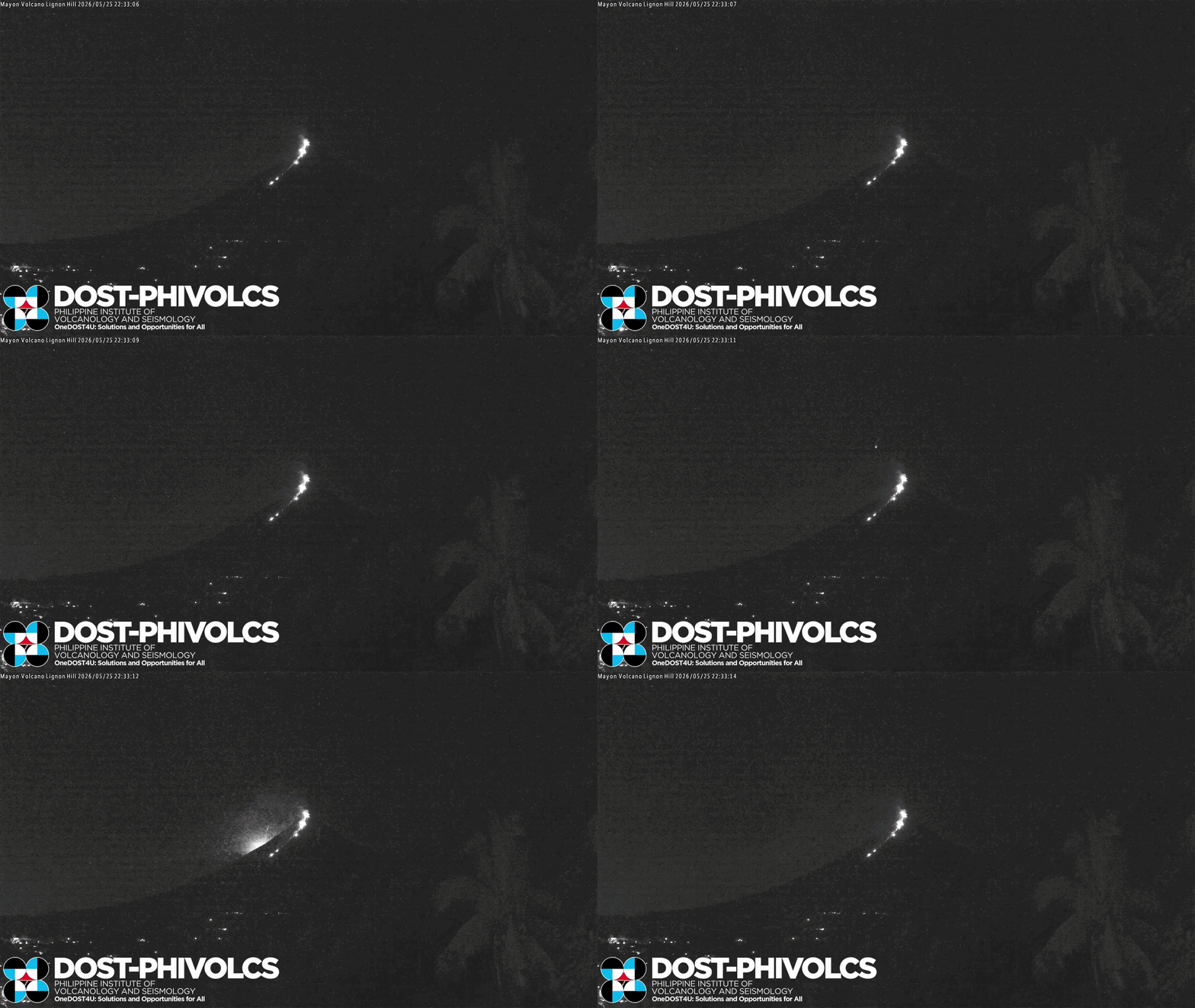
Green Fireball Meteor Captured Exploding Over Erupting Mayon Volcano in the Philippines
A visually striking bright-green “fireball” meteor recently exploded in the skies over Mount Mayon in the Philippines. The event occurred while the volcano was already undergoing an ongoing eruption, creating a rare dual display of celestial and geological activity.
The fireball was spotted at 10:33 p.m. Local time on Sunday, May 25, in the province of Albay on the island of Luzon. The event was captured by two separate livestreams monitoring the volcano’s activity.
Clarifying the Impact
Initial reports from the Philippine Institute of Volcanology and Seismology (PHIVOLCS) suggested the meteor may have struck the northern slopes of the mountain. This initial assessment led to several misleading videos circulating on social media.
However, PHIVOLCS later provided a correction after reviewing seismic data, infrasound, and additional camera footage. Experts confirmed that the meteor disintegrated within the atmosphere and did not actually strike the slopes of Mayon.
Potential Safety Implications
While the meteor disintegrated, the Philippine Information Agency provided estimates on the potential danger of such a collision. Had the space rock struck the volcano, it could have impacted with a force equivalent to 7,500 tons (6,800 metric tons) of dynamite.
Experts noted that such a massive impact likely would have triggered sizable rockfalls. These events would have been detectable by earthquake sensors situated around the volcano.
The Science of Fireballs
Fireball meteors occur when asteroids survive their initial reentry into Earth’s atmosphere but eventually burn up due to high friction with the air. This process typically happens between 37 and 62 miles (60 to 100 kilometers) above the Earth’s surface.
According to the Philippine Space Agency, extreme speeds cause friction that heats the asteroids until they vaporize. This heat ionizes surrounding air molecules, creating the glowing streaks known as “shooting stars.”
In this specific instance, the emerald-green hue of the fireball was likely caused by a high concentration of nickel within the asteroid. While most burn up, some larger fragments can survive to become meteorites.
Global Context and Rare Occurrences
Similar events have occurred in the United States, illustrating the unpredictability of these space rocks. In Texas, a cannonball-size fireball fragment recently smashed through the roof of a home in Houston.

a rare daytime fireball recently triggered a massive sonic boom over Ohio. These incidents demonstrate that while most meteors disintegrate, fragments can occasionally reach the ground and impact property.
Frequently Asked Questions
Did the meteor strike Mount Mayon?
No. Although initial reports suggested an impact on the northern slopes, PHIVOLCS later clarified that the meteor disintegrated in the atmosphere.
Why was the fireball green in color?
Based on previous observations, the green hue is likely attributed to a high concentration of nickel within the asteroid.
What would have happened if the meteor had hit the volcano?
It is estimated that the impact could have had a force equivalent to 7,500 tons of dynamite, which likely would have triggered sizable rockfalls.
Do you think increased monitoring of atmospheric entries could better prepare us for rare geological collisions?