
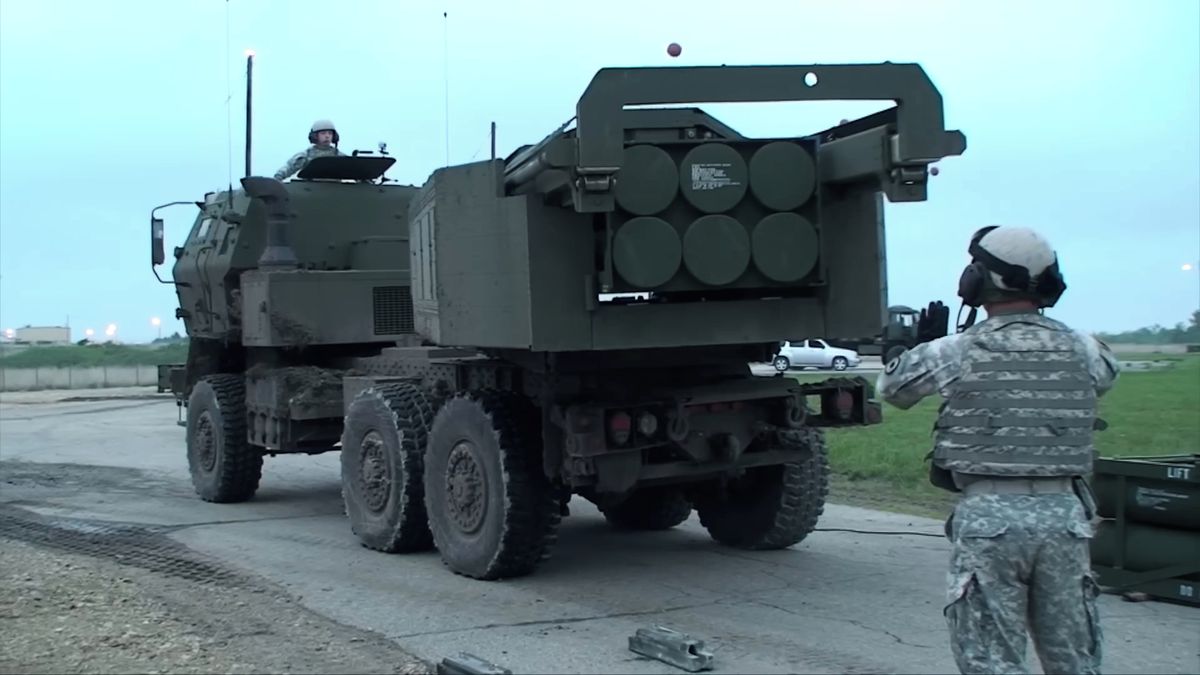
HIMARS FLEX: Doubling Firepower and Air Defense Capabilities
Lockheed Martin has introduced the HIMARS FLEX, a rocket system featuring two launch modules on an FNTV 6×6 chassis. According to the manufacturer, this design doubles firepower and allows for the use of anti-aircraft and anti-missile ammunition, including PAC-3 MSE missiles, to counter Russian Kinzhal and Iskander threats.
How does the HIMARS FLEX increase firepower?
The HIMARS FLEX utilizes the same FNTV 6×6 vehicle chassis as the standard model but replaces the single launch module with two. This modification increases the number of GMLRS/ER guided rockets from six to 12, according to Lockheed Martin.

The system also increases the capacity for ballistic missiles. ATACMS capacity rises from one to two missiles, while PrSM short-range ballistic missiles increase to four.
What air defense capabilities does the new system provide?
Lockheed Martin states that the two-container configuration allows the system to be easily equipped with anti-aircraft and anti-missile ammunition. The platform can function as a launcher for up to eight PAC-3 MSE surface-to-air missiles.
These capabilities integrate with the American Patriot air defense system or the short-range IFPC air defense system. The manufacturer notes this is specifically useful for countering Russian Kinzhal and Iskander missiles facing Ukraine.
How is the system performing against electronic warfare?
Experts describe the HIMARS as one of the most significant platforms used by Ukraine to stop and push back the Russian invasion. Ukrainian soldiers, cited by the Unian agency, highlight the system’s high mobility, which allows it to fire and leave a position before Russian artillery can respond.
The Russian army is actively using electronic warfare systems to jam the guidance signals of these rockets. In response, American and Ukrainian engineers are providing continuous software updates to the missiles.
What may happen next?
Russia may continue its efforts to develop a rocket artillery system that serves as an analog to the HIMARS, according to the Unian agency.
Engineers could likely release further software updates to maintain precision against evolving electronic jamming. The deployment of the FLEX variant may lead to a shift in how anti-missile ammunition is distributed on the battlefield.
Frequently Asked Questions
What is the primary hardware difference in the HIMARS FLEX?
It uses the same FNTV 6×6 chassis as the standard version but features two launch modules instead of one.
Which specific Russian threats can the HIMARS FLEX counter?
According to Lockheed Martin, the system is usable against Kinzhal and Iskander missiles.
How has the Russian military responded to HIMARS deployments?
The Russian army uses electronic warfare to jam guidance signals and is working on creating its own analogous rocket system.