
KFF Tracking Poll on Health Information and Trust: Use of Social Media and AI For Health Information and Advice
Roughly three in ten U.S. adults now use social media or AI tools monthly for health advice, according to a KFF Tracking Poll on Health Information and Trust. While 31% utilize social media, 29% use AI chatbots—a figure that nearly doubled from 17% in June 2024.
Most adults still avoid these tools regularly. KFF reports that 71% of adults “never” or “occasionally” use AI tools, while 69% say the same regarding social media for health information.
Who is using AI and social media for health advice?
The audiences for these technologies differ by age, income, and ethnicity. According to KFF, adults under 30 (40%), Hispanic adults (42%), Black adults (39%), and those earning $40,000 or less annually (40%) are the most likely to use social media monthly.
AI adoption follows a different pattern. While it is common among adults aged 18 to 29 and 30 to 49, its use is more frequent among those with higher incomes or advanced education. Hispanic adults are notable for adopting both platforms, whereas White adults are less likely to use either.
Why are adults bypassing traditional health care sources?
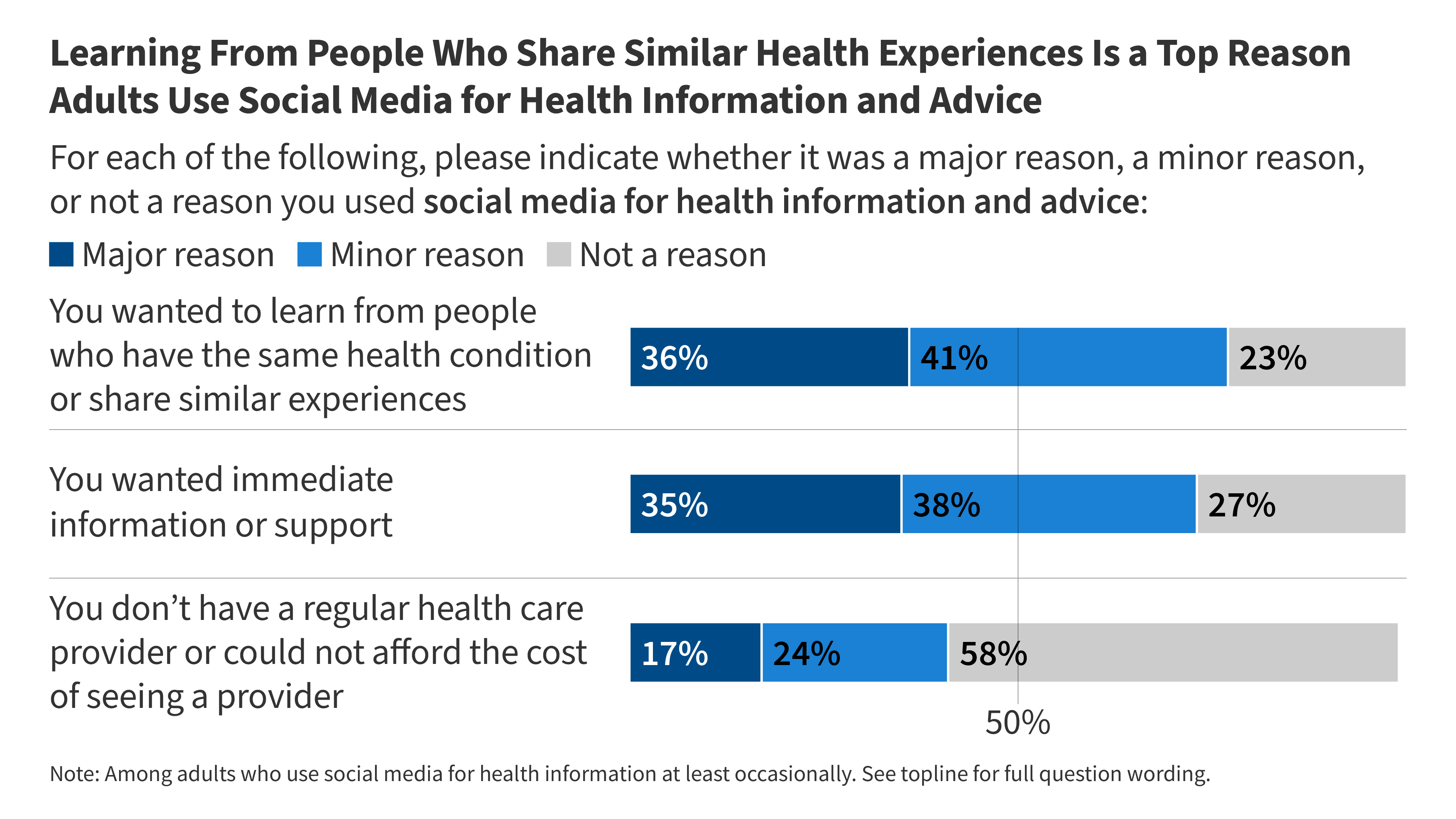
Users seek community and speed. KFF found that 36% of social media users cite wanting to learn from people with similar health conditions as a “major reason” for their use. Another 35% prioritize immediate information or support.

Lack of access also drives this shift. Among social media users, 32% of uninsured adults and 30% of LGBT adults report that not having a regular provider or being unable to afford care is a “major reason” they turn to these platforms.
Similar barriers apply to AI. KFF’s March 2026 Tracking Poll on Health Information and Trust indicates that 19% of AI users cite the cost of seeing a provider and 18% cite the lack of a regular provider as major reasons for using the technology.
Do users verify the health information they find online?
Confidence often outweighs verification. KFF reports that 61% of adults are confident they can tell what is true or false on social media, and 56% feel the same about AI chatbots.
However, few users actually validate these claims. Only 36% of social media users follow up with a doctor “every time” or “most of the time.” Just 35% consult other online sources like WebMD, and only 21% check health agency websites such as the CDC.
In contrast, trust remains highest in personal professional relationships. According to the poll, 80% of adults are confident in their ability to parse information provided by a doctor or health care provider.
What happens next for digital health seeking?
The growing reliance on non-traditional sources may lead to a wider gap in how different demographic groups receive health guidance. Because lower-income adults and those without insurance are more likely to use social media due to cost, they could be more exposed to unverified information.
As AI use continues to climb, trust may become more dependent on frequency of use. KFF’s March 2026 data suggests that those who use AI most often are the most likely to trust it, which could further reduce the likelihood of users seeking professional medical verification.
Frequently Asked Questions
How many U.S. adults use AI for health information monthly?
According to KFF, 29% of adults use AI tools or chatbots for health information monthly.
Why do some adults prefer social media over doctors for health advice?
Major reasons include wanting to learn from people with similar experiences (36%) and the need for immediate information (35%). For 32% of uninsured adults and 30% of LGBT adults, a lack of a regular provider or cost is a major factor.
Do most people verify the health information they find on social media?
No. A majority of users say they “some of the time,” “rarely,” or “never” follow up with a provider (64%) or check a government health agency website (78%).
Do you trust AI chatbots to provide accurate health advice, or do you always verify the information with a doctor?