

LFP vs NMC: Which EV Battery Is Best for India?
LFP batteries are the most practical choice for India’s mass-market EVs because they’re cheaper, safer in high heat, and last longer than NMC alternatives. The International Energy Agency (IEA) reports LFP batteries made up over 55% of global EV deployments in 2025, driven by heavy adoption in China and emerging markets.
Why is LFP the preferred choice for India’s mass market?
LFP, or Lithium Iron Phosphate, avoids expensive metals like nickel and cobalt. This chemistry is naturally more thermally stable, which is critical for India’s extreme summer temperatures and stop-go traffic. According to a 2024 comparative study published on ScienceDirect, LFP batteries can offer life cycles exceeding 2,000 charges and cost roughly 30% less than comparable technologies.

IRENA notes that LFP is praised for its safety and durability. For drivers who park in open sunlight or rely on frequent city charging, LFP provides a larger safety margin against thermal runaway. It doesn’t release oxygen during overheating as easily as nickel-rich chemistries do.
When does NMC make more sense for EV buyers?
NMC (Nickel Manganese Cobalt) batteries remain the standard for premium and performance EVs. Their primary advantage is energy density. ScienceDirect reports that NMC can reach energy densities of approximately 260 Wh/kg, allowing manufacturers to pack more range into a lighter, smaller battery pack.
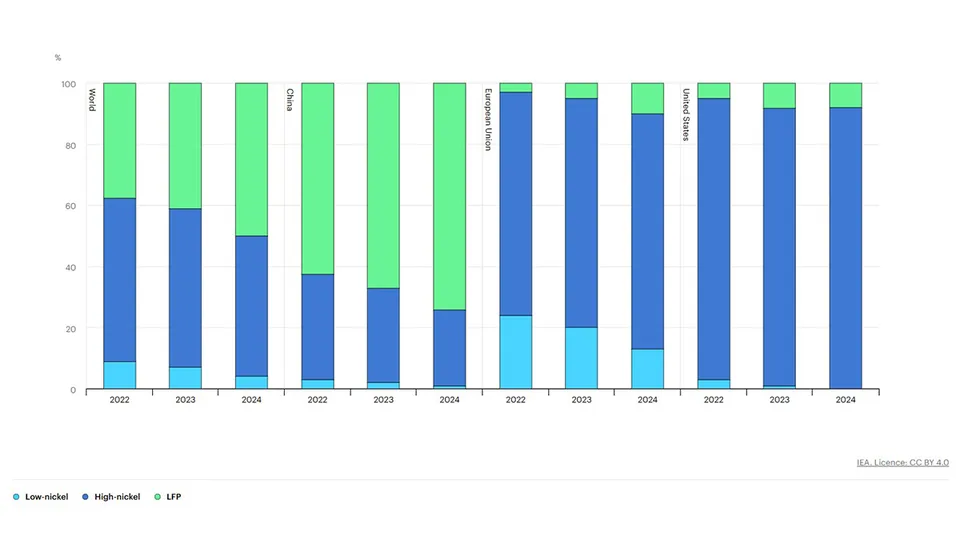
This makes NMC the better fit for buyers prioritizing:
- Longer highway range between charges.
- Faster acceleration and higher power output.
- Lighter overall vehicle weight for better handling.
While LFP is safer by chemistry, a well-engineered NMC pack using advanced cooling and battery management software can still meet strict safety standards.
How are Indian carmakers using these batteries?
Indian manufacturers are leaning into LFP to drive mass adoption. Tata Motors uses LFP prismatic cells in the Punch EV, featuring a 40 kWh pack designed to balance affordability with range. Reports indicate Tata is using this model specifically to address range anxiety and price sensitivity in the Indian market.
Mahindra has also focused on LFP for its “born-electric” platforms. Company reports highlight LFP’s resilience and thermal advantages as key reasons for choosing this chemistry over NMC for the Indian climate.
| Feature | LFP Battery | NMC Battery |
|---|---|---|
| Cost | Lower (No Nickel/Cobalt) | Higher |
| Safety | High Thermal Stability | More Heat-Sensitive |
| Lifespan | 2,000+ Cycles | Moderate |
| Best Use | City, Fleet, Budget SUVs | Luxury, Performance, Long-Range |
What are the future trends in battery technology?
The gap between LFP and NMC is closing. CATL recently unveiled the Shenxing Plus LFP battery, claiming a driving range of over 1,000 km on a single charge. This proves LFP isn’t just for short-range city cars anymore.
Industry trends point toward LMFP (Lithium Manganese Iron Phosphate), which aims to combine the safety and cost of LFP with the higher energy density of NMC. IRENA notes that this hybrid approach could provide a middle ground for mid-range EVs. Additionally, sodium-ion batteries are emerging as a potential ultra-low-cost alternative for two-wheelers and three-wheelers.
Frequently Asked Questions
Which battery is safer for Indian summers?
LFP batteries are generally safer in hot climates because they are more thermally stable and less prone to oxygen release during overheating, according to IRENA.
Does LFP mean shorter range?
Historically, yes. However, newer innovations like CATL’s Shenxing Plus are pushing LFP ranges beyond 1,000 km, narrowing the gap with NMC.
Why are LFP batteries cheaper?
They use iron and phosphate instead of expensive, volatile metals like nickel and cobalt, which significantly reduces production costs.
Which battery chemistry would you prefer for your next EV—the long-range power of NMC or the durability and safety of LFP? Let us know in the comments below or subscribe to our newsletter for more EV insights.