

Lightsails have hit another speed bump on the road to interstellar travel
Relativistic lightsails, a proposed method for interstellar travel using laser-powered momentum, face a significant propulsion efficiency drop as they approach 75% of the speed of light, according to a preprint study by researchers Chao Shen and Jiaze Li of the Harbin Institute of Technology. While the concept remains a primary candidate for deep-space exploration, the findings indicate that diffuse scattering of light may turn into an active drag force at extreme velocities.
Why do lightsails lose efficiency at relativistic speeds?
Lightsail propulsion relies on three distinct photon-driven forces: incident light, specular reflection, and diffuse scattering. According to the Harbin Institute of Technology research, these forces do not scale linearly as a spacecraft gains speed. As the sail approaches relativistic velocities, the Doppler effect reduces the frequency of incoming photons from the laser source, causing thrust to diminish.
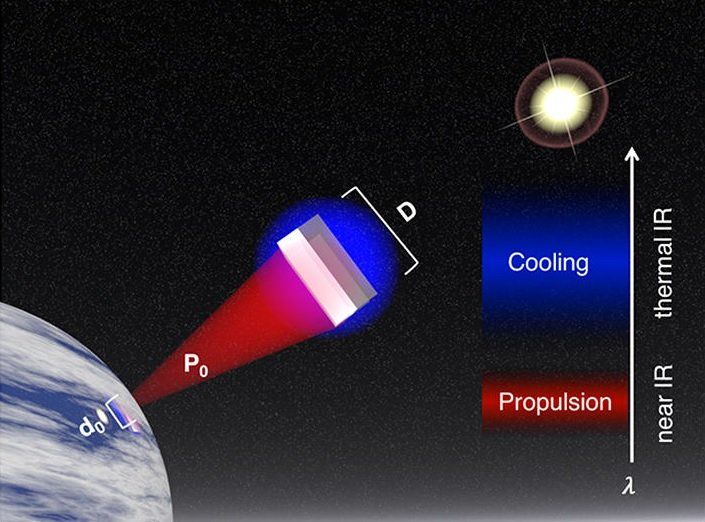
The study highlights a transition point near 75% of the speed of light. At this threshold, diffuse scattering—previously a contributor to the craft’s forward momentum—begins to act as a drag force. While the net force remains positive, meaning the laser continues to push the craft forward, the overall efficiency of the propulsion system drops, complicating long-distance interstellar mission profiles.
NASA has previously explored diffractive solar sails for missions to the Sun’s poles. Unlike reflective sails that bounce light, diffractive sails use holographic-like structures to steer light, offering more precise control over the spacecraft’s trajectory.
How does this study change the outlook for interstellar travel?
The Harbin Institute of Technology findings represent a theoretical shift in how mission planners must account for radiative dynamics. Before this research, many models assumed that photon pressure would remain relatively stable across a wide range of speeds. Now, engineers must integrate these drag variables into their mission architecture.
This development contrasts with early, idealized models of lightsail propulsion, such as those promoted by The Planetary Society’s LightSail projects, which focused on low-Earth orbit deployment where relativistic effects are negligible. By identifying the limitations of photon dynamics at high speeds, Shen and Li have provided a new constraint for future interstellar mission design, similar to how engineers must account for gas drag or interstellar dust collisions.
Are there solutions for high-speed drag?
Current engineering research focuses on advanced materials and photonic structures to mitigate these losses. According to the study, the theoretical nature of the preprint leaves room for potential mitigation strategies. Future mission designs may utilize sails with specific reflective coatings or structural geometries designed to minimize diffuse scattering even as the Doppler effect shifts the incoming laser light.
When designing space systems for high-speed travel, always account for “radiative dynamics.” Even if a force seems negligible at low speeds, the non-linear nature of light at relativistic velocities can create unexpected drag.
Frequently Asked Questions
What is a lightsail?
A lightsail is a spacecraft that uses the pressure of photons from a laser or the Sun to push against a thin, reflective surface, providing constant acceleration without the need for onboard chemical fuel.
Is the lightsail concept still viable?
Yes. The study by Shen and Li identifies a constraint on efficiency at extreme speeds, but it does not suggest that lightsails are impossible. It simply adds a new variable for engineers to solve during the design phase.
What are the biggest challenges for lightsails besides speed?
Engineers must still address the survival of the sail material under intense laser heating, the stability of the laser beam over interstellar distances, and the impact of physical obstacles like interstellar gas and dust.
What are your thoughts on the future of interstellar propulsion? Share your perspective in the comments below or subscribe to our newsletter for the latest updates on space technology trends.