
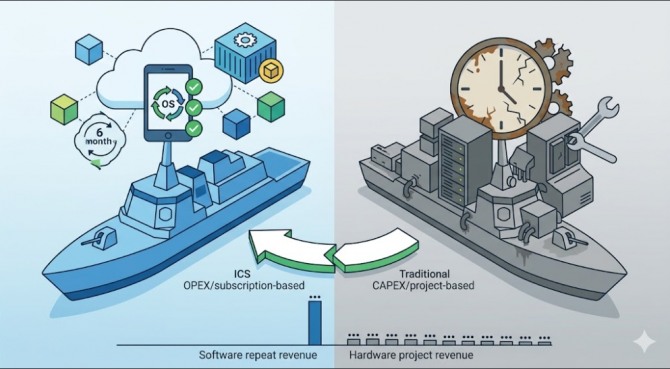
Lockheed Martin Combat OS: The Shift From Hardware to Subscription Models
The Rise of the ‘Combat OS’: How Software is Redefining Naval Warfare
For decades, the strength of a navy was measured by the tonnage of its steel and the caliber of its guns. But a seismic shift is occurring in the depths of naval engineering. We are entering the era of the Software-Defined Vessel (SDV), where the decisive edge in battle is no longer found in the hull, but in the code.
Lockheed Martin recently signaled this transition by delivering the first Integrated Combat System (ICS) software package to the U.S. Navy. This isn’t just another update; We see the birth of a “Combat OS” that transforms warships from static hardware platforms into dynamic, upgradable ecosystems.
From ‘One-Time Project’ to ‘Defense-as-a-Service’
Historically, the defense industry operated on a “project-based” revenue model. A company would build a ship, install a Combat Management System (CMS) and receive a massive one-time payment. Any future upgrades required new, expensive contracts and extensive hardware overhauls.
The ICS model flips this script. By utilizing a Tactical Platform as a Service (PaaS), the combat system is virtualized. This means that target detection, missile guidance, and sensor fusion are treated as “apps” that can be deployed across different hardware configurations without needing to rebuild the entire system.
This shifts the financial burden from CAPEX (Capital Expenditure)—the massive upfront cost of building the ship—to OPEX (Operating Expenditure)—the recurring cost of maintaining and updating the software. For defense primes, this creates a high-margin, subscription-like revenue stream.
The ‘App Store’ for Warships
Imagine a destroyer in the South China Sea. An enemy deploys a new type of electronic jamming. In the old world, that ship would be vulnerable until a fleet-wide hardware upgrade occurred years later. In the “Combat OS” world, the Navy can push a software patch—much like an iOS or Android update—to neutralize the threat in near real-time.
The Global Risk: The ‘Indigenous Trap’
While the U.S. Leads the charge, this shift creates a critical crossroads for nations developing their own indigenous warships. Take, for example, the KDDX (Korean Next-Generation Destroyer) project. By pursuing a 100% domestic design to avoid reliance on foreign systems, Korea gains sovereignty but faces a new risk: technological isolation.
If an indigenous system is built on traditional, closed-loop hardware architecture, it risks becoming a “legacy system” the moment it hits the water. To remain competitive, domestic programmes must adopt Open Architecture (OA).
Without a container-based virtualization structure, integrating future technologies—such as Unmanned Surface Vessels (USVs) or hypersonic missile interceptors—will become exponentially more expensive and time-consuming compared to the “plug-and-play” nature of the ICS.
Investor’s Playbook: Tracking the Digital Defense Pivot
For those investing in the defense sector, the metrics for success have changed. The value of a company is no longer tied to how much steel it can weld, but to its ability to manage complex software integration.
Here are three key indicators to monitor in quarterly reports:
- R&D Spend on Virtualization: Is the company investing in middleware, cloud integration, and AI-driven system integration, or just refining old hardware?
- PBL (Performance-Based Logistics) Contracts: Look for a shift toward contracts that reward “system availability” and “software performance” rather than just “parts replacement.”
- Big Tech Partnerships: Keep a close eye on collaborations with cloud giants (AWS, Azure, Google Cloud) or specialized AI firms. These partnerships are often the catalyst for a transition to a software-defined model.
FAQ: Understanding the Software-Defined Vessel (SDV)
Q: What exactly is a ‘Software-Defined Vessel’?
A: It is a ship where the core combat functions are decoupled from the physical hardware. This allows the navy to update sensors, weapons, and tactics via software updates without needing to physically modify the ship’s electronics.
Q: Why is ‘Open Architecture’ so important?
A: Open Architecture allows different vendors to create “apps” or modules that work on a single platform. This prevents “vendor lock-in” and allows the military to integrate the best available technology quickly.
Q: Will this make ships easier to hack?
A: While any networked system has risks, a centralized “Combat OS” allows for faster security patching. It is far easier to push a security update to a software platform than to manually replace hardware across an entire fleet.
Want to stay ahead of the curve in defense tech? Join our newsletter for deep dives into the intersection of AI, robotics, and national security, or explore our latest analysis on autonomous naval warfare.
What do you think? Will software-defined warfare make traditional naval power obsolete, or just more efficient? Let us know in the comments below!